01 · The discovery
The idea, in everyday language
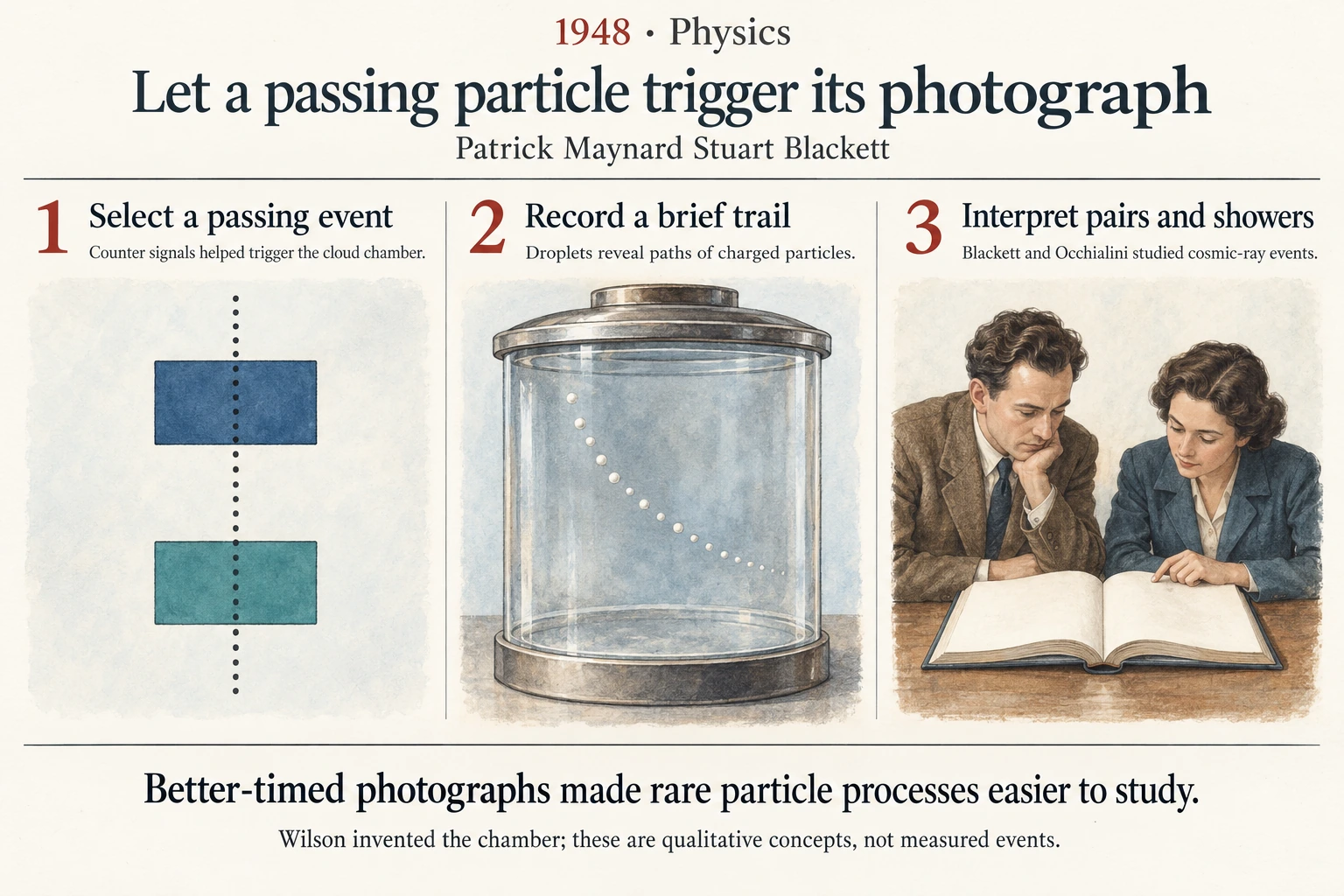
How can an experiment record a particle that arrives at an unpredictable moment? Wilson’s cloud chamber made the path of a charged particle visible through droplets forming along the ionised trail. A photograph taken at the wrong time, however, could miss the event. Blackett and Giuseppe Occhialini connected particle counters to the chamber so that coincident signals helped select when it should operate.
Their counter-controlled method, developed in 1932, greatly improved the chance of recording useful cosmic-ray tracks. In 1933 their studies of positive and negative electrons in pairs and showers helped establish particle creation in matter and supported Dirac’s theory. Earlier cloud-chamber work had also recorded nuclear transmutation. The prize recognised both development of the method and discoveries made with it, rather than the invention of the chamber itself.
Why it matters
Better selection and clearer records made rare nuclear and cosmic-ray processes available for detailed study. Photographs, measurement and physical interpretation worked together. Blackett’s collaboration with Occhialini was essential, and Anderson’s prior discovery of the positron remains a separate achievement.