c.curionodeThe Nobel Archive

1950 · Physics

Particle tracks reveal a changing cast of matter

Powell developed photographic emulsions into reliable research tools, helping the Bristol team discover and distinguish mesons.

Photographic emulsionParticle tracksPions and muons
1950Physics

Visual guide

The prize, pictured

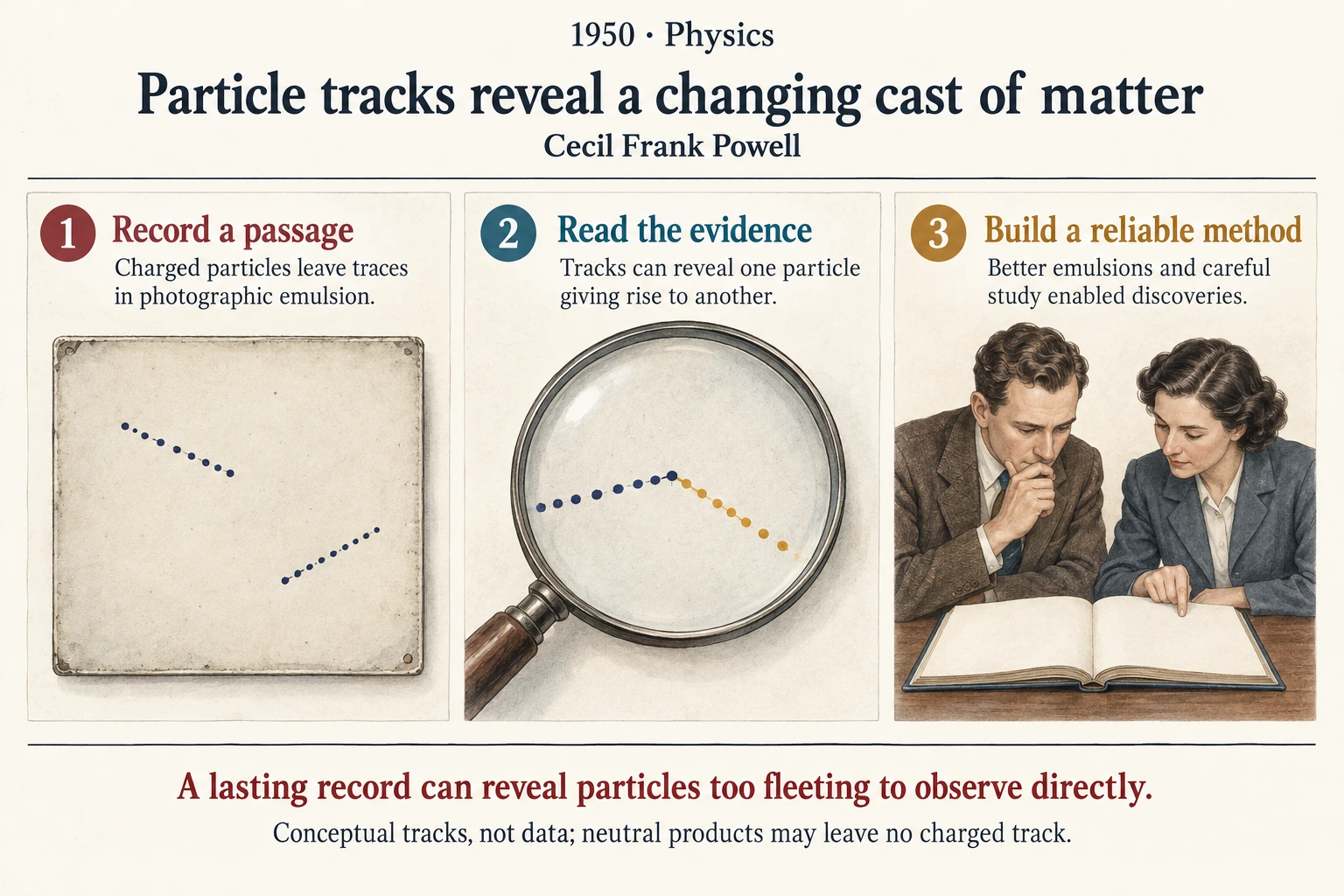
Infographic explaining Particle tracks reveal a changing cast of matter
Original AI-generated infographic. A conceptual overview; the explanations and sources below provide context.
Read the poster text

A lasting record can reveal particles too fleeting to observe directly.

  1. Record a passage

    Charged particles leave traces in photographic emulsion.

  2. Read the evidence

    Tracks can reveal one particle giving rise to another.

  3. Build a reliable method

    Better emulsions and careful study enabled discoveries.

Conceptual tracks, not data; neutral products may leave no charged track.

01 · The discovery

The idea, in everyday language

How can an extremely small, short-lived particle be studied after it has passed? A charged particle can leave an ionisation trail in a photographic emulsion. Development reveals affected grains, and a microscope makes the track available for close examination. Powell improved the sensitivity and reliability of this older principle with colleagues and emulsion manufacturers.

In 1947 Lattes, Muirhead, Occhialini and Powell reported tracks indicating that one kind of particle could give rise to another. The distinction between pions and the particles now called muons helped resolve a puzzle in cosmic-ray research. The method combined recording, careful scanning and interpretation; identifying a particle required several kinds of evidence, not simply recognising a line in a picture.

Why it matters

The technique provided a compact, lasting record of rare events and expanded particle physics. Powell alone received the 1950 prize, while the papers and investigations involved a wider team, including the women who searched emulsions under microscopes. Photographic emulsions and cloud chambers were different recording methods.
02 · The people

Who brought the idea to life?

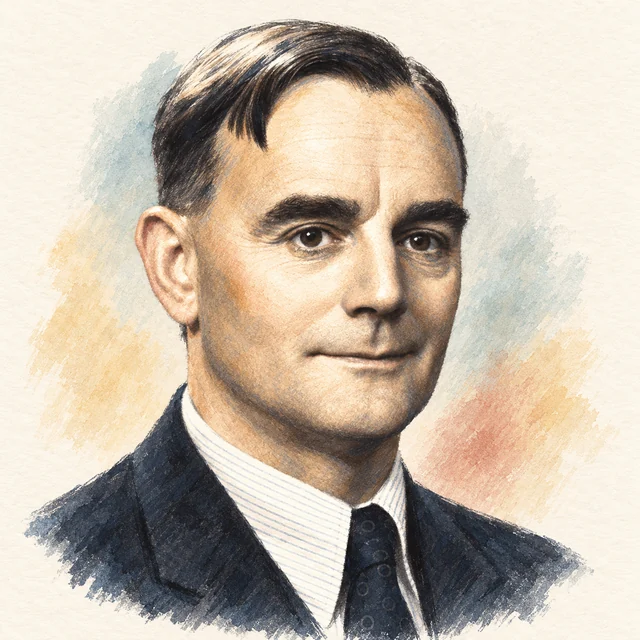
Illustrated portrait of Cecil Frank Powell

Cecil Frank Powell

Prize share · 1

Powell developed reliable photographic methods for nuclear research and made meson discoveries with the Bristol team. He received the full Physics Prize; the discovery papers also credited Lattes, Muirhead and Occhialini.

Read the biography ↗

03 · Years in the making

The path here

  1. 1927

    Powell completes his doctorate and joins Bristol.

  2. 1938

    He begins cosmic-radiation experiments using emulsions.

  3. 1946

    Improved emulsions make particle records clearer and more reliable.

  4. 1947

    Lattes, Muirhead, Occhialini and Powell report meson evidence.

  5. 1948

    Powell becomes Melville Wills Professor.

  6. 1950

    He receives the Physics Prize for the method and discoveries.

04 · Read further

From the original sources

Original explanations by Curionode, based on the official records below. Biographical details and affiliations refer to the award year.

  1. Official award summary nobelprize.org
  2. Award ceremony speech nobelprize.org
  3. Bristol: photographic emulsions and the research team bristol.ac.uk
  4. Nature: the four-author 1947 meson publication nature.com
  5. CERN: modern particle classification home.cern
  6. Official biography: Cecil Frank Powell nobelprize.org