01 · The discovery
The idea, in everyday language
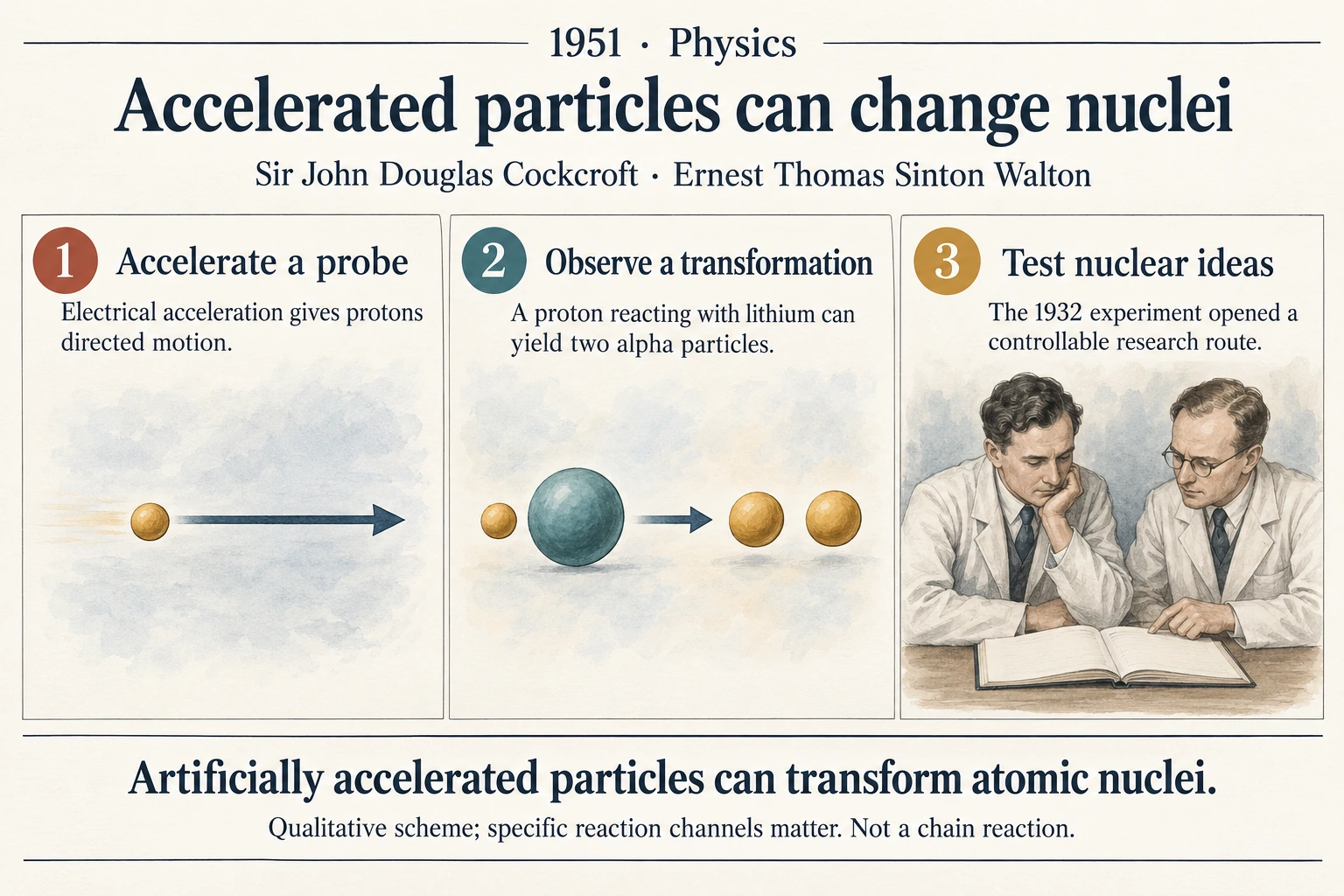
Rutherford had already shown nuclear transmutation using particles emitted by radioactive matter. Could an electrical accelerator make particles that would bring about such changes under experimental control? Cockcroft and Walton developed an accelerator at Cambridge and in 1932 observed alpha particles from lithium bombarded by protons.
In an important reaction, a proton and a lithium nucleus give rise to two helium nuclei, or alpha particles. This changes nuclei and chemical identity, rather than merely rearranging electrons in a chemical bond. The energy released is accounted for by the difference between initial and final rest masses, with total mass-energy conserved. Quantum tunnelling helps explain why reactions can occur below a simple classical barrier estimate.
Why it matters
Artificial acceleration widened experimental nuclear physics and the study of nuclear transformations. Cockcroft and Walton shared the prize equally. Their 1932 work took place at Cambridge; their 1951 affiliations were Harwell and Trinity College Dublin respectively.