01 · The discovery
The idea, in everyday language
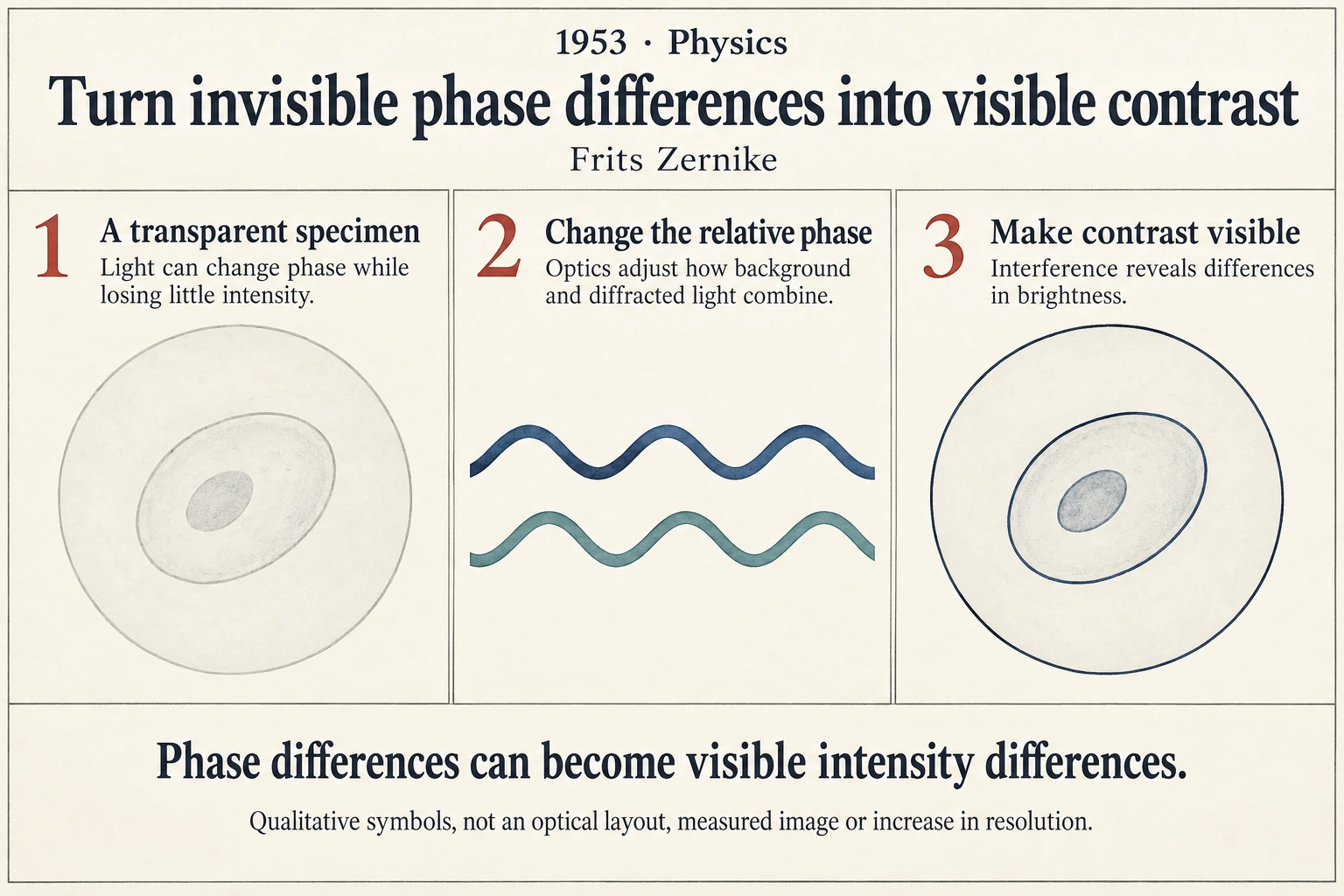
A transparent cell may absorb little light, yet its thickness and refractive index alter the phase of light passing through it. An ordinary brightfield image can therefore show little detail even though the light carries information about the specimen. More magnification alone does not recover that missing contrast.
Zernike developed an optical method that changes the relative phase of the undeviated background and specimen-diffracted light. Their interference then produces visible intensity differences. In a phase-contrast microscope, a condenser annulus and a phase plate near the objective’s rear focal plane have different roles and locations. The full 1953 prize recognised the invention, especially its microscopy application.
Why it matters
Phase contrast made many living, unstained specimens easier to observe. Researchers could follow structures and changes while avoiding some of the disturbance associated with fixation and staining. It complemented other imaging methods rather than replacing every one of them.