c.curionodeThe Nobel Archive

1959 · Physiology or Medicine

Enzymes that build nucleic acid chains

Ochoa’s and Kornberg’s groups made RNA and DNA synthesis accessible to experiments with isolated enzymes.

Nucleic acid synthesisIsolated enzymesTemplates and chains
1959Physiology or Medicine

Visual guide

The prize, pictured

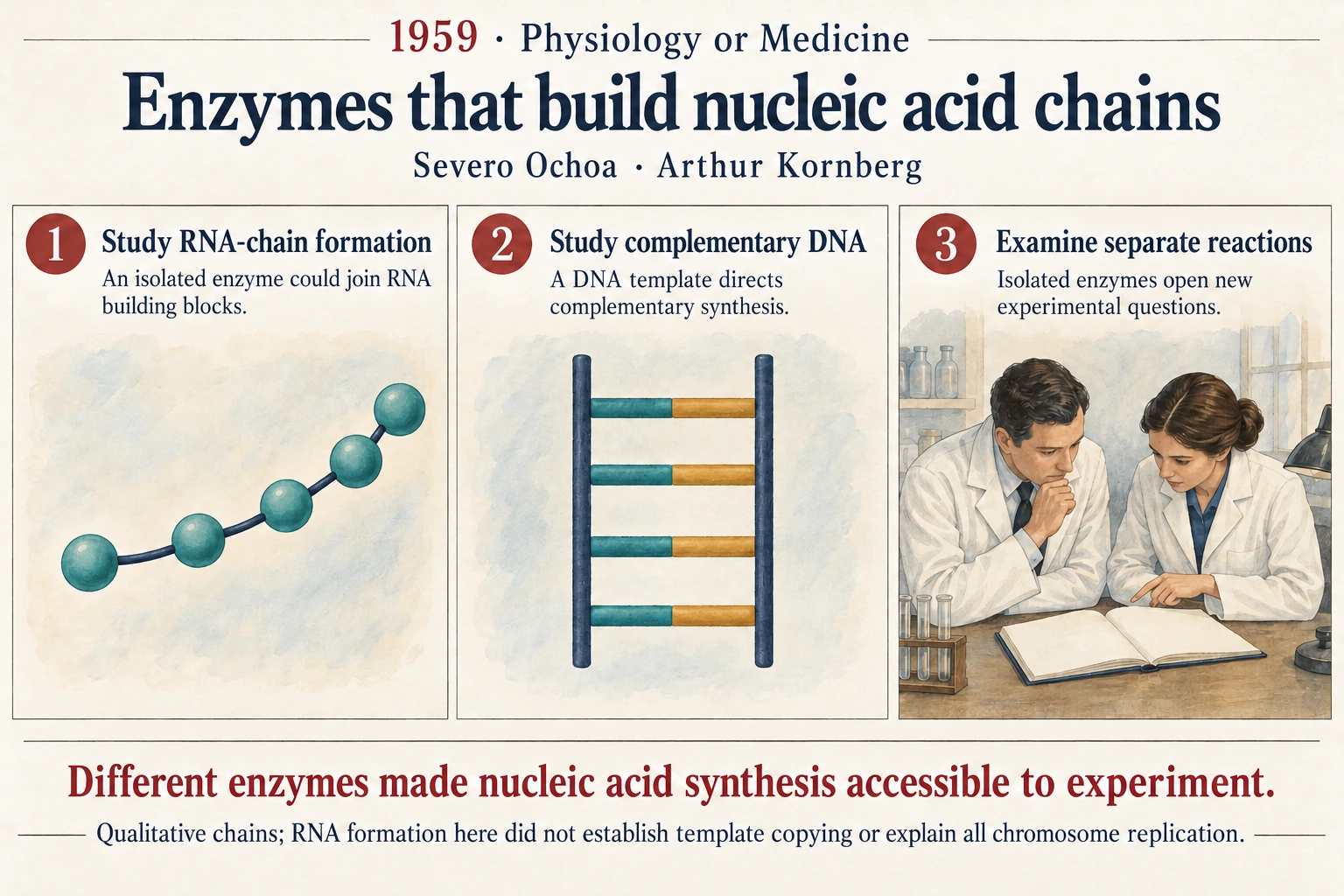
Infographic explaining Enzymes that build nucleic acid chains
Original AI-generated infographic. A conceptual overview; the explanations and sources below provide context.
Read the poster text

Different enzymes made nucleic acid synthesis accessible to experiment.

  1. Study RNA-chain formation

    An isolated enzyme could join RNA building blocks.

  2. Study complementary DNA

    A DNA template directs complementary synthesis.

  3. Examine separate reactions

    Isolated enzymes open new experimental questions.

Qualitative chains; RNA formation here did not establish template copying or explain all chromosome replication.

01 · The discovery

The idea, in everyday language

Knowing that nucleic acids carried biological information did not explain how cells assembled their chains. Researchers needed to identify enzymes and study synthesis outside the cell, separating particular reactions from the complexity of living systems.

In 1955 Marianne Grunberg-Manago and Ochoa reported an enzyme activity that could form RNA chains: polynucleotide phosphorylase. Kornberg and collaborators, including Bessman, Lehman and Simms, reported enzymatic DNA synthesis in 1956. The DNA polymerase used a DNA template to direct complementary synthesis. These were separate experimental achievements, recognised by equal shares of the 1959 prize.

Why it matters

Isolated enzymes helped researchers examine nucleic acid synthesis and investigate the relationship between molecular structure and biological information. The discoveries enabled later work without themselves deciphering the complete genetic code. Ochoa’s enzyme was subsequently studied in RNA metabolism; those later findings should not be treated as achievements already established by the 1959 award.
02 · The people

Who brought the idea to life?

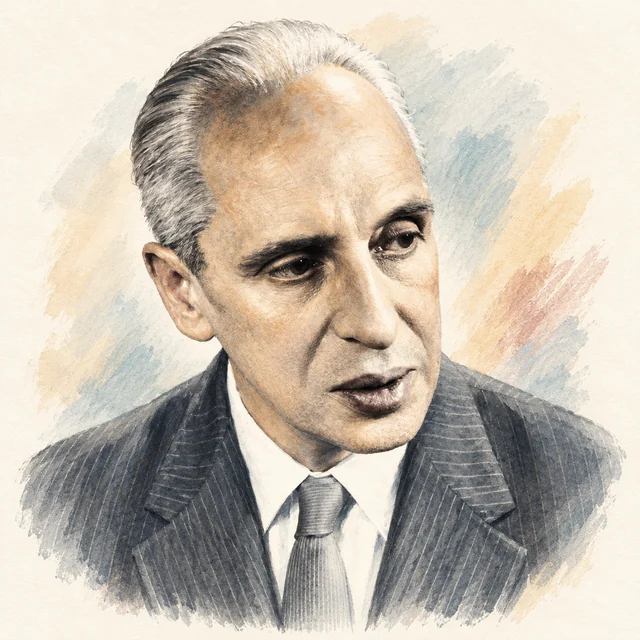
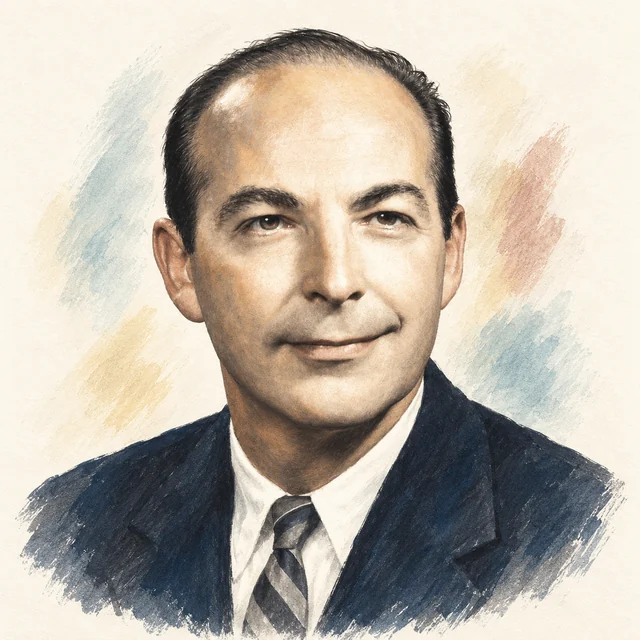
Illustrated portrait of Severo Ochoa

Severo Ochoa

Prize share · 1/2

Ochoa and Grunberg-Manago discovered polynucleotide phosphorylase and investigated enzymatic formation of RNA-like chains. Ochoa received half of the Medicine Prize.

Read the biography ↗
Illustrated portrait of Arthur Kornberg

Arthur Kornberg

Prize share · 1/2

Kornberg and collaborators identified DNA polymerase and established enzymatic, template-directed DNA synthesis. He received half of the Medicine Prize.

Read the biography ↗

03 · Years in the making

The path here

  1. 1942

    Ochoa joins New York University.

  2. 1946

    Kornberg trains in Ochoa’s laboratory.

  3. 1947

    Kornberg works with Carl Cori.

  4. 1953

    Kornberg becomes head of microbiology at Washington University.

  5. 1954

    Ochoa becomes professor of biochemistry at NYU.

  6. 1955

    Grunberg-Manago and Ochoa report the RNA-forming enzyme.

  7. 1956

    Kornberg and collaborators report enzymatic DNA synthesis.

  8. 1959

    Kornberg leads Stanford’s new biochemistry department; he and Ochoa share the prize.

04 · Read further

From the original sources

Original explanations by Curionode, based on the official records below. Biographical details and affiliations refer to the award year.

  1. Official award summary nobelprize.org
  2. Award ceremony speech nobelprize.org
  3. Original RNA enzyme publication metadata pubs.acs.org
  4. Original DNA synthesis publication metadata pubmed.ncbi.nlm.nih.gov
  5. Ochoa’s Nobel lecture nobelprize.org
  6. Later polynucleotide phosphorylase research pmc.ncbi.nlm.nih.gov
  7. Official biography: Severo Ochoa nobelprize.org
  8. Official biography: Arthur Kornberg nobelprize.org

More in Physiology or Medicine

Browse this subject ↗