c.curionodeThe Nobel Archive

1962 · Physics

Understanding quantum liquid helium

Landau’s theories connected the unusual behaviour of cold liquid helium with collective quantum states.

Quantum liquidsCollective excitationsCondensed matter
1962Physics

Visual guide

The prize, pictured

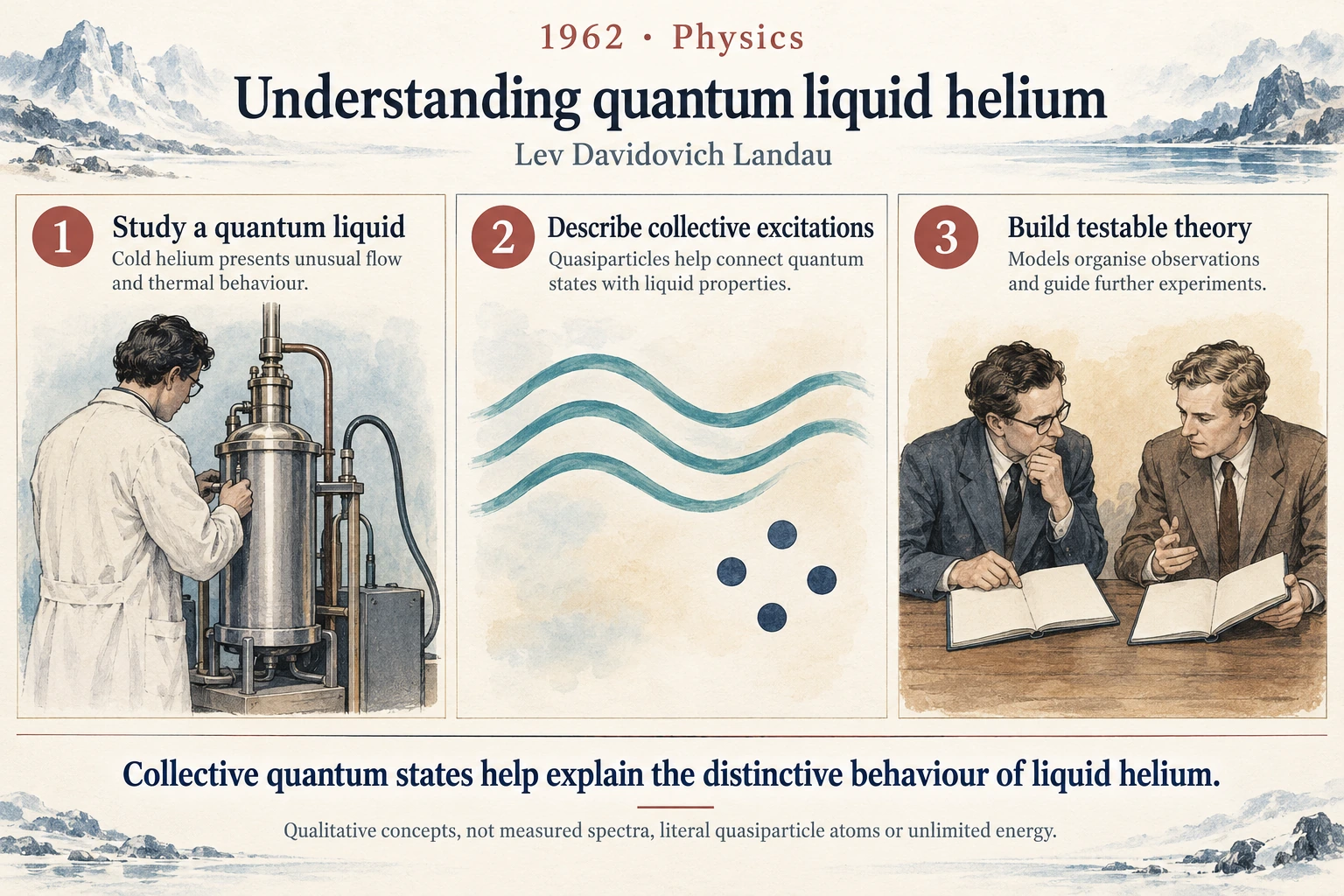
Infographic explaining Understanding quantum liquid helium
Original AI-generated infographic. A conceptual overview; the explanations and sources below provide context.
Read the poster text

Collective quantum states help explain the distinctive behaviour of liquid helium.

  1. Study a quantum liquid

    Cold helium presents unusual flow and thermal behaviour.

  2. Describe collective excitations

    Quasiparticles help connect quantum states with liquid properties.

  3. Build testable theory

    Models organise observations and guide further experiments.

Qualitative concepts, not measured spectra, literal quasiparticle atoms or unlimited energy.

01 · The discovery

The idea, in everyday language

Liquid helium behaves in ways ordinary fluid models cannot explain. In helium-4 at sufficiently low temperatures, superfluid flow becomes possible. Experiments by Kapitsa and others posed questions about motion, heat and the liquid’s excitations.

Landau treated the quantum states of the liquid as a whole. Its elementary excitations could be described as quasiparticles, including phonons and rotons, rather than independent classical atoms. His 1941 and 1947 work linked excitation properties with superfluid behaviour and second sound. Later Fermi-liquid theory addressed the very different helium-3 liquid.

Why it matters

The theories made important properties of quantum liquids understandable and testable. Neutron-scattering experiments subsequently examined the excitation spectrum. Landau received the full prize for pioneering condensed-matter theory, especially liquid helium; the recognition was broader than a single flow demonstration.
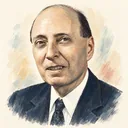
02 · The people

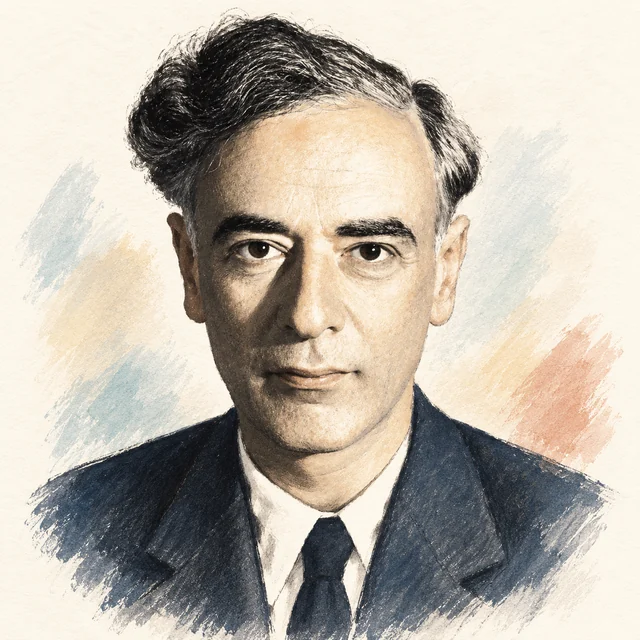
Who brought the idea to life?

03 · Years in the making

The path here

  1. 1927

    Landau graduates from Leningrad University.

  2. 1937

    He joins the Moscow Institute for Physical Problems.

  3. 1938

    Kapitsa reports superfluid helium behaviour.

  4. 1941–1947

    Landau develops his superfluid-helium theory.

  5. 1956–1958

    He develops Fermi-liquid theory.

  6. 1962

    He receives the Physics Prize in Moscow.

04 · Read further

From the original sources

Original explanations by Curionode, based on the official records below. Biographical details and affiliations refer to the award year.

  1. Official award summary nobelprize.org
  2. Award ceremony speech nobelprize.org
  3. Landau 1941 publication metadata journals.aps.org
  4. Official biography: Lev Davidovich Landau nobelprize.org