c.curionodeThe Nobel Archive

1965 · Physics

Making quantum electrodynamics calculable

Tomonaga, Schwinger and Feynman developed complementary formulations of how charged particles interact with the electromagnetic field.

Quantum electrodynamicsRenormalizationCalculation and observation
1965Physics

Visual guide

The prize, pictured

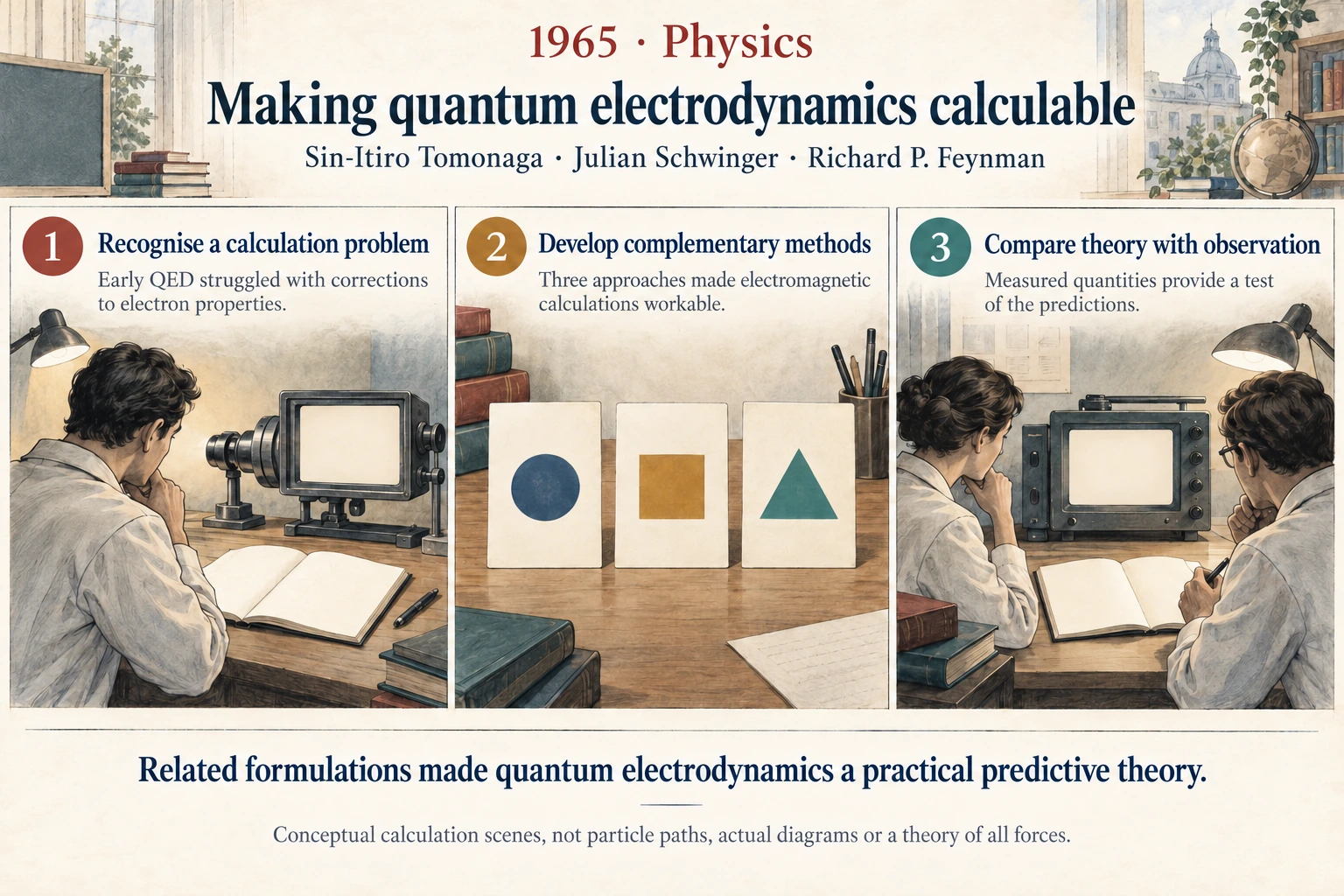
Infographic explaining Making quantum electrodynamics calculable
Original AI-generated infographic. A conceptual overview; the explanations and sources below provide context.
Read the poster text

Related formulations made quantum electrodynamics a practical predictive theory.

  1. Recognise a calculation problem

    Early QED struggled with corrections to electron properties.

  2. Develop complementary methods

    Three approaches made electromagnetic calculations workable.

  3. Compare theory with observation

    Measured quantities provide a test of the predictions.

Conceptual calculation scenes, not particle paths, actual diagrams or a theory of all forces.

01 · The discovery

The idea, in everyday language

Quantum electrodynamics combined quantum theory with relativity, but early calculations of corrections to electron properties produced troublesome infinities. Experiments such as the Lamb shift and measurements of the electron’s magnetic moment demanded a workable theory.

Tomonaga developed a covariant formulation and renormalization methods. Schwinger supplied powerful field-theoretic calculations, including the leading anomalous magnetic-moment correction. Feynman’s space-time approach and diagrams organised interaction terms efficiently. Their independent, related approaches made observable predictions possible by relating theoretical parameters to measured mass and charge.

Why it matters

The work made QED a practical framework for comparing theory with precise observations and supplied methods with wider consequences for particle physics. Earlier theoretical work and experiments, including those of Bethe, Lamb, Retherford, Kusch and Foley, were part of the setting. Each laureate received one third of the prize.

02 · The people

Who brought the idea to life?

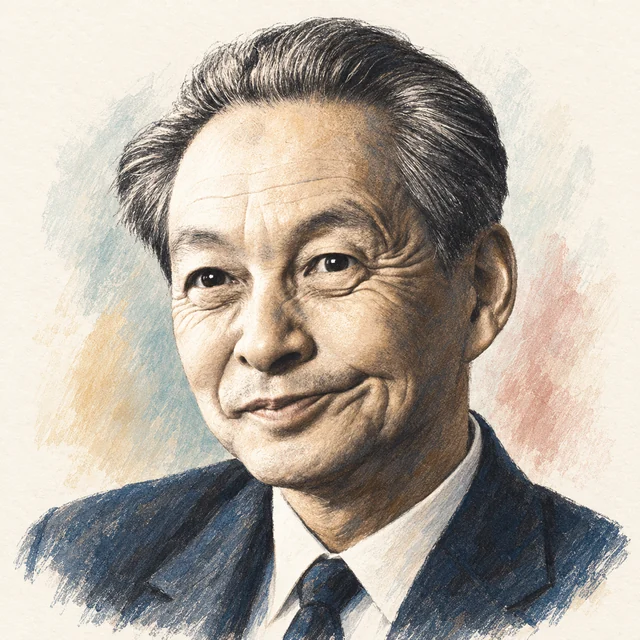
Illustrated portrait of Sin-Itiro Tomonaga

Sin-Itiro Tomonaga

Prize share · 1/3

Tomonaga developed a relativistically covariant formulation and renormalization methods for quantum electrodynamics. He received one third of the Physics Prize.

Read the biography ↗
Illustrated portrait of Julian Schwinger

Julian Schwinger

Prize share · 1/3

Schwinger developed quantum-electrodynamic methods and explained the electron’s anomalous magnetic moment. He received one third of the Physics Prize.

Read the biography ↗

03 · Years in the making

The path here

  1. 1943

    Tomonaga publishes his Japanese covariant-theory paper.

  2. 1946

    Its English translation appears.

  3. 1947

    New spectroscopic and magnetic-moment results sharpen the challenge.

  4. 1948

    Postwar renormalized QED develops through related approaches.

  5. 1949

    Feynman’s Space-Time Approach paper appears in September.

  6. 1965

    The three physicists share the Physics Prize.

04 · Read further

From the original sources

Original explanations by Curionode, based on the official records below. Biographical details and affiliations refer to the award year.

  1. Official award summary nobelprize.org
  2. Award ceremony speech nobelprize.org
  3. Tsukuba Tomonaga chronology tomonaga.tsukuba.ac.jp
  4. Tomonaga paper publication metadata (1946) academic.oup.com
  5. Feynman original abstract (1949) journals.aps.org
  6. Official biography: Sin-Itiro Tomonaga nobelprize.org
  7. Official biography: Julian Schwinger nobelprize.org
  8. Official biography: Richard P. Feynman nobelprize.org