01 · The contribution
The idea, in everyday language
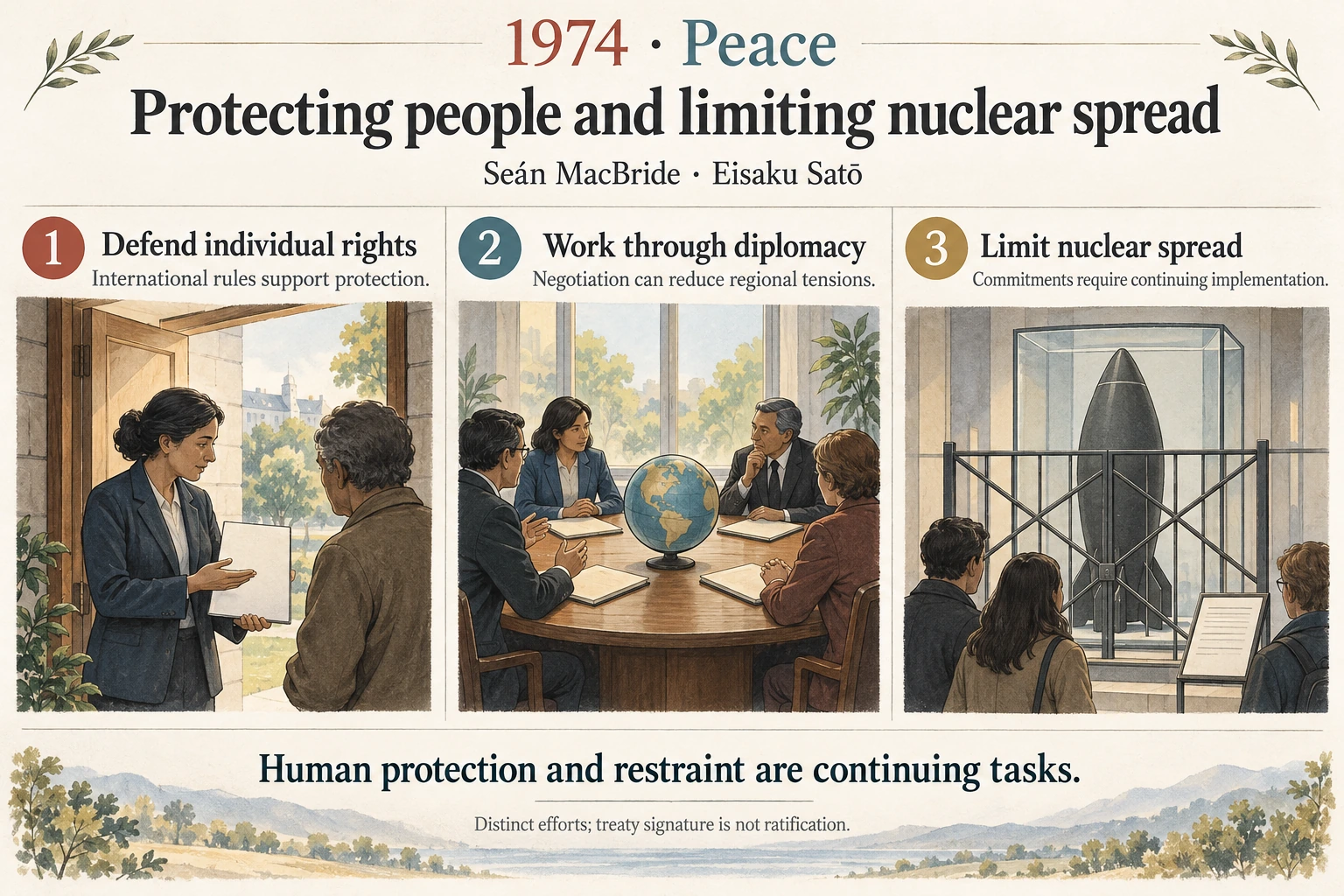
MacBride argued that protecting individuals should be an obligation reaching beyond a state’s internal affairs. Work on the European Convention on Human Rights, Amnesty International and the International Commission of Jurists linked legal principles with cases of persecution and abuse. International organisations and public advocacy could make violations harder to ignore, even though a written agreement alone could not guarantee enforcement. His earlier involvement in armed Irish politics was part of his history, not the contribution honoured by this prize.
Satō’s government pursued regional relations and negotiations, including the return of Okinawa to Japanese administration. His 1967 statement set out principles against possessing, producing or allowing the introduction of nuclear weapons. Japan signed the Nuclear Non-Proliferation Treaty in 1970, but had not ratified it by the 1974 award. The committee recognised these efforts while hoping to encourage wider non-proliferation. Satō’s politics and close security relationship with the United States remained disputed. The award does not establish that Japan’s security debates were settled or that all nuclear weapons had been eliminated.
Why it matters
The award highlighted protection of individuals and diplomatic restraint as parts of peace work. MacBride’s international legal advocacy and Satō’s regional and nuclear-policy commitments belonged to different contexts. Their recognition was not a joint treaty or proof that the same method had resolved every conflict.