01 · The discovery
The idea, in everyday language
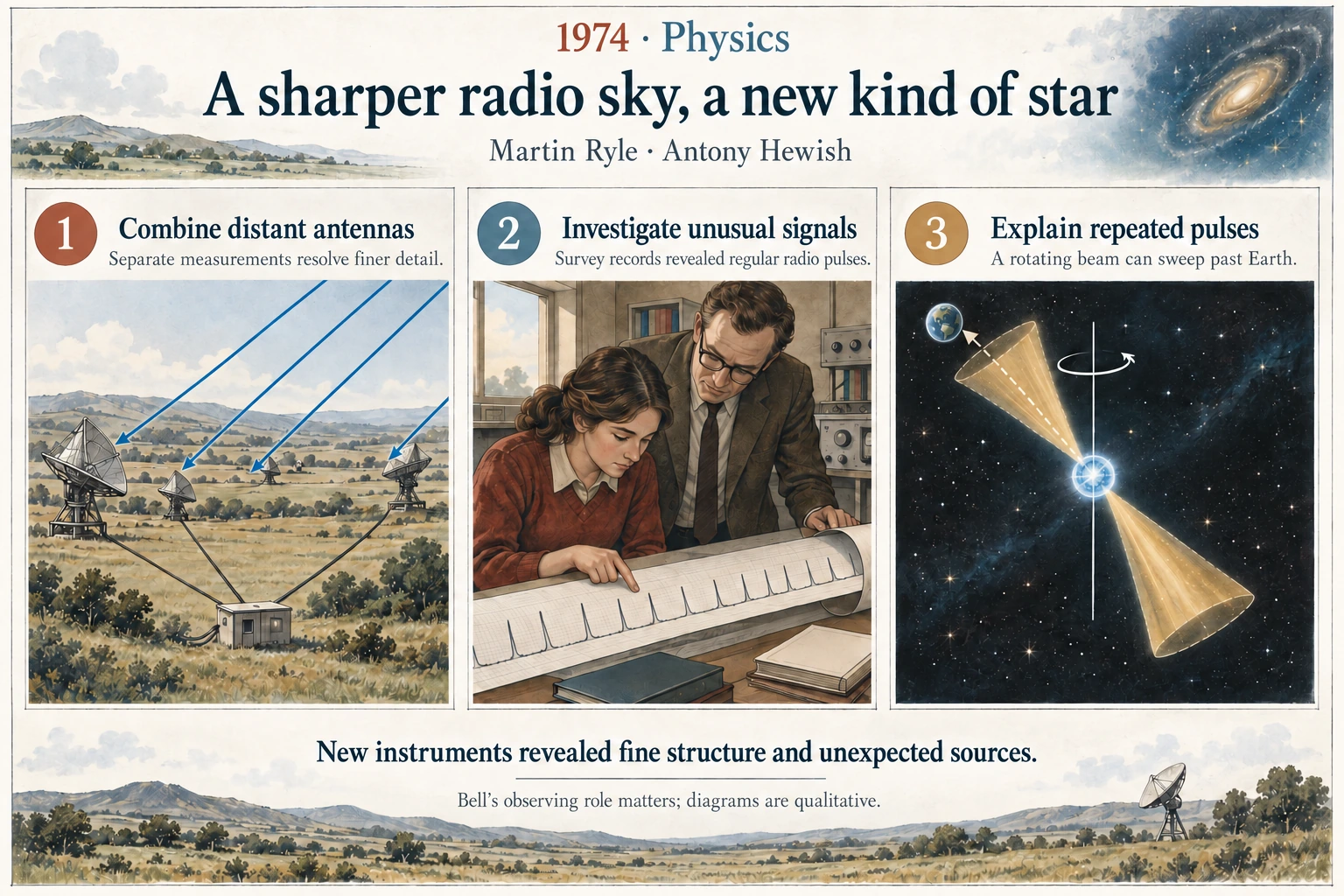
A radio telescope must distinguish sources arriving from nearly the same direction. Ryle developed aperture synthesis: measurements from separated antennas, taken at different arrangements and times, are combined to reconstruct finer spatial detail. Earth’s rotation changes the orientations sampled by an array. The technique gains angular resolution from the separation of antennas; it does not collect as much energy as a filled dish covering the whole area between them.
Hewish studied radio scintillation and designed a large array to survey sources whose signals twinkled through interplanetary plasma. Graduate student Jocelyn Bell helped construct the array and scrutinised its paper records in 1967. She noticed unusual signals, and follow-up observations established regular pulses. Pulsars are associated with rotating neutron stars: if a beam of radiation crosses our direction during rotation, repeated pulses can be observed. Ryle’s imaging methods and the pulsar discovery are connected through radio astronomy, but are distinct achievements with wider teams behind them.
Why it matters
Aperture synthesis opened detailed mapping of celestial radio sources. Pulsar discovery supplied evidence for compact neutron stars and a new way to investigate extreme astrophysical conditions. The award recognised both instrumental advances and the identification of an unexpected class of objects.