c.curionodeThe Nobel Archive

1978 · Chemistry

A gradient powers the cell

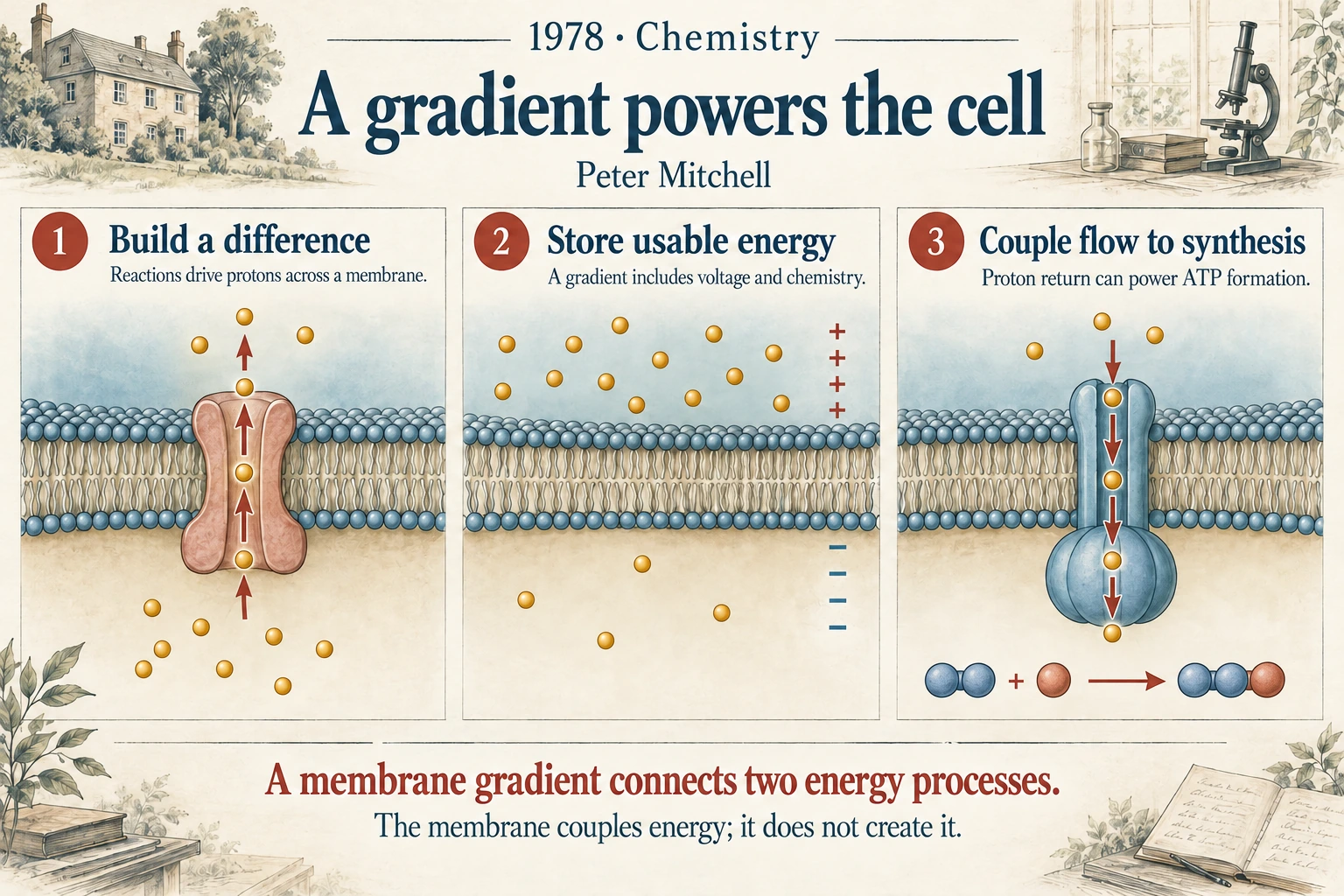
How could energy released by one set of reactions help a different enzyme make ATP? Mitchell proposed a connection through a membrane and an electrochemical proton gradient.

Chemiosmotic theoryProton gradientATP synthesis
1978Chemistry

Visual guide

The prize, pictured

Infographic explaining A gradient powers the cell
Original AI-generated infographic. A conceptual overview; the explanations and sources below provide context.
Read the poster text

A membrane gradient connects two energy processes.

  1. Build a difference

    Reactions drive protons across a membrane.

  2. Store usable energy

    A gradient includes voltage and chemistry.

  3. Couple flow to synthesis

    Proton return can power ATP formation.

The membrane couples energy; it does not create it.

01 · The discovery

The idea, in everyday language

Electron-transfer reactions can drive the movement of protons across a membrane. The resulting difference combines an electrical potential with a difference in proton chemical activity. Keeping the two sides separated allows energy from those reactions to be stored in this electrochemical gradient.

Protons returning through ATP synthase can couple that flow to making ATP from ADP and inorganic phosphate. The membrane and gradient link the processes without requiring the enzymes to hand over a special energy-rich chemical intermediate. Mitchell’s 1961 hypothesis was tested and revised through experiments by his group and many others.

Why it matters

Chemiosmotic theory connected respiration, photosynthetic energy conversion and membrane transport in a common explanation of energy coupling. It changed what experiments needed to measure: gradients, membrane integrity and the relation between ion flow and ATP production.
02 · The people

Who brought the idea to life?

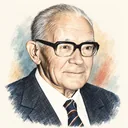
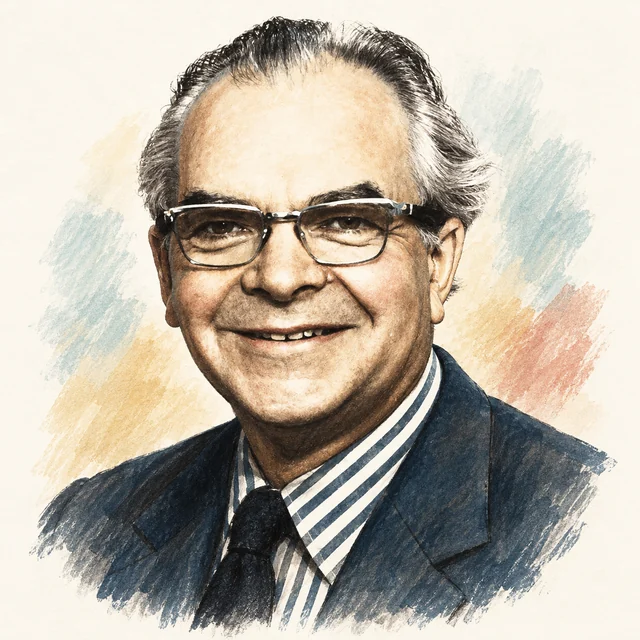
Illustrated portrait of Peter Mitchell

Peter Mitchell

Prize share · 1

Mitchell received the full Chemistry Prize for formulating chemiosmotic theory. A membrane can couple energy-releasing processes to ATP synthesis through an electrochemical proton gradient. Jennifer Moyle and many other researchers contributed to testing and developing the account.

Read the biography ↗

03 · Years in the making

The path here

  1. 1951

    Mitchell receives his Cambridge doctorate.

  2. 1955

    He establishes a chemical-biology unit in Edinburgh.

  3. 1961

    The chemiosmotic hypothesis is published.

  4. 1965

    Mitchell and Moyle begin the Glynn research programme.

  5. 1978

    The theory of biological energy transfer receives the full prize.

04 · Read further

From the original sources

Original explanations by Curionode, based on the official records below. Biographical details and affiliations refer to the award year.

  1. Official announcement nobelprize.org
  2. Mitchell’s lecture: chemiosmotic coupling nobelprize.org

More in Chemistry

Browse this subject ↗