01 · The discovery
The idea, in everyday language
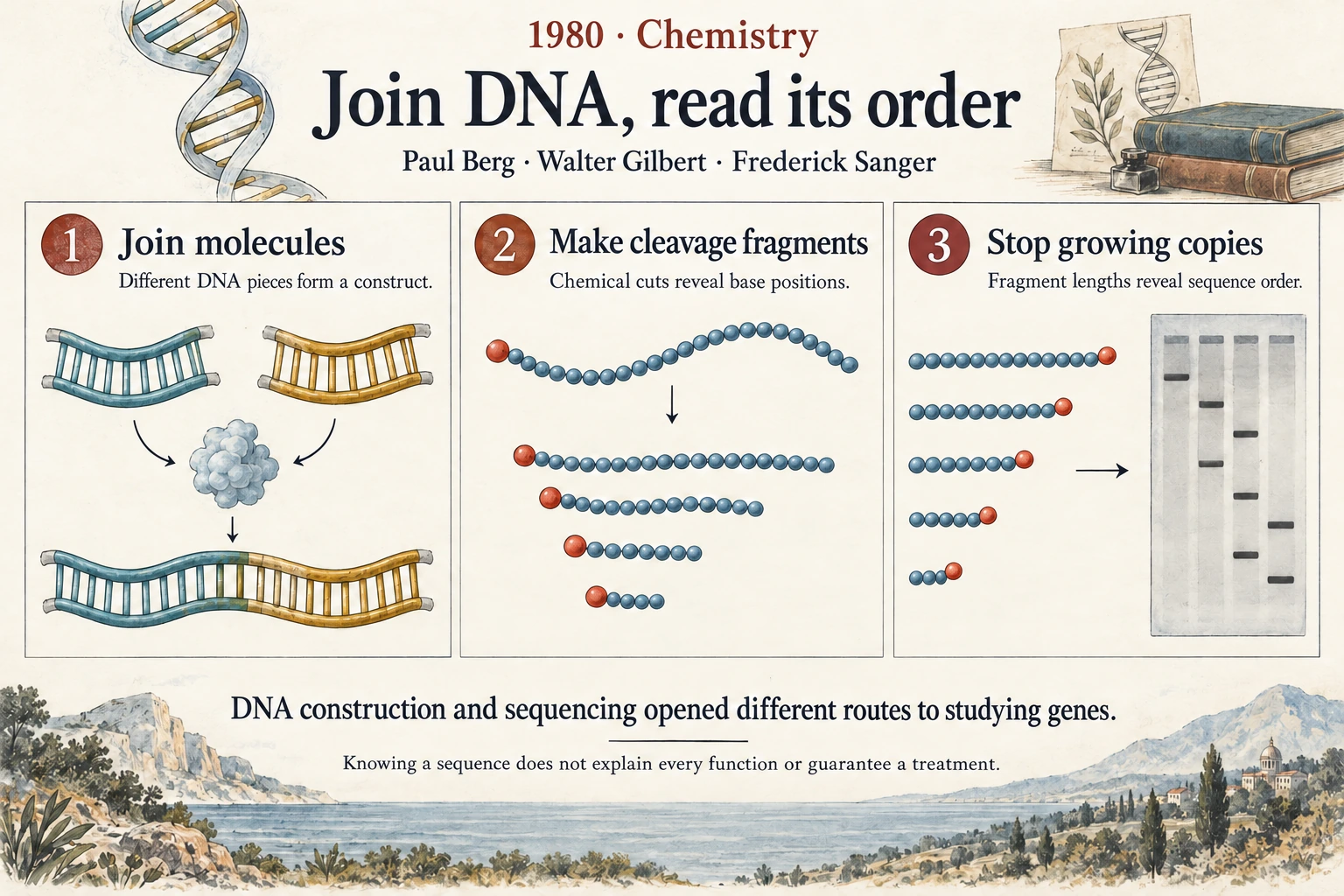
Knowing that DNA contains four kinds of base is different from knowing their order, and different again from joining chosen DNA molecules. Berg’s biochemical work made such joining possible in a test tube. His group’s 1972 recombinant-DNA construction combined material from viral and bacterial sources, opening an experimental route to studying gene structure and function.
Gilbert and Allan Maxam read DNA using chemical reactions that partially cleave a labelled strand at particular bases. Fragment lengths indicate positions along it. Sanger’s group, including Alan Coulson and Steve Nicklen, instead made complementary copies whose growth could stop at selected bases. Separating the resulting fragments by length allowed the base order to be inferred. The two methods published in 1977 differed in how the readable fragments were made.
Why it matters
Together the methods expanded the ability to investigate genes and compare biological information, helping establish molecular tools used in later biotechnology. Berg received one half of the prize; Gilbert and Sanger one quarter each. Their collaborators and earlier nucleic-acid research are essential parts of that development. Sanger’s 1958 prize for protein sequencing was a different recognition.