01 · The discovery
The idea, in everyday language
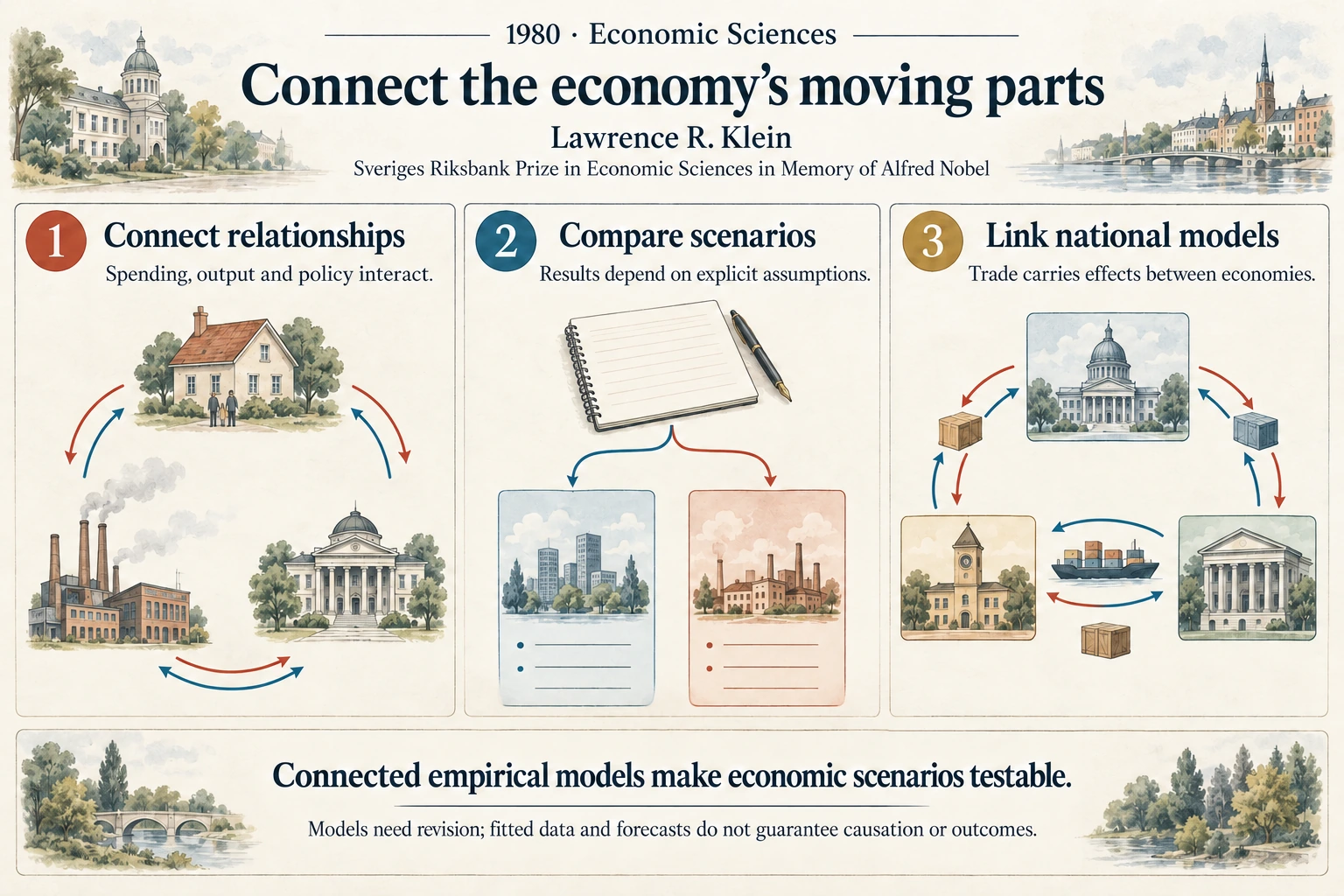
A national economy cannot be understood by forecasting each quantity in isolation. Consumption responds to income; investment and production interact with demand; policy and outside shocks can affect several relationships at once. Klein combined economic theory with observed data in systems of equations, estimating relationships and checking how the connected model behaved.
The Klein–Goldberger model, Wharton models and larger collaborations explored increasingly detailed versions of this task. Project LINK, begun in 1968, connected national models through trade: one country’s import demand could become another’s export opportunity. The point was to study interactions and conditional scenarios, not to treat a fitted equation as an infallible description of human behaviour.
Why it matters
The work made empirical macroeconomics a practical tool for studying fluctuations, forecasting and exploring policy scenarios. It encouraged international cooperation and explicit comparison of assumptions with data. Klein’s contributions built on Tinbergen and colleagues such as Marschak and Goldberger. The award was the Sveriges Riksbank Prize in Economic Sciences in Memory of Alfred Nobel.