c.curionodeThe Nobel Archive

1980 · Economic Sciences

Connect the economy’s moving parts

Economic choices affect one another through spending, production and trade. Klein built empirical models that made those connections explicit and allowed conditional forecasts and policy comparisons.

The Sveriges Riksbank Prize in Economic Sciences in Memory of Alfred Nobel.

Macroeconometric modelsConditional forecastsInternational trade
1980Economic Sciences

Visual guide

The prize, pictured

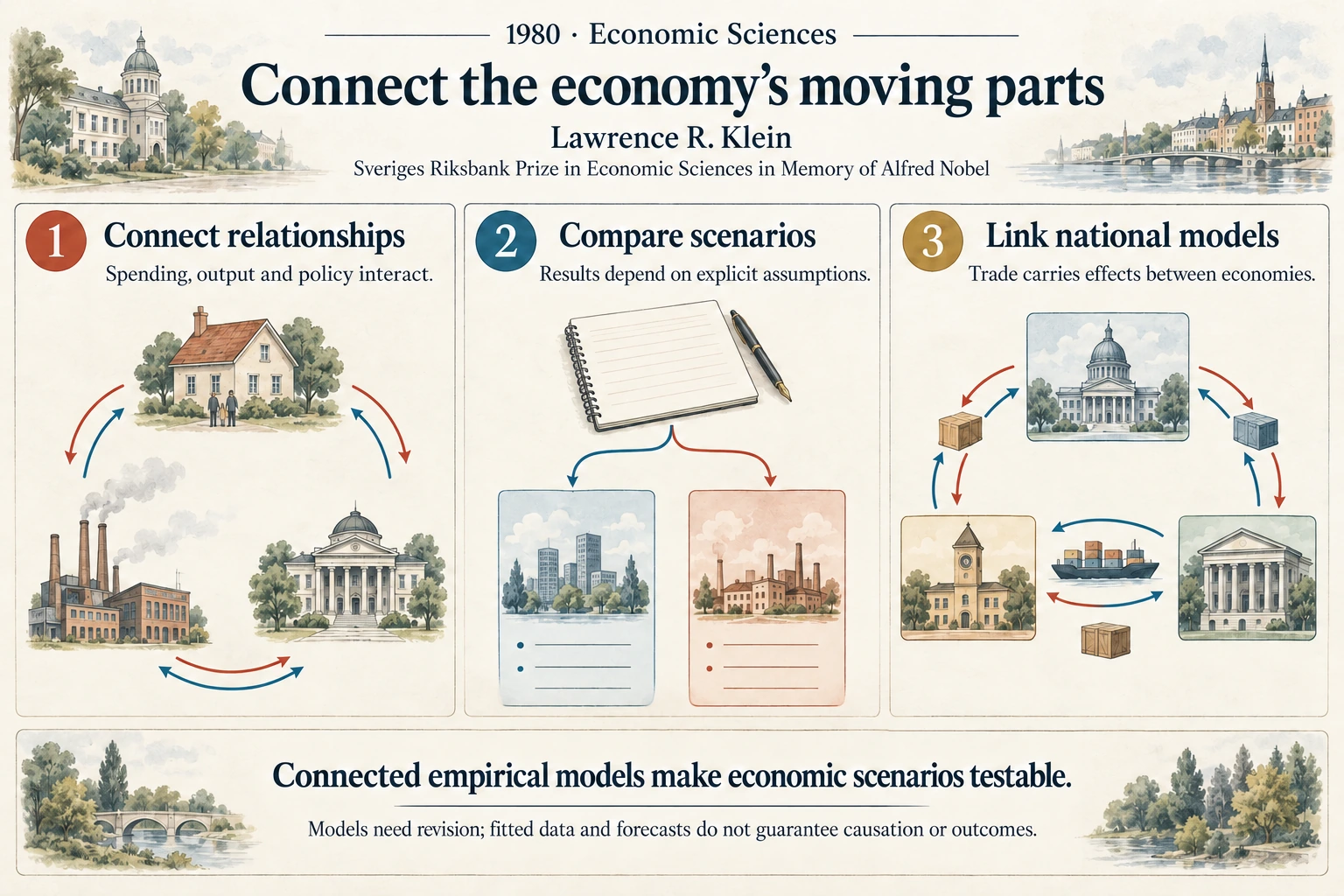
Infographic explaining Connect the economy’s moving parts
Original AI-generated infographic. A conceptual overview; the explanations and sources below provide context.
Read the poster text

Connected empirical models make economic scenarios testable.

  1. Connect relationships

    Spending, output and policy interact.

  2. Compare scenarios

    Results depend on explicit assumptions.

  3. Link national models

    Trade carries effects between economies.

Models need revision; fitted data and forecasts do not guarantee causation or outcomes.

01 · The discovery

The idea, in everyday language

A national economy cannot be understood by forecasting each quantity in isolation. Consumption responds to income; investment and production interact with demand; policy and outside shocks can affect several relationships at once. Klein combined economic theory with observed data in systems of equations, estimating relationships and checking how the connected model behaved.

The Klein–Goldberger model, Wharton models and larger collaborations explored increasingly detailed versions of this task. Project LINK, begun in 1968, connected national models through trade: one country’s import demand could become another’s export opportunity. The point was to study interactions and conditional scenarios, not to treat a fitted equation as an infallible description of human behaviour.

Why it matters

The work made empirical macroeconomics a practical tool for studying fluctuations, forecasting and exploring policy scenarios. It encouraged international cooperation and explicit comparison of assumptions with data. Klein’s contributions built on Tinbergen and colleagues such as Marschak and Goldberger. The award was the Sveriges Riksbank Prize in Economic Sciences in Memory of Alfred Nobel.
02 · The people

Who brought the idea to life?

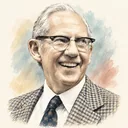
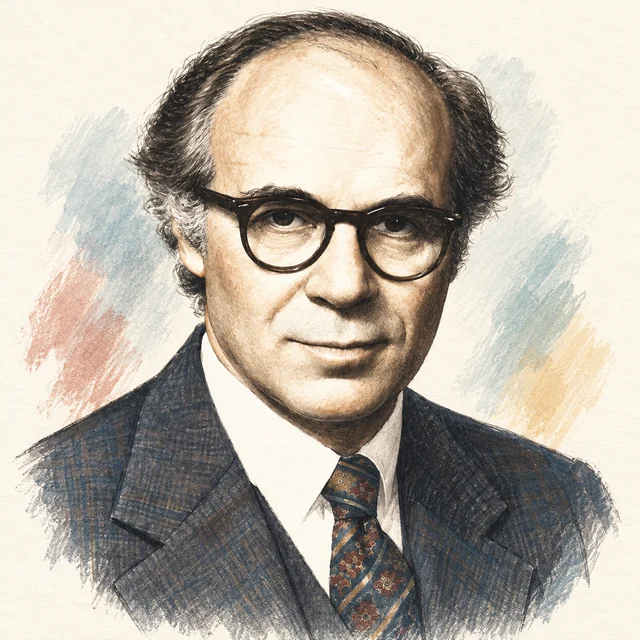
Illustrated portrait of Lawrence R. Klein

Lawrence R. Klein

Prize share · 1/1

Klein constructed and applied empirical models of interconnected economic relationships to study fluctuations and policy scenarios. He received the full Sveriges Riksbank memorial prize. The models make assumptions explicit and allow conditional comparisons; they do not guarantee future outcomes or establish causation merely by fitting historical data.

Read the biography ↗

03 · Years in the making

The path here

  1. 1940s

    At the Cowles Commission, Klein develops empirical macroeconomic models.

  2. 1950s

    Klein and Goldberger develop a model at Michigan.

  3. 1958

    Klein joins the University of Pennsylvania.

  4. 1968

    Project LINK begins as an international model-linking collaboration.

  5. 1980

    The memorial prize recognises model construction and its applications.

04 · Read further

From the original sources

Original explanations by Curionode, based on the official records below. Biographical details and affiliations refer to the award year.

  1. Official announcement nobelprize.org
  2. Official biography nobelprize.org

More in Economic Sciences

Browse this subject ↗