01 · The discovery
The idea, in everyday language
A metal complex contains a metal centre and surrounding ligands. Two complexes can exchange an electron, but the same overall change need not imply the same mechanism. Taube connected ligand-exchange behaviour, rates and reaction products to evidence about the path. A complex that exchanges ligands slowly is kinetically inert; this does not mean exchange is impossible or that every reaction is slow.
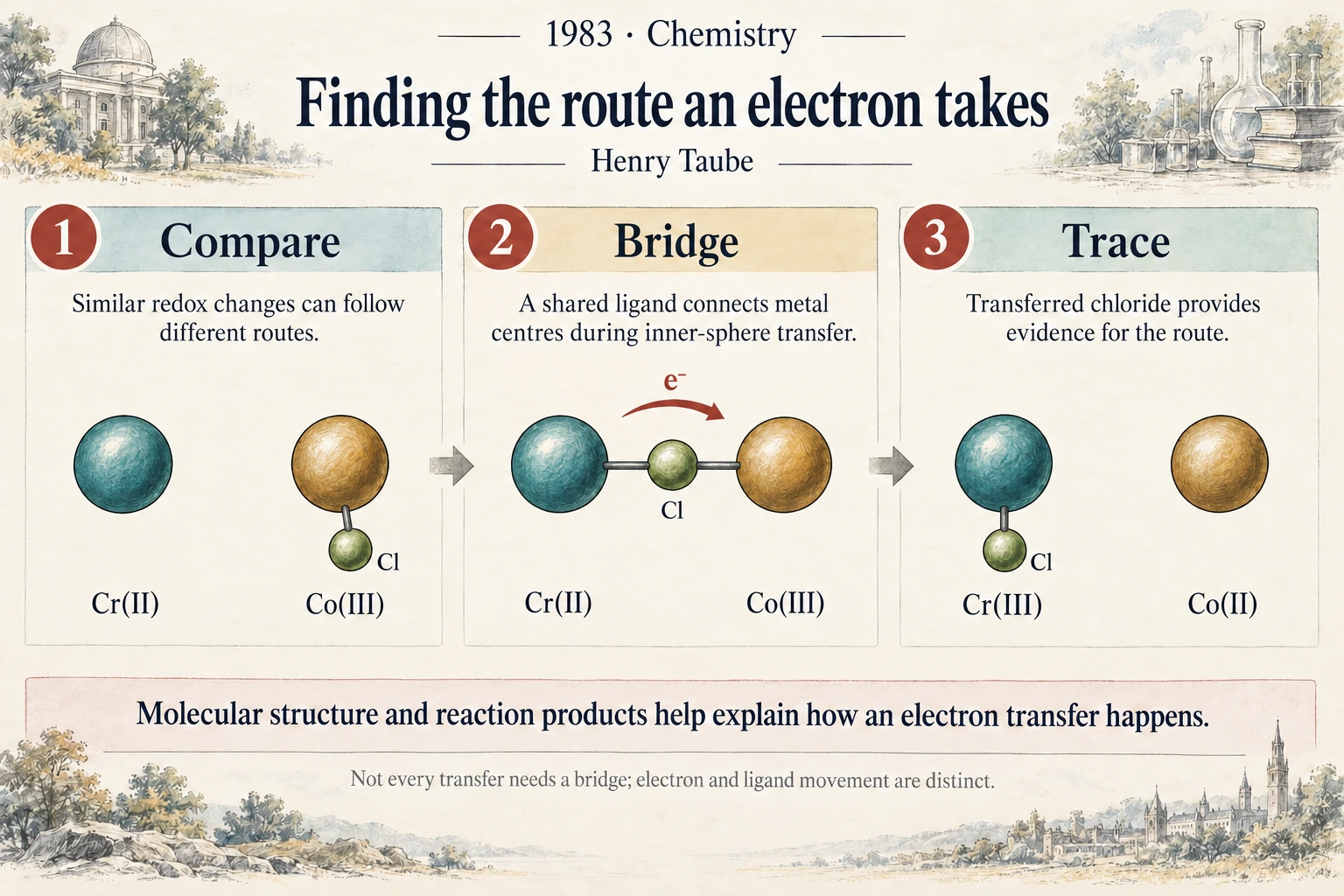
In the classic chromium(II)/cobalt(III) experiment, chloride initially attached to cobalt bridges the two centres. An electron moves from chromium to cobalt: chromium is oxidised to III and cobalt reduced to II. Chloride ends up attached to chromium, giving a chemical trace of the connection. This inner-sphere route differs from outer-sphere transfer, where the centres do not share such a bridge.
Why it matters
Mechanistic chemistry explains why reactions with similar overall equations can have different rates and sensitivities to molecular structure. Taube’s work also opened questions about electronic interaction in mixed-valence compounds, including research with Carol Creutz. These are foundations for understanding reactivity, rather than guarantees of a particular device or treatment.