c.curionodeThe Nobel Archive

1983 · Chemistry

Finding the route an electron takes

A redox reaction changes oxidation states. Taube showed how experiments can reveal the molecular route behind that change, especially in metal complexes.

Electron transferMetal complexesInner-sphere mechanism
1983Chemistry

Visual guide

The prize, pictured

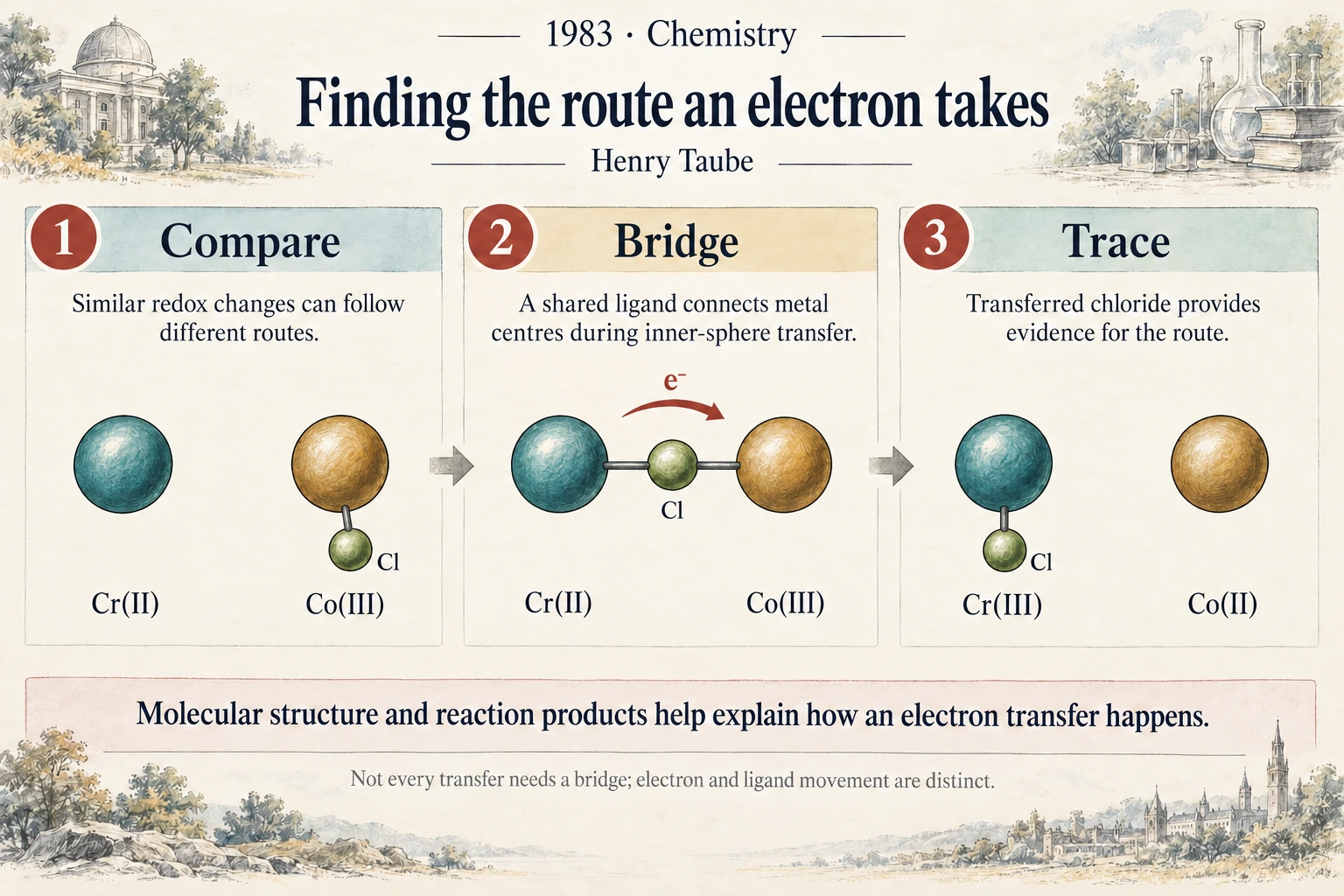
Infographic explaining Finding the route an electron takes
Original AI-generated infographic. A conceptual overview; the explanations and sources below provide context.
Read the poster text

Molecular structure and reaction products help explain how an electron transfer happens.

  1. Compare

    Similar redox changes can follow different routes.

  2. Bridge

    A shared ligand connects metal centres during inner-sphere transfer.

  3. Trace

    Transferred chloride provides evidence for the route.

Not every transfer needs a bridge; electron and ligand movement are distinct.

01 · The discovery

The idea, in everyday language

A metal complex contains a metal centre and surrounding ligands. Two complexes can exchange an electron, but the same overall change need not imply the same mechanism. Taube connected ligand-exchange behaviour, rates and reaction products to evidence about the path. A complex that exchanges ligands slowly is kinetically inert; this does not mean exchange is impossible or that every reaction is slow.

In the classic chromium(II)/cobalt(III) experiment, chloride initially attached to cobalt bridges the two centres. An electron moves from chromium to cobalt: chromium is oxidised to III and cobalt reduced to II. Chloride ends up attached to chromium, giving a chemical trace of the connection. This inner-sphere route differs from outer-sphere transfer, where the centres do not share such a bridge.

Why it matters

Mechanistic chemistry explains why reactions with similar overall equations can have different rates and sensitivities to molecular structure. Taube’s work also opened questions about electronic interaction in mixed-valence compounds, including research with Carol Creutz. These are foundations for understanding reactivity, rather than guarantees of a particular device or treatment.
02 · The people

Who brought the idea to life?

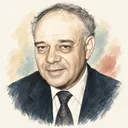
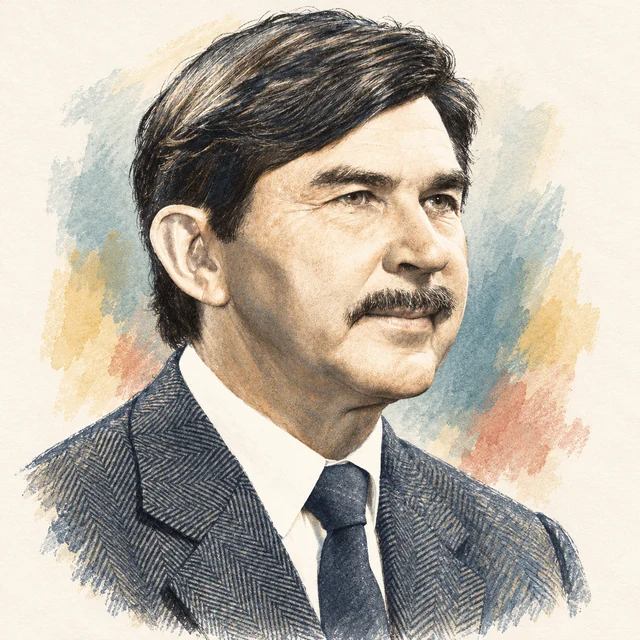
Illustrated portrait of Henry Taube

Henry Taube

Prize share · 1

Taube explained mechanisms of electron transfer, especially in metal complexes. A shared ligand can connect two metal centres during inner-sphere transfer; changes in ligand attachment and metal oxidation states provide evidence for that route. He also investigated transfer without a shared bridge and electronic interactions in mixed-valence compounds. The Chemistry Prize recognised this mechanistic programme, not a claim that all electron transfer requires a bridge.

Read the biography ↗

03 · Years in the making

The path here

  1. 1940

    Taube earns his Berkeley doctorate with W. C. Bray.

  2. 1946

    He joins Chicago and develops research on metal-complex reactions.

  3. 1962

    He moves to Stanford.

  4. 1983

    The Chemistry Prize recognises electron-transfer mechanisms, especially in metal complexes.

04 · Read further

From the original sources

Original explanations by Curionode, based on the official records below. Biographical details and affiliations refer to the award year.

  1. Official announcement nobelprize.org
  2. National Academy memoir of Taube nasonline.org

More in Chemistry

Browse this subject ↗