c.curionodeThe Nobel Archive

1985 · Chemistry

Recover the missing phases in crystal diffraction

Hauptman and Karle turned intensity patterns into a powerful route to molecular structure.

crystallographyphase problemdirect methodsmolecular structure
1985Chemistry

Visual guide

The prize, pictured

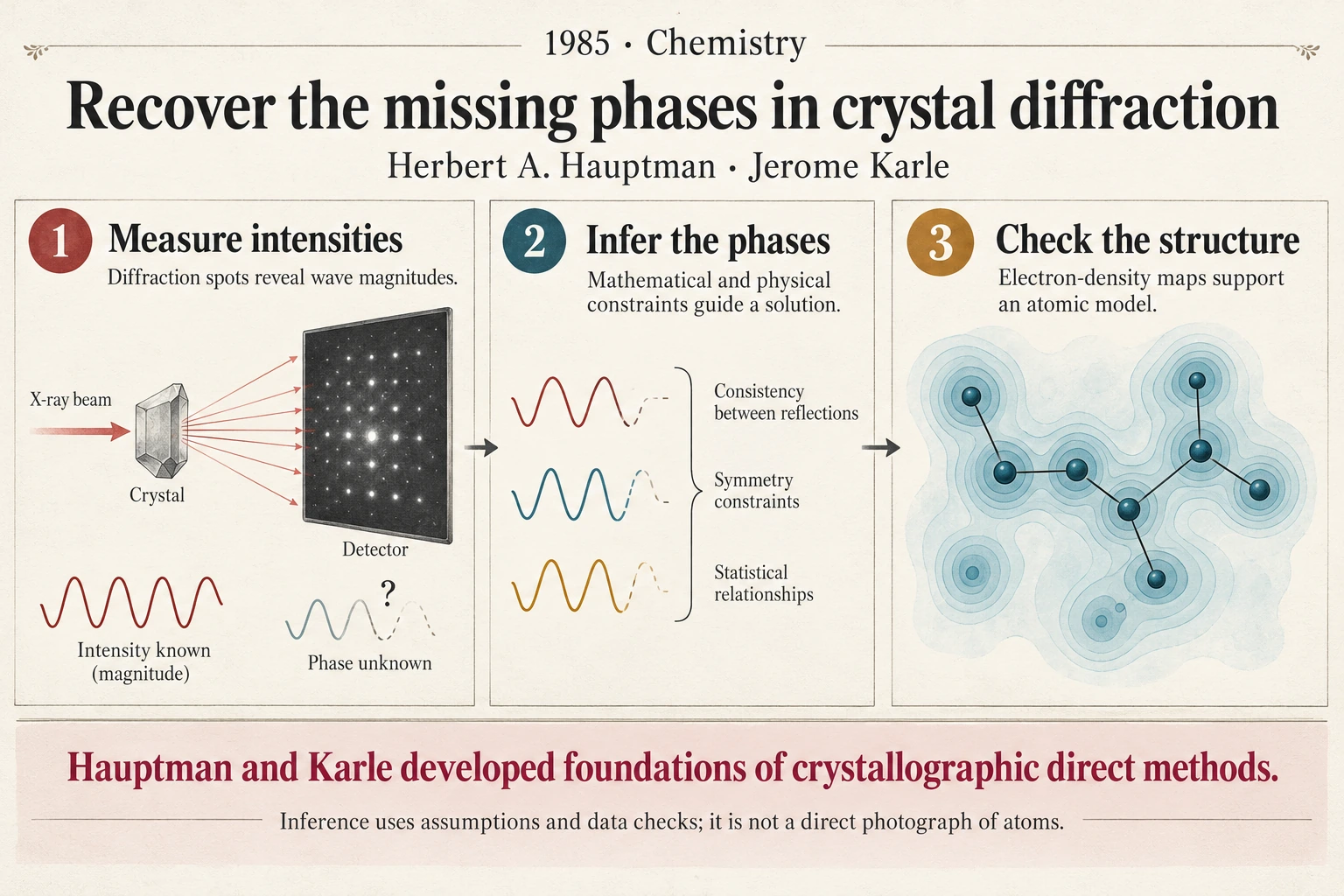
Infographic explaining Recover the missing phases in crystal diffraction
Original AI-generated infographic. A conceptual overview; the explanations and sources below provide context.
Read the poster text

Hauptman and Karle developed foundations of crystallographic direct methods.

  1. Measure intensities

    Diffraction spots reveal wave magnitudes.

  2. Infer the phases

    Mathematical and physical constraints guide a solution.

  3. Check the structure

    Electron-density maps support an atomic model.

Inference uses assumptions and data checks; it is not a direct photograph of atoms.

01 · The discovery

The idea, in everyday language

X-rays scattered by a crystal make a diffraction pattern. Detectors measure the intensities of the spots, which tell us about the magnitudes of scattered waves. A reconstruction also needs their relative phases, information usually absent from those intensity measurements. This is the crystallographic phase problem.

Hauptman and Karle developed direct methods using mathematical relationships and physical constraints, including nonnegative electron density and the atomic nature of structures. Statistical relationships among reflections help infer possible phases. Computing an electron-density map, fitting an atomic model and checking it against data turn those inferences into a structure determination. Isabella Karle and other crystallographers made crucial experimental and practical contributions.

Why it matters

Direct methods made many small-molecule crystal structures much easier to determine. Chemical bonding, molecular shape and material properties could be studied with structural evidence. The 1953 joint monograph was an important foundation; later theory, experiments and computing broadened the methods.
02 · The people

Who brought the idea to life?

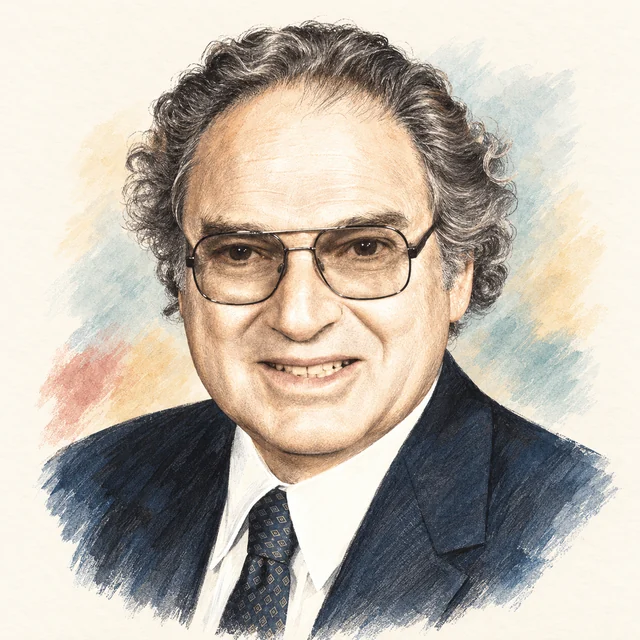
Illustrated portrait of Herbert A. Hauptman

Herbert A. Hauptman

Prize share · 1/2

Hauptman developed mathematical and statistical relationships that allow phases to be inferred from X-ray diffraction intensities under structural constraints. Together with Karle, he established central foundations of crystallographic direct methods. These methods help reconstruct electron-density maps and determine molecular structures; they do not directly photograph atoms or guarantee a solution from every dataset. He received one half of the Chemistry Prize.

Read the biography ↗
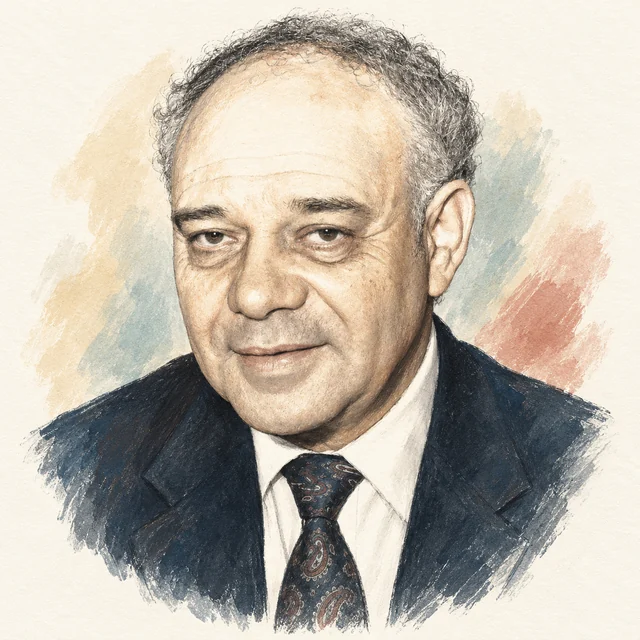
Illustrated portrait of Jerome Karle

Jerome Karle

Prize share · 1/2

Karle linked physical constraints on electron density with mathematical phase relationships. His work with Hauptman made direct methods powerful tools for solving crystal structures from measured diffraction intensities. Experimental validation, notably by Isabella Karle, helped turn theory into practice. He received one half of the Chemistry Prize; Isabella’s important contribution did not make her an additional recipient of this award.

Read the biography ↗

03 · Years in the making

The path here

  1. 1947

    Hauptman and Karle begin their partnership at the Naval Research Laboratory.

  2. 1953

    Their monograph develops foundations for phase determination.

  3. 1963

    Isabella Karle demonstrates symbolic addition in a practical structure solution.

  4. 1985

    Hauptman and Karle share the Chemistry Prize equally.

04 · Read further

From the original sources

Original explanations by Curionode, based on the official records below. Biographical details and affiliations refer to the award year.

  1. Official announcement nobelprize.org

More in Chemistry

Browse this subject ↗