c.curionodeThe Nobel Archive

1983 · Physics

How stars hold together and make elements

Stellar evolution needs both a theory of structure and a nuclear account of matter. Chandrasekhar explained physical limits inside stars; Fowler connected laboratory reactions to the making of elements.

Stellar structureWhite dwarfsNucleosynthesis
1983Physics

Visual guide

The prize, pictured

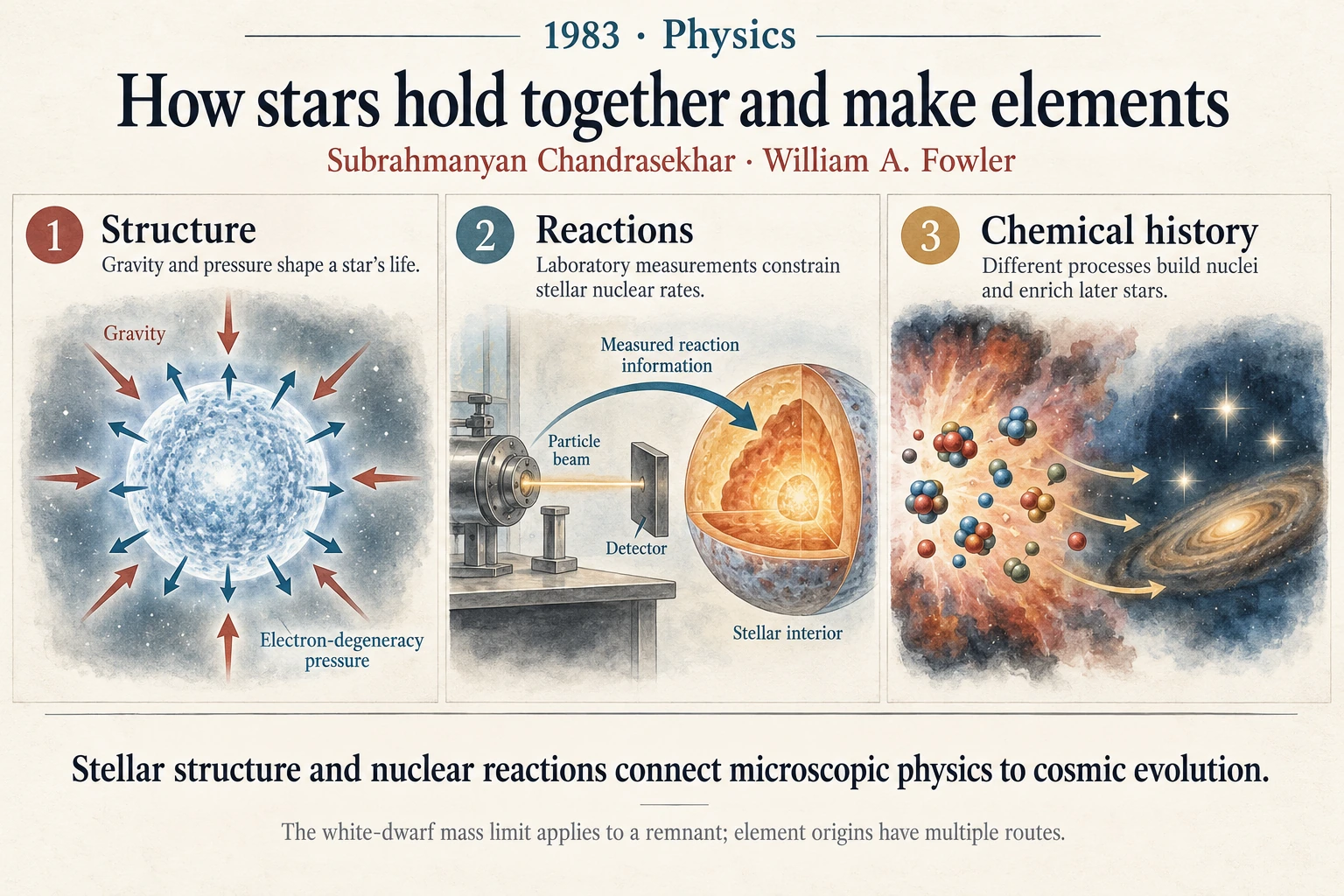
Infographic explaining How stars hold together and make elements
Original AI-generated infographic. A conceptual overview; the explanations and sources below provide context.
Read the poster text

Stellar structure and nuclear reactions connect microscopic physics to cosmic evolution.

  1. Structure

    Gravity and pressure shape a star’s life.

  2. Reactions

    Laboratory measurements constrain stellar nuclear rates.

  3. Chemical history

    Different processes build nuclei and enrich later stars.

The white-dwarf mass limit applies to a remnant; element origins have multiple routes.

01 · The discovery

The idea, in everyday language

Gravity pulls stellar matter inward. Pressure can resist it, but the source of that pressure changes as a star evolves. Chandrasekhar studied these balances mathematically. In an idealised cold, nonrotating white dwarf, quantum electron degeneracy pressure has a limiting mass of roughly 1.4 Suns for common compositions. Including relativity is essential to this result.

Fowler’s experiments measured the probabilities of nuclear reactions; theory translates those measurements into rates at stellar temperatures. With the Burbidges, Hoyle and many laboratory colleagues, he developed a quantitative account of nucleosynthesis. Different burning and neutron-capture processes make different nuclei, and expelled matter can become material for later stars and planets.

Why it matters

These complementary programmes linked microscopic physics to stellar lives and cosmic chemical history. Reaction measurements constrain astrophysical calculations; structural theory explains which configurations can persist. Their reach includes stellar remnants, rather than a promise that one simple diagram predicts every star’s fate.


02 · The people

Who brought the idea to life?

Illustrated portrait of Subrahmanyan Chandrasekhar

Subrahmanyan Chandrasekhar

Prize share · 1/2

Chandrasekhar combined quantum physics, relativity and mathematical analysis to explain stellar structure and evolution. His white-dwarf result showed that electron degeneracy pressure has a mass limit. It concerns a stellar remnant, not a universal threshold for the initial mass of any star. He received one half of the Physics Prize; William A. Fowler’s nuclear-reaction research supplied a distinct contribution.

Read the biography ↗
Illustrated portrait of William A. Fowler

William A. Fowler

Prize share · 1/2

Fowler measured and analysed nuclear reactions to establish how stars produce chemical elements. Reaction probabilities measured in the laboratory help calculate rates under stellar conditions. B²FH and related work brought many processes into a common account, with major contributions from his co-authors and other researchers. He received one half of the Physics Prize. He did not discover every source of every element alone.

Read the biography ↗

03 · Years in the making

The path here

  1. 1930

    Chandrasekhar graduates in Madras and begins Cambridge research.

  2. 1931

    His early paper gives a maximum mass for ideal white dwarfs.

  3. 1936

    Fowler completes his Caltech doctorate in nuclear physics.

  4. 1957

    B²FH integrates stellar element-production processes.

  5. 1983

    The two complementary programmes receive equal halves of the Physics Prize.

04 · Read further

From the original sources

Original explanations by Curionode, based on the official records below. Biographical details and affiliations refer to the award year.

  1. Official announcement nobelprize.org
  2. Chandra guide to white dwarfs chandra.harvard.edu
  3. Caltech: Fowler in 1983 calteches.library.caltech.edu