c.curionodeThe Nobel Archive

1989 · Economic Sciences

Test economic models as interacting systems

Haavelmo put probability and simultaneous relations at the foundation of econometrics.

The Sveriges Riksbank Prize in Economic Sciences in Memory of Alfred Nobel.

econometricsprobabilityidentificationsimultaneous equations
1989Economic Sciences

Visual guide

The prize, pictured

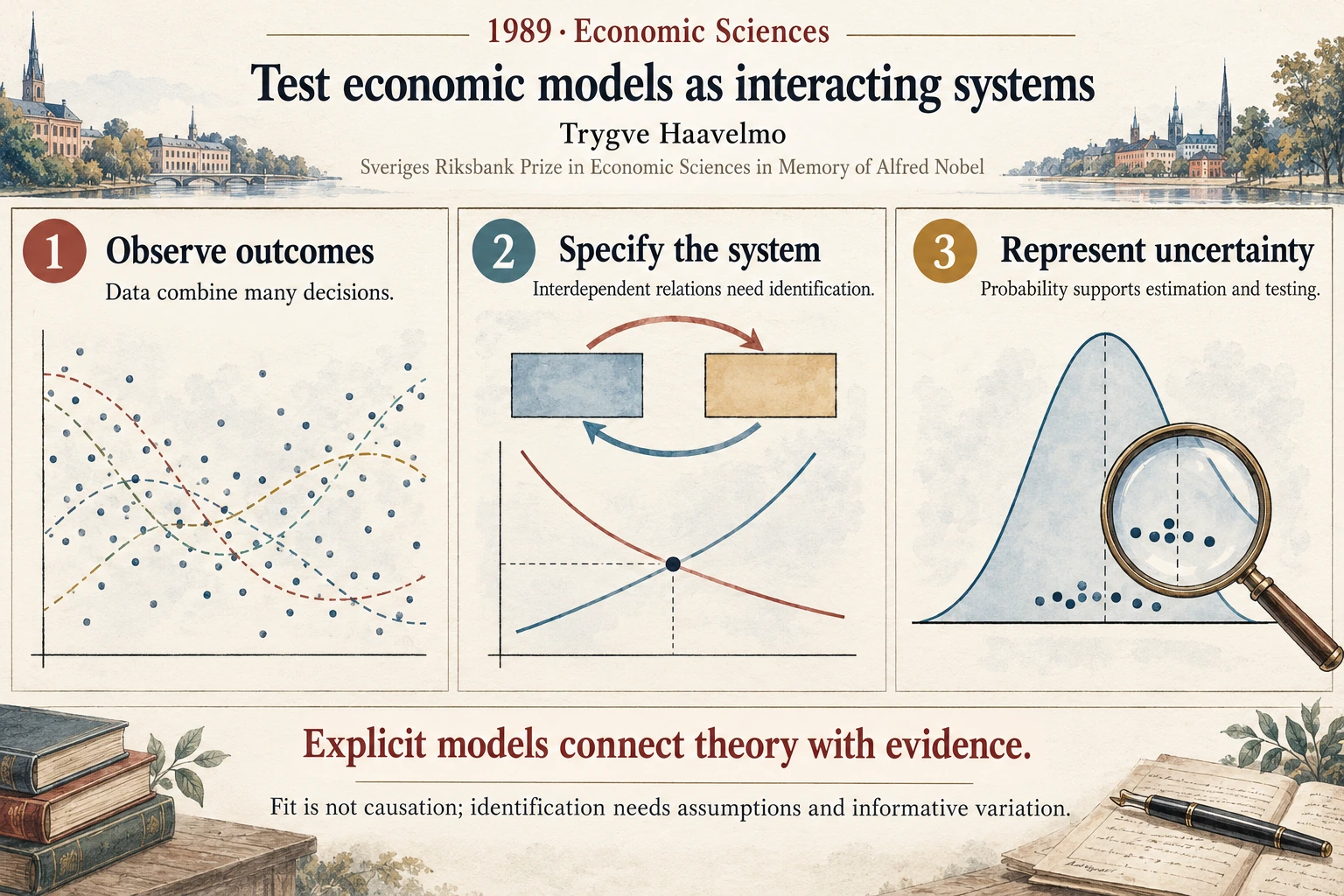
Infographic explaining Test economic models as interacting systems
Original AI-generated infographic. A conceptual overview; the explanations and sources below provide context.
Read the poster text

Explicit models connect theory with evidence.

  1. Observe outcomes

    Data combine many decisions.

  2. Specify the system

    Interdependent relations need identification.

  3. Represent uncertainty

    Probability supports estimation and testing.

Fit is not causation; identification needs assumptions and informative variation.

01 · The discovery

The idea, in everyday language

Economic data are produced by many interacting decisions, rather than by one isolated relation. A market’s observed prices and quantities reflect both supply and demand. Simply fitting a curve through those outcomes need not identify either underlying relation. Haavelmo showed why a model must specify the structure generating the observations and what information can distinguish competing explanations.

His probability approach expresses departures from a simplified theory as part of a statistical model, rather than treating all deviations as mere measurement mistakes. This makes estimation, testing and forecasting possible under explicit assumptions. His analysis of simultaneous economic structures explained why estimating one relation in isolation can be misleading when variables are jointly determined. Probability supplies a framework for uncertainty; it does not make assumptions true or predictions certain.

Why it matters

The work supplied foundations for modern econometrics and influenced research at the Cowles Commission and beyond. Haavelmo also developed investment and economic-development theory and taught generations of economists at Oslo. The Sveriges Riksbank Prize in Economic Sciences in Memory of Alfred Nobel recognised his probability foundations and analysis of simultaneous structures, not a tool that guarantees successful policy.

02 · The people

Who brought the idea to life?

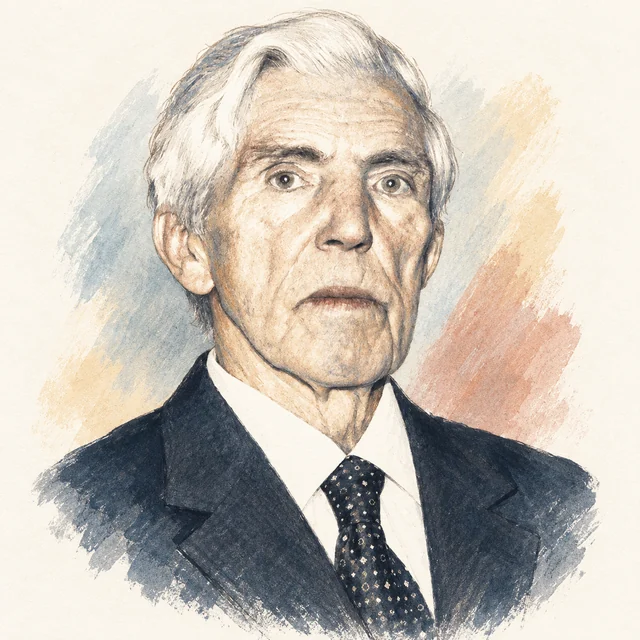
Illustrated portrait of Trygve Haavelmo

Trygve Haavelmo

Prize share · 1

Haavelmo formulated economic models as probabilistic systems so that data could support estimation and testing. He analysed how mutually dependent relations, such as supply and demand, create identification and estimation problems. Observed price–quantity pairs alone need not reveal either underlying curve. Clear structural assumptions and suitable variation are needed; fitting a line is insufficient. He received the whole Economic Sciences memorial prize for these foundations and analyses.

Read the biography ↗

03 · Years in the making

The path here

  1. 1933

    Haavelmo earns his Oslo economics degree and begins work with Frisch.

  2. 1941

    He presents the probability approach at Harvard.

  3. 1944

    The Probability Approach in Econometrics is published.

  4. 1946

    The University of Oslo awards his doctorate.

  5. 1989

    He receives the Economic Sciences memorial prize.

04 · Read further

From the original sources

Original explanations by Curionode, based on the official records below. Biographical details and affiliations refer to the award year.

  1. Official announcement nobelprize.org
  2. Official curriculum vitae nobelprize.org

More in Economic Sciences

Browse this subject ↗