01 · The discovery
The idea, in everyday language
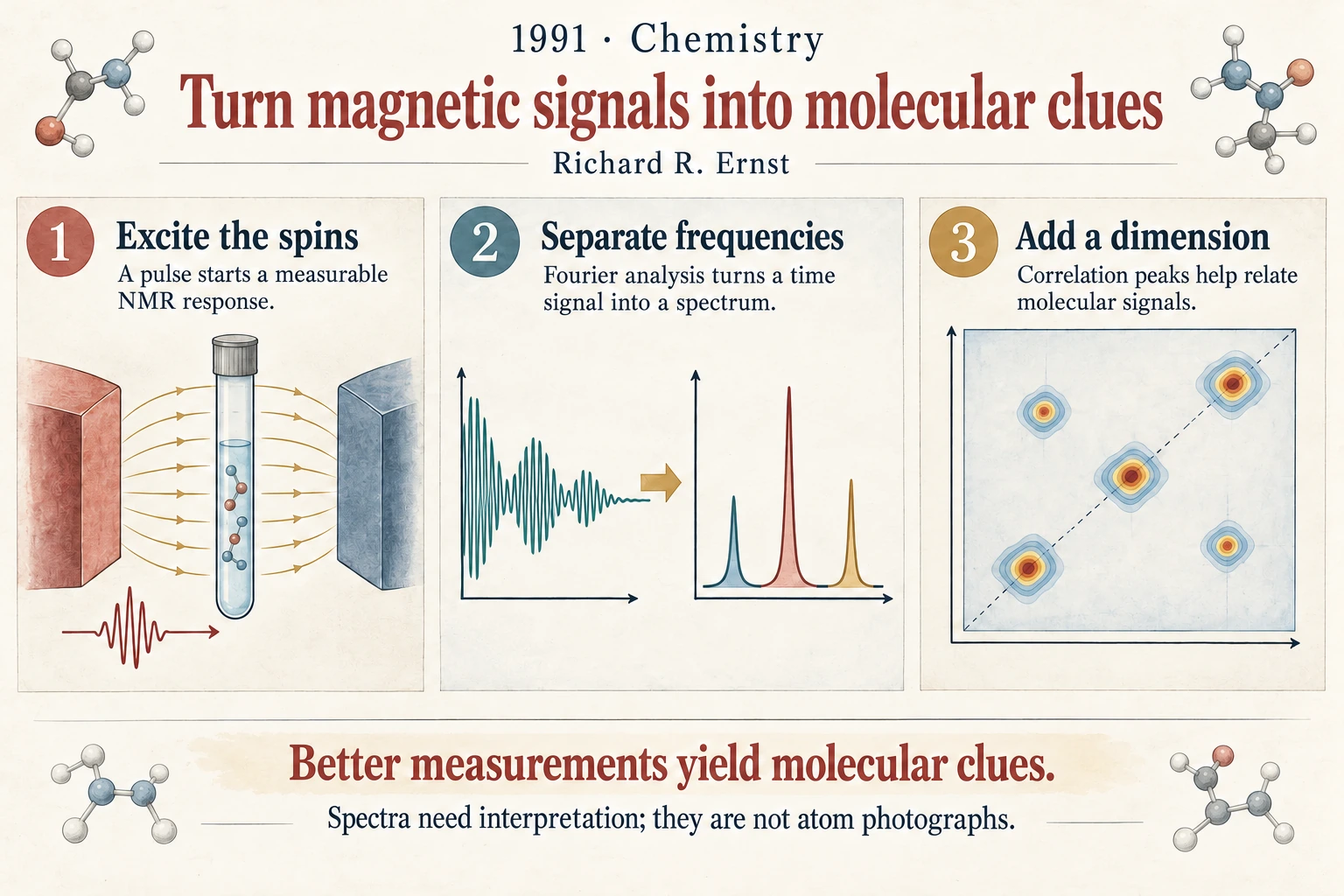
Some atomic nuclei have spin and respond to radio-frequency excitation in a magnetic field. Their resonance signals depend on the surrounding chemical environment. Early spectroscopy could be slow and limited in sensitivity. Ernst and Weston Anderson developed pulse-based Fourier-transform NMR: a short pulse excites many resonances, and a decaying time signal is mathematically transformed into a spectrum of frequencies.
Building on Jean Jeener’s proposal, Ernst and collaborators developed two-dimensional NMR. Experiments vary one time interval and record another, then use Fourier analysis in both dimensions. A spectrum with two frequency axes separates overlapping information; correlation peaks connect resonances through the particular experiment’s interactions. Together with analysis and other evidence, these measurements help infer molecular structure and motion.
Why it matters
Pulse Fourier methods made efficient data collection and signal averaging possible. Multidimensional methods greatly expanded chemical analysis and the study of biological molecules in solution. Their structural information contributed to a broader field of spectroscopy and collaborators’ work; a spectrum is evidence used to build a molecular model.