c.curionodeThe Nobel Archive

1991 · Physics

Find shared patterns in soft materials

De Gennes connected ideas about order to the behaviour of liquid crystals and long polymer chains.

soft matterliquid crystalspolymer chainsscaling
1991Physics

Visual guide

The prize, pictured

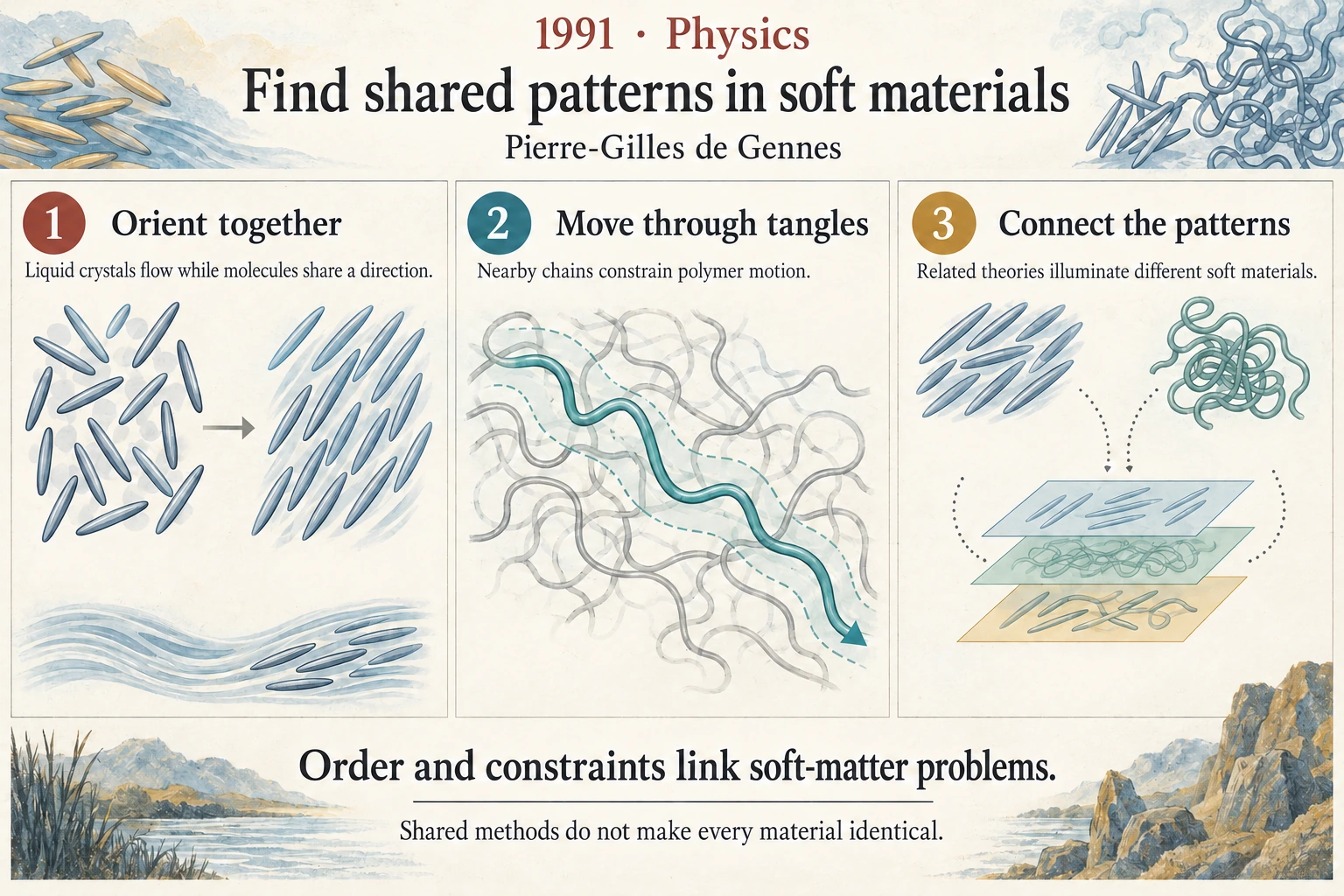
Infographic explaining Find shared patterns in soft materials
Original AI-generated infographic. A conceptual overview; the explanations and sources below provide context.
Read the poster text

Order and constraints link soft-matter problems.

  1. Orient together

    Liquid crystals flow while molecules share a direction.

  2. Move through tangles

    Nearby chains constrain polymer motion.

  3. Connect the patterns

    Related theories illuminate different soft materials.

Shared methods do not make every material identical.

01 · The discovery

The idea, in everyday language

A liquid crystal can flow while its elongated molecules share a preferred direction. A polymer is a long chain whose motion depends on other chains around it. These materials seemed very different from simpler systems used to study magnetism and superconductivity. De Gennes showed how concepts of order, fluctuations and large-scale behaviour could travel between such problems.

He developed descriptions of liquid-crystal alignment and used scaling ideas to connect polymer behaviour across length scales. For entangled chains, the surrounding chains constrain sideways motion: a chain can move more easily along a path shaped by its neighbours. This conceptual tube is a model of constraints, not a solid tube surrounding each molecule. The connections provided useful predictions while leaving each material’s details important.

Why it matters

The work gave soft-matter physics a coherent set of tools for understanding liquid crystals, plastics and complex fluids. It linked abstract theory to material properties and experiments. Practical devices depend on many additional discoveries and engineering choices; de Gennes did not invent every liquid-crystal display or polymer material.
02 · The people

Who brought the idea to life?

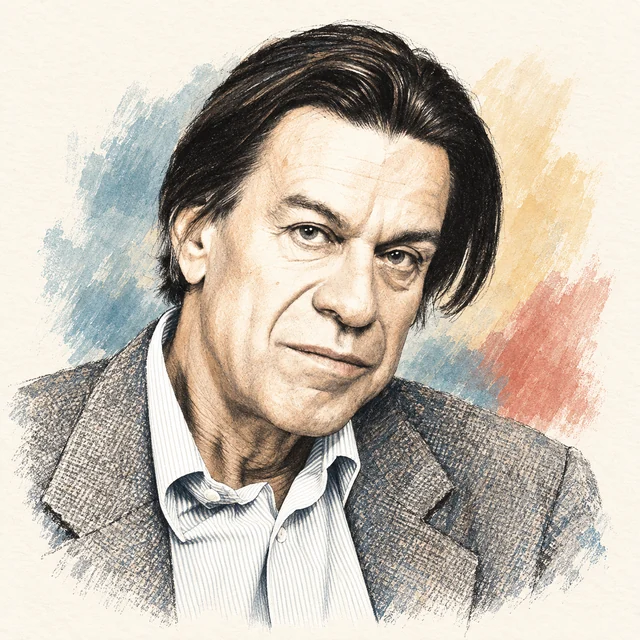
Illustrated portrait of Pierre-Gilles de Gennes

Pierre-Gilles de Gennes

Prize share · 1

De Gennes adapted ideas developed for relatively simple ordered systems to more complex materials, notably liquid crystals and polymers. He related molecular alignment to descriptions of other ordering transitions, and explained large-scale polymer behaviour using scaling and constraints from tangled chains. These were tools for finding connections across different materials, not a claim that all transitions or all molecules behave identically. He received the whole Physics Prize.

Read the biography ↗

03 · Years in the making

The path here

  1. 1968

    De Gennes turns his research toward liquid crystals.

  2. 1971

    At the Collège de France he develops research on polymers.

  3. 1979

    Scaling Concepts in Polymer Physics develops a unifying approach to long chains.

  4. 1991

    The Physics Prize recognises extensions of methods for order to liquid crystals and polymers.

04 · Read further

From the original sources

Original explanations by Curionode, based on the official records below. Biographical details and affiliations refer to the award year.

  1. Official announcement nobelprize.org