c.curionodeThe Nobel Archive

1992 · Economic Sciences

Economic choices beyond the marketplace

Becker used microeconomic models to investigate education, households, discrimination and other nonmarket behaviour.

The Sveriges Riksbank Prize in Economic Sciences in Memory of Alfred Nobel.

human capitalopportunity costnonmarket behavioureconomic models
1992Economic Sciences

Visual guide

The prize, pictured

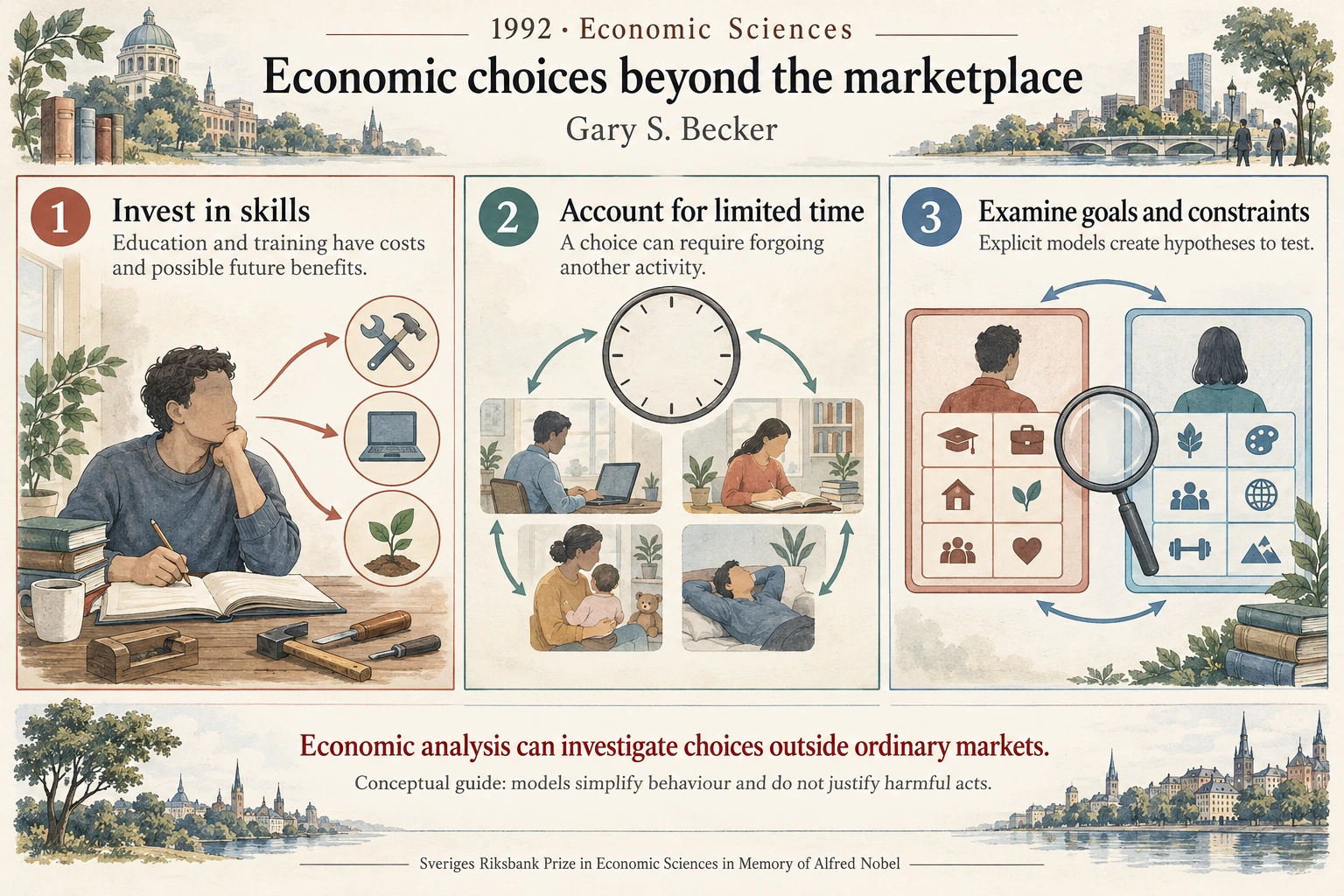
Infographic explaining Economic choices beyond the marketplace
Original AI-generated infographic. A conceptual overview; the explanations and sources below provide context.
Read the poster text

Economic analysis can investigate choices outside ordinary markets.

  1. Invest in skills

    Education and training have costs and possible future benefits.

  2. Account for limited time

    A choice can require forgoing another activity.

  3. Examine goals and constraints

    Explicit models create hypotheses to test.

Conceptual guide: models simplify behaviour and do not justify harmful acts.

01 · The discovery

The idea, in everyday language

Economic analysis had often focused on prices, firms and market exchange. Becker extended it to choices about learning, the allocation of household time, discrimination and crime. His approach made goals and constraints explicit: pursuing one activity uses resources and means forgoing another. These opportunity costs can matter even when no money changes hands.

Education and training can be analysed as investments in human capital, with costs now and possible benefits later. Household models include the time needed to produce meals, care and other activities. Models of discrimination and crime ask how incentives and constraints affect behaviour. The contribution was a research programme spanning different domains, not one equation that fully explains every person.

Why it matters

Becker broadened what economists considered legitimate research questions and helped develop empirical work on human capital and social behaviour. His models stimulated discussion across economics, sociology and demography. Making assumptions explicit provides something to investigate and challenge; the assumptions do not become facts merely because a model is mathematically clear.
02 · The people

Who brought the idea to life?

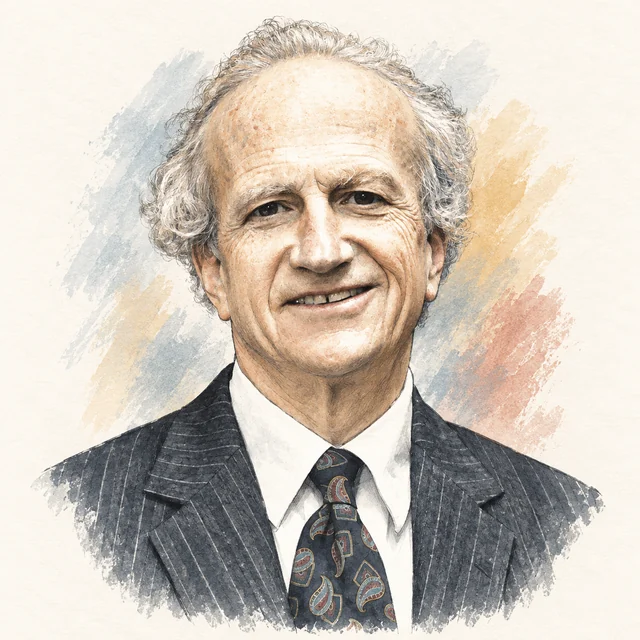
Illustrated portrait of Gary S. Becker

Gary S. Becker

Prize share · 1

Becker extended microeconomic analysis to education, family decisions, discrimination, crime and other behaviour outside ordinary markets. Models made goals, constraints, incentives and opportunity costs explicit, creating hypotheses that could be examined with evidence. This broadened economic research without proving that people always calculate perfectly or that all relationships are financial transactions. Explaining discrimination or crime through a model does not justify it morally or settle policy by itself.

Read the biography ↗

03 · Years in the making

The path here

  1. 1957

    The Economics of Discrimination applies economic analysis to prejudice and market outcomes.

  2. 1964

    Human Capital develops the analysis of education and training investments.

  3. 1965

    A study of time allocation includes the time cost of household activities.

  4. 1968

    Crime and Punishment examines behaviour under incentives and uncertainty.

  5. 1981

    A Treatise on the Family extends the analysis of household and family decisions.

  6. 1992

    The Economic Sciences memorial prize recognises the expanded scope of analysis.

04 · Read further

From the original sources

Original explanations by Curionode, based on the official records below. Biographical details and affiliations refer to the award year.

  1. Official announcement nobelprize.org

More in Economic Sciences

Browse this subject ↗