01 · The discovery
The idea, in everyday language
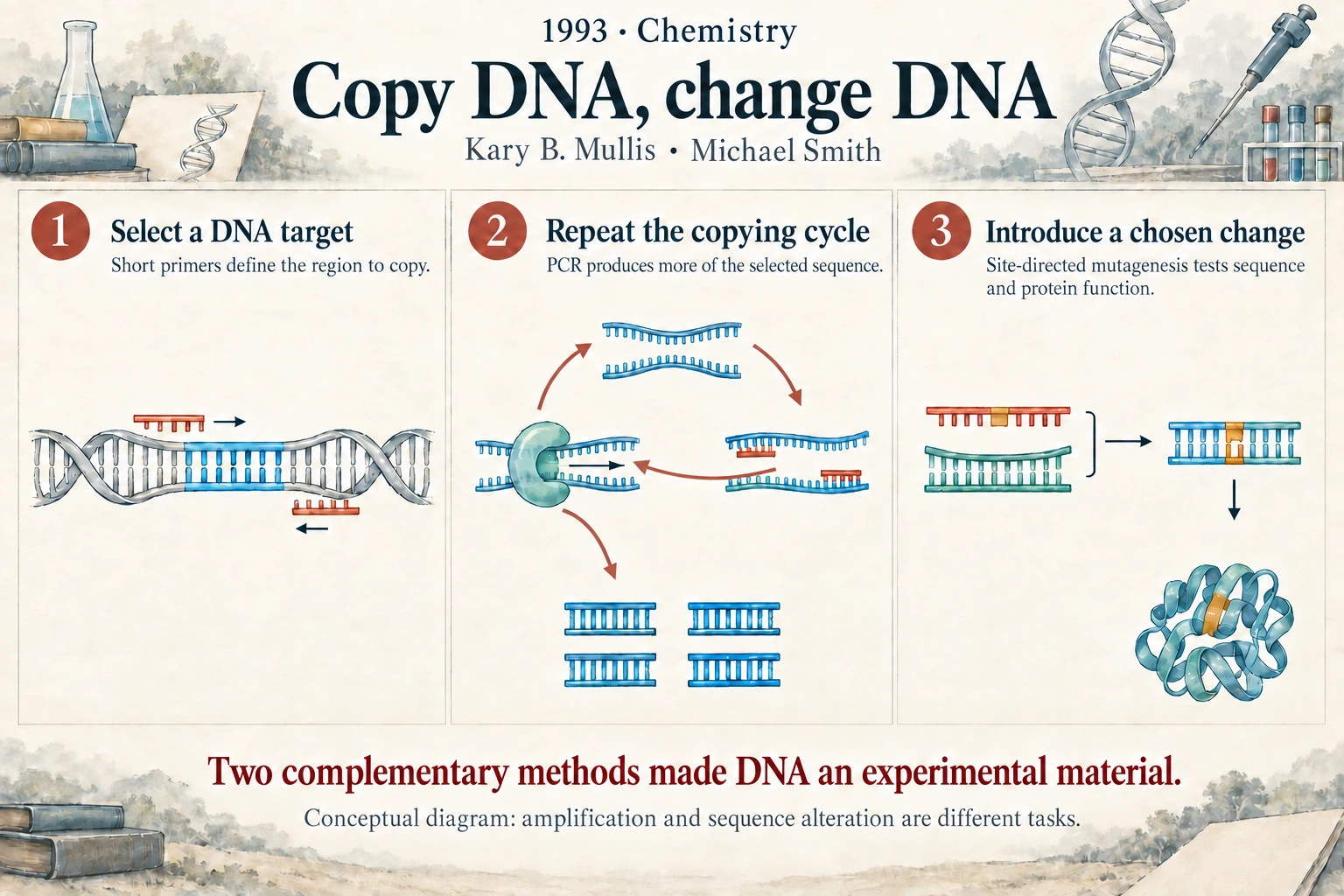
A useful DNA sample can be too scarce to analyse, and a protein’s function can be hard to explain without changing its instructions. The 1993 prize recognised two methods addressing those different problems. Mullis’s PCR uses two short primers to select a DNA region, separates strands with heat, and uses a polymerase to make new strands. Repeated cycles let new products serve as templates for further copies.
Smith’s method uses a synthetic short DNA strand carrying an intended sequence difference. It can still pair with a suitable template and direct production of DNA containing the chosen change. Expressing an altered gene then lets researchers investigate how a selected change affects a protein. Amplification increases material; mutagenesis changes a sequence. Neither operation by itself explains every consequence.
Why it matters
The methods transformed research on genes and proteins, enabling analysis from small DNA samples and controlled tests of molecular function. Their development involved collaborators and later improvements, including more practical PCR cycling. They became foundations for many laboratory applications rather than complete answers to every biological question.