01 · The discovery
The idea, in everyday language
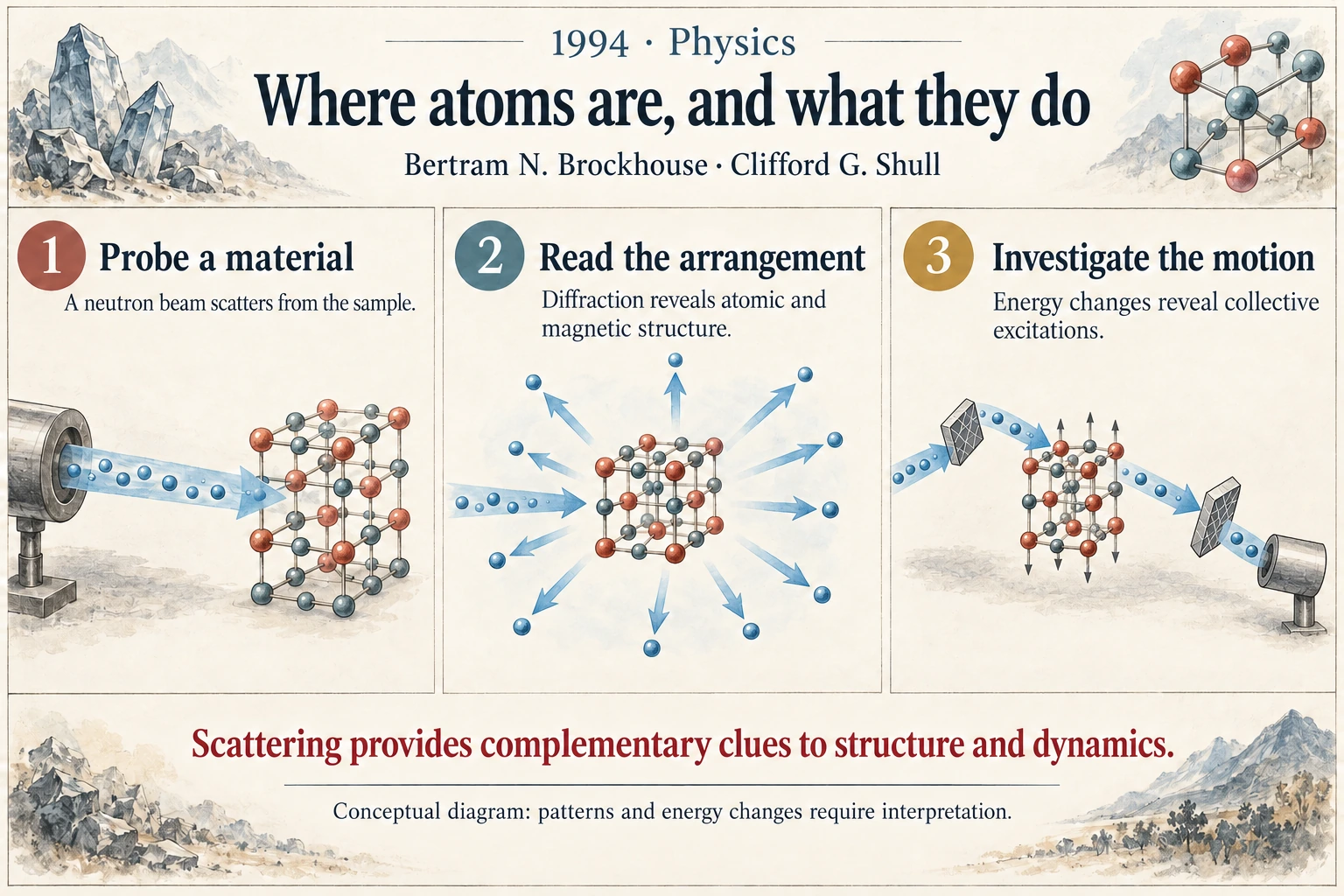
A material’s properties depend on how its atoms are arranged and how they move together. Neutrons can probe both questions. When a beam meets a sample, the directions in which neutrons scatter carry information about structure. Shull developed diffraction methods that made these patterns interpretable, including ways to locate hydrogen and investigate magnetic ordering.
Brockhouse developed the complementary study of energy changes. Inelastic scattering can transfer energy between neutrons and collective excitations in the sample, such as vibrations called phonons. His triple-axis spectrometer selects incoming neutron energies, scatters them from a sample and analyses their outgoing energies. Together these techniques made neutron beams powerful tools for condensed-matter research, rather than merely a source of nuclear reactions.
Why it matters
The methods opened ways to study crystals, liquids, magnetic materials, polymers and biological structures. They connect microscopic organisation and collective motion to material properties. Later instruments and sources extended the reach of this work; the prize recognises the pioneering methods rather than every later application.