c.curionodeThe Nobel Archive

1999 · Chemistry

Timing the moment a bond changes

Zewail used ultrashort laser pulses to follow chemical reactions as atoms rearranged, opening the field of femtochemistry.

femtochemistrypump–probelaser pulsesreaction dynamics
1999Chemistry

Visual guide

The prize, pictured

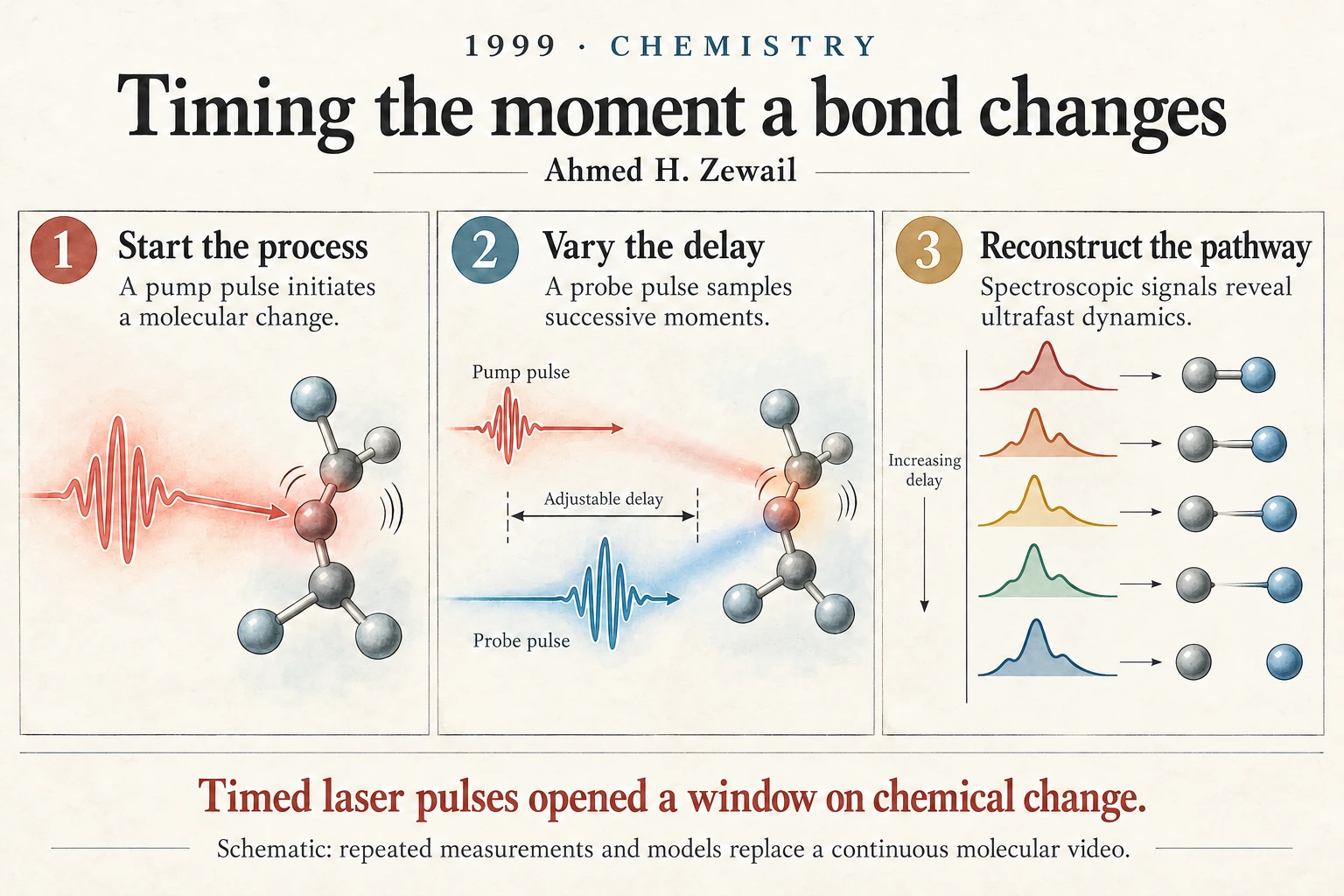
Infographic explaining Timing the moment a bond changes
Original AI-generated infographic. A conceptual overview; the explanations and sources below provide context.
Read the poster text

Timed laser pulses opened a window on chemical change.

  1. Start the process

    A pump pulse initiates a molecular change.

  2. Vary the delay

    A probe pulse samples successive moments.

  3. Reconstruct the pathway

    Spectroscopic signals reveal ultrafast dynamics.

Schematic: repeated measurements and models replace a continuous molecular video.

01 · The discovery

The idea, in everyday language

Knowing the ingredients and products does not reveal the route between them. The decisive rearrangements in a reaction can occur on the timescale of atomic vibrations, far faster than ordinary instruments resolve. Chemical kinetics could describe overall rates while leaving the fleeting steps around a transition state inaccessible to direct time-resolved investigation.

Zewail’s pump–probe method uses one pulse to initiate a process and another to interrogate it after a controlled delay. Repeating this at different delays reconstructs changes from spectroscopic signals. Experiments in the late 1980s resolved bond breaking and short-lived configurations, allowing researchers to distinguish possible reaction pathways rather than infer everything from final products.

Why it matters

Femtochemistry made reaction dynamics experimentally accessible. It helped investigate bond breaking, intermediates, energy flow and light-induced structural changes across gases, liquids and other systems. Understanding mechanisms can inform control of reactions, but practical improvements depend on the particular chemical system and experimental conditions.

02 · The people

Who brought the idea to life?

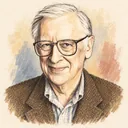
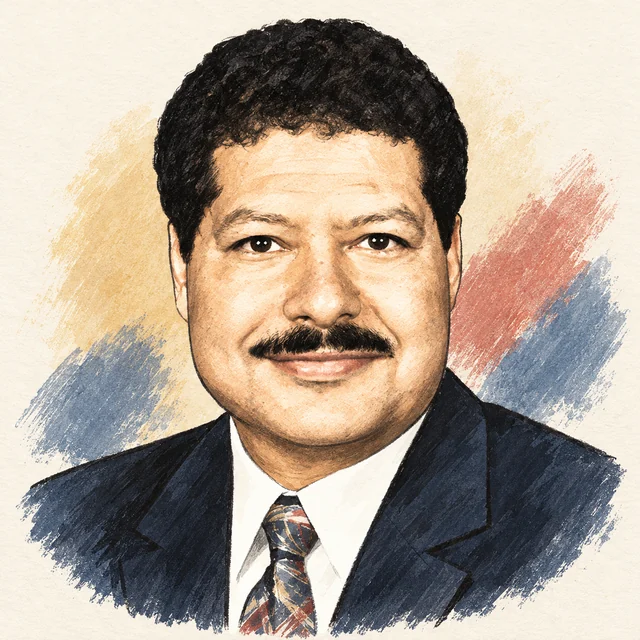
Illustrated portrait of Ahmed H. Zewail

Ahmed H. Zewail

Prize share · 1/1

Zewail developed femtosecond pump–probe experiments that followed chemical reactions on the timescale of atomic motion. An initial laser pulse starts a process; a second pulse probes it after a controlled delay. Repeating the experiment at different delays reveals short-lived configurations and reaction pathways through their spectroscopic signals. His late-1980s work established femtochemistry as a way to investigate transition-state dynamics.

Read the biography ↗

03 · Years in the making

The path here

  1. 1976

    Zewail joined Caltech.

  2. 1980s

    Late-decade experiments established femtosecond investigation of reaction dynamics.

  3. 1999

    The Chemistry Prize recognized transition-state studies using femtosecond spectroscopy.

04 · Read further

From the original sources

Original explanations by Curionode, based on the official records below. Biographical details and affiliations refer to the award year.

  1. Official announcement nobelprize.org

More in Chemistry

Browse this subject ↗