c.curionodeThe Nobel Archive

1999 · Economic Sciences

Policy choices when money crosses borders

Mundell explained how exchange-rate arrangements shape economic policy and when regions might share a currency.

The Sveriges Riksbank Prize in Economic Sciences in Memory of Alfred Nobel.

exchange ratescapital mobilityoptimum currency areasmonetary policy
1999Economic Sciences

Visual guide

The prize, pictured

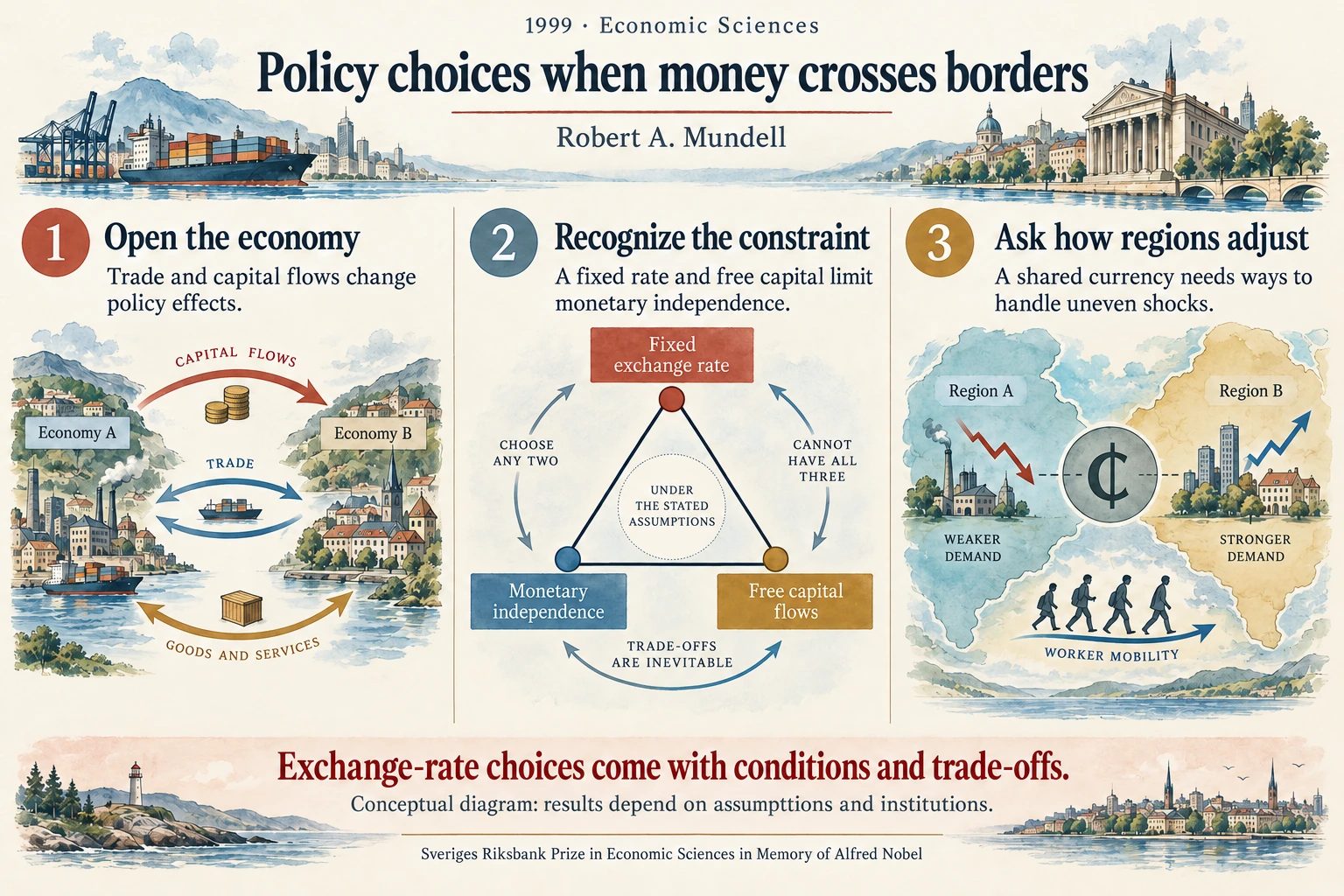
Infographic explaining Policy choices when money crosses borders
Original AI-generated infographic. A conceptual overview; the explanations and sources below provide context.
Read the poster text

Exchange-rate choices come with conditions and trade-offs.

  1. Open the economy

    Trade and capital flows change policy effects.

  2. Recognize the constraint

    A fixed rate and free capital limit monetary independence.

  3. Ask how regions adjust

    A shared currency needs ways to handle uneven shocks.

Conceptual diagram: results depend on assumptions and institutions.

01 · The discovery

The idea, in everyday language

An economy that trades and exchanges capital with others cannot be analyzed as a closed box. Mundell showed how the effects of monetary and fiscal policy depend on whether exchange rates are fixed or floating and on how readily capital moves. In a simplified setting with highly mobile capital, defending a fixed exchange rate restricts monetary independence; a floating rate changes how policy influences demand and net exports.

His optimum-currency-area analysis asked a second question: when might different regions benefit from one currency? Lower exchange costs and less currency uncertainty must be weighed against the loss of separate exchange-rate adjustments. If regions face different shocks, the ability of workers to move and other adjustment mechanisms become central. The point is to identify conditions and trade-offs, rather than treat borders as an automatic guide to currency design.

Why it matters

The work reshaped international macroeconomics and informed debates about exchange-rate regimes, stabilization policy and currency unions. The incompatible trinity—fixed exchange rate, free capital movement and independent monetary policy—clarifies a recurring policy constraint. The framework helps organize questions; real outcomes depend on institutions, expectations and the specific shock.

02 · The people

Who brought the idea to life?

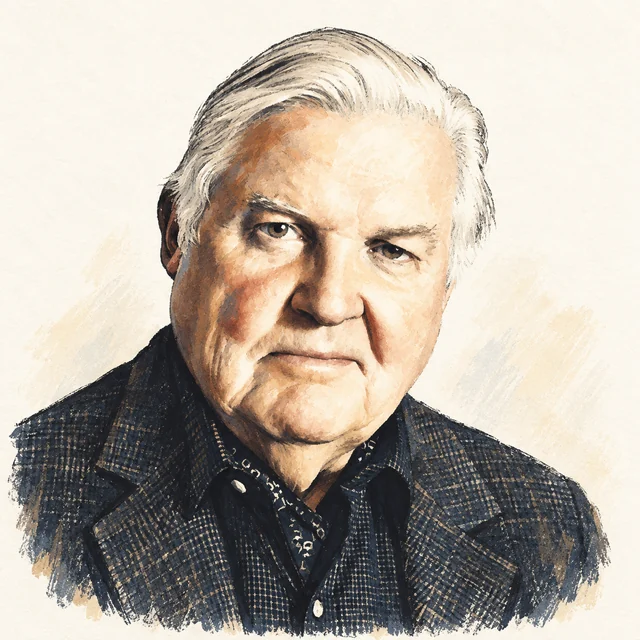
Illustrated portrait of Robert A. Mundell

Robert A. Mundell

Prize share · 1/1

Mundell analyzed how monetary and fiscal policy work under fixed and floating exchange rates and different degrees of capital mobility. He also developed the theory of optimum currency areas, asking when regions might benefit from sharing a currency and how they could adjust to uneven shocks. These were conditional analytical frameworks, not a claim that one exchange-rate system or currency union is best for every economy.

Read the biography ↗

03 · Years in the making

The path here

  1. 1961

    Mundell published his analysis of optimum currency areas.

  2. 1963

    He analyzed stabilization policy under fixed and flexible exchange rates with capital mobility.

  3. 1999

    The prize recognized both exchange-rate policy analysis and optimum currency areas.

04 · Read further

From the original sources

Original explanations by Curionode, based on the official records below. Biographical details and affiliations refer to the award year.

  1. Official announcement nobelprize.org

More in Economic Sciences

Browse this subject ↗