c.curionodeThe Nobel Archive

2001 · Economic Sciences

When one side knows more

Unequal information changes markets—and explains why signals, screening and institutions matter.

The Sveriges Riksbank Prize in Economic Sciences in Memory of Alfred Nobel.

asymmetric informationadverse selectionsignallingscreening
2001Economic Sciences

Visual guide

The prize, pictured

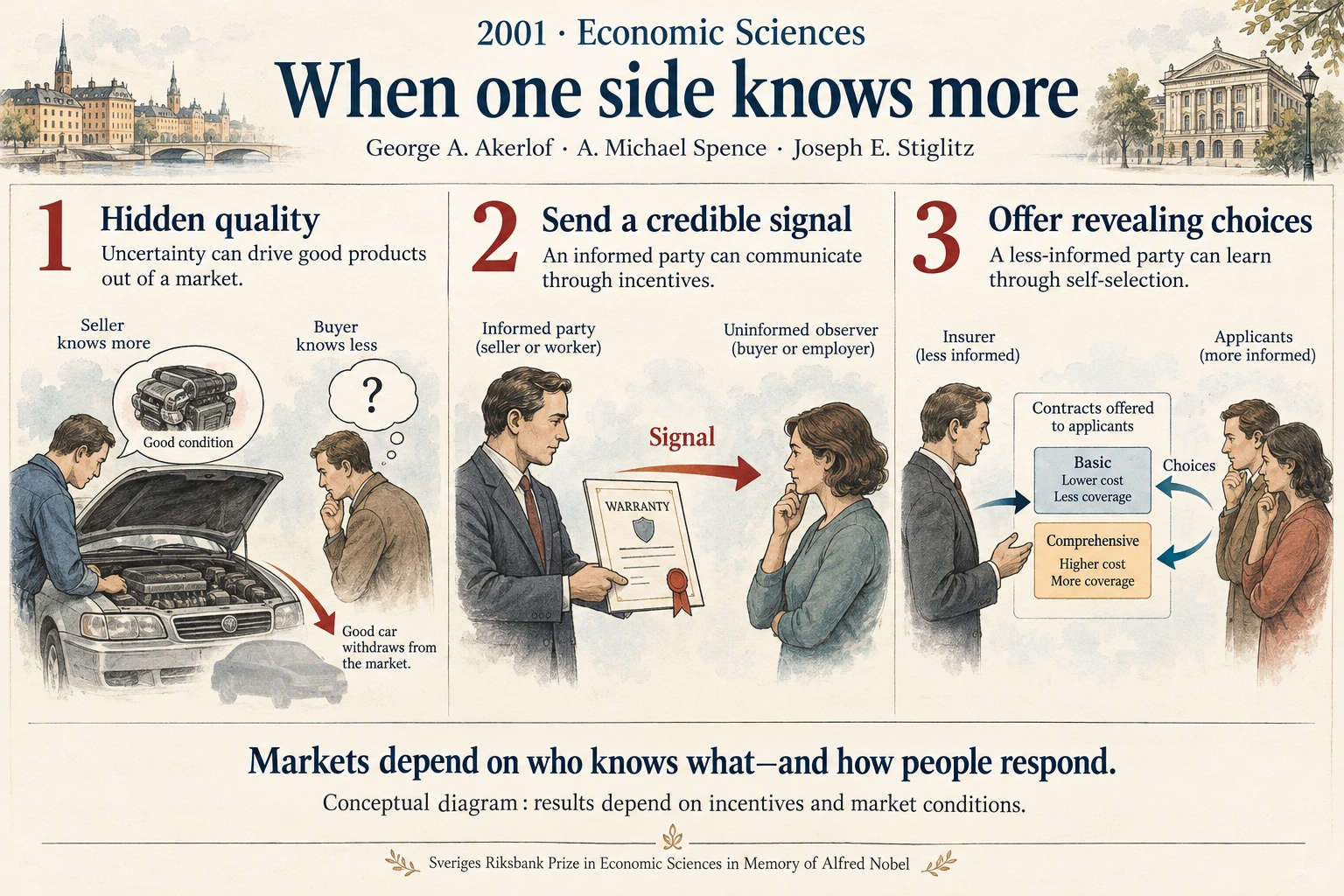
Infographic explaining When one side knows more
Original AI-generated infographic. A conceptual overview; the explanations and sources below provide context.
Read the poster text

Markets depend on who knows what—and how people respond.

  1. Hidden quality

    Uncertainty can drive good products out of a market.

  2. Send a credible signal

    An informed party can communicate through incentives.

  3. Offer revealing choices

    A less-informed party can learn through self-selection.

Conceptual diagram: results depend on incentives and market conditions.

01 · The discovery

The idea, in everyday language

A seller may know more about a product’s quality than a buyer. Akerlof showed how this can discourage good-quality sellers and make trade less effective: the buyer’s uncertainty changes the price, which changes who is willing to sell. His used-car example revealed a general mechanism called adverse selection.

Spence studied signalling: a better-informed party takes an action that can credibly convey a hidden characteristic. Stiglitz and collaborators studied screening: the less-informed party offers choices designed to reveal information through self-selection. These approaches made information and incentives part of the explanation of how markets work, rather than assuming everyone already knows the relevant facts.

Why it matters

The theories changed the analysis of insurance, employment, credit and many other markets. They help explain institutions such as warranties, credentials and contract menus, as well as situations where trade is limited despite potential gains. They also show why policy analysis must consider who knows what and how a rule changes incentives.


02 · The people

Who brought the idea to life?

Illustrated portrait of George A. Akerlof

George A. Akerlof

Prize share · 1/3

Akerlof showed how hidden quality can undermine mutually beneficial trade. If a buyer cannot distinguish a reliable used car from a defective one, the offered price may reflect average quality. Owners of better cars may then withdraw, lowering the quality of what remains. This adverse-selection mechanism explains why information gaps matter and why warranties, reputation or certification can become valuable. Market breakdown is a possible outcome under particular conditions, not a prediction for every market.

Read the biography ↗
Illustrated portrait of A. Michael Spence

A. Michael Spence

Prize share · 1/3

Spence analysed market signalling, using education and hiring as an influential example. An action can reveal a hidden characteristic when its costs or benefits differ across types of people, making imitation less attractive for some than for others. A signal is not credible merely because it is expensive. His theory explains one possible informational role of education; it does not establish that education never develops useful skills.

Read the biography ↗
Illustrated portrait of Joseph E. Stiglitz

Joseph E. Stiglitz

Prize share · 1/3

Stiglitz and collaborators analysed how a less-informed party can learn from the choices offered to a better-informed one. In work with Michael Rothschild, insurance contracts with different combinations of coverage and cost helped reveal different risks through self-selection. Other work explored information problems in credit and labour markets. Screening can improve information, but its consequences depend on incentives and market structure; it does not automatically produce a fully efficient outcome.

Read the biography ↗

03 · Years in the making

The path here

  1. 1970

    Akerlof published the market-for-lemons analysis.

  2. 1973

    Spence published his analysis of job-market signalling.

  3. 2001

    The prize recognised analyses of markets with asymmetric information.

04 · Read further

From the original sources

Original explanations by Curionode, based on the official records below. Biographical details and affiliations refer to the award year.

  1. Official announcement nobelprize.org
  2. Popular science background nobelprize.org

More in Economic Sciences

Browse this subject ↗