01 · The discovery
The idea, in everyday language
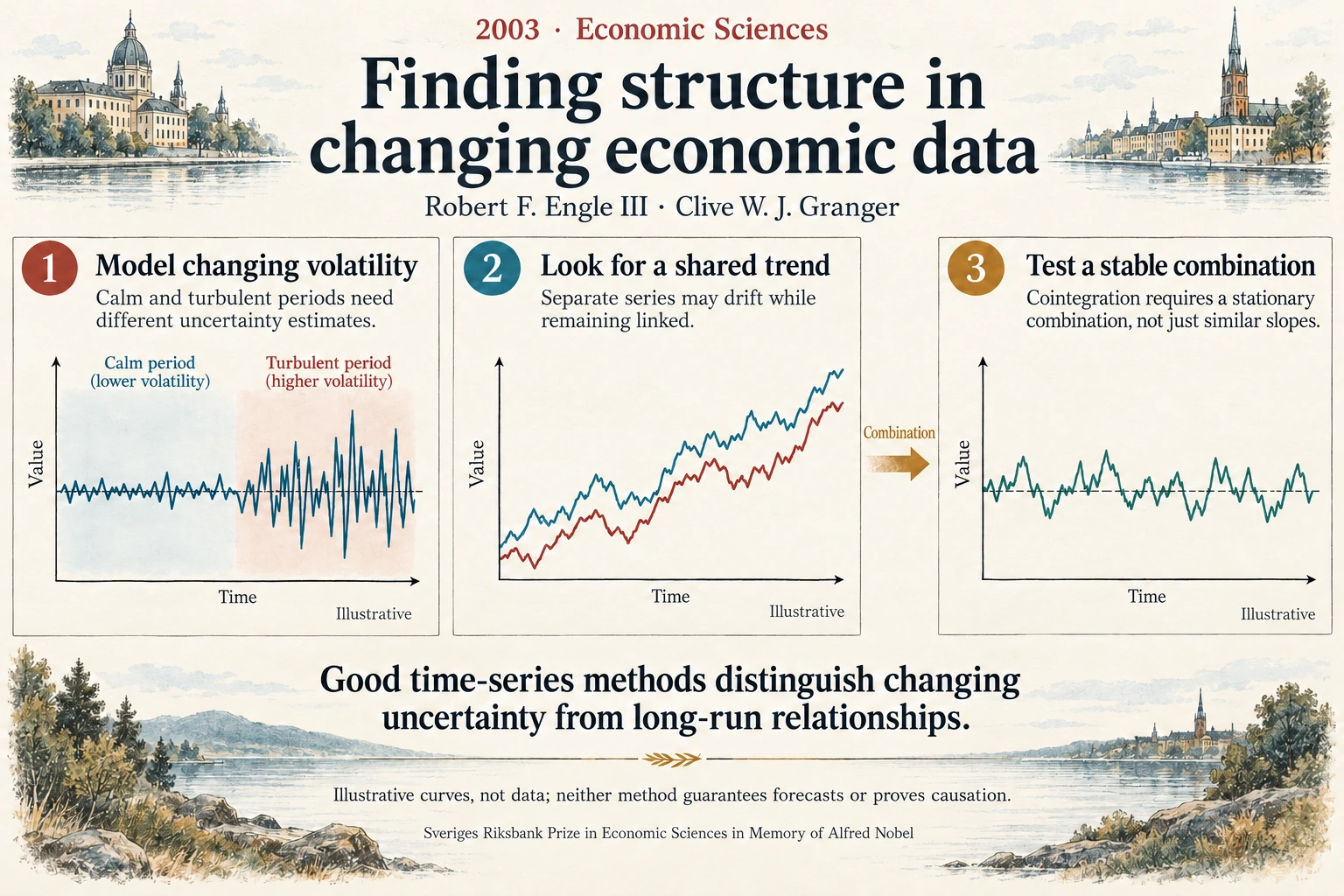
Economic observations arrive in time order, and their statistical behaviour is rarely uniform. A financial series may alternate between calm and turbulent periods. Another series may drift so that a shock changes its level for a long time. Applying methods that assume stable variation and a fixed mean can produce misleading confidence or apparent relationships between unrelated variables.
Engle’s ARCH framework lets the conditional variance of a model’s errors change in response to earlier surprises. Granger’s cointegration framework asks whether a particular linear combination of individually nonstationary series is stationary. Such a combination can describe a long-run relationship while an error-correction model describes short-run departures and adjustment. The two contributions solve different problems and can be useful together.
Why it matters
The methods changed how researchers estimate dynamic relationships and assess uncertainty. Volatility models support risk measurement, while cointegration helps preserve information about long-run relationships that can disappear when only period-to-period changes are studied. Their value lies in testing assumptions and making models fit the behaviour of data more closely.