01 · The discovery
The idea, in everyday language
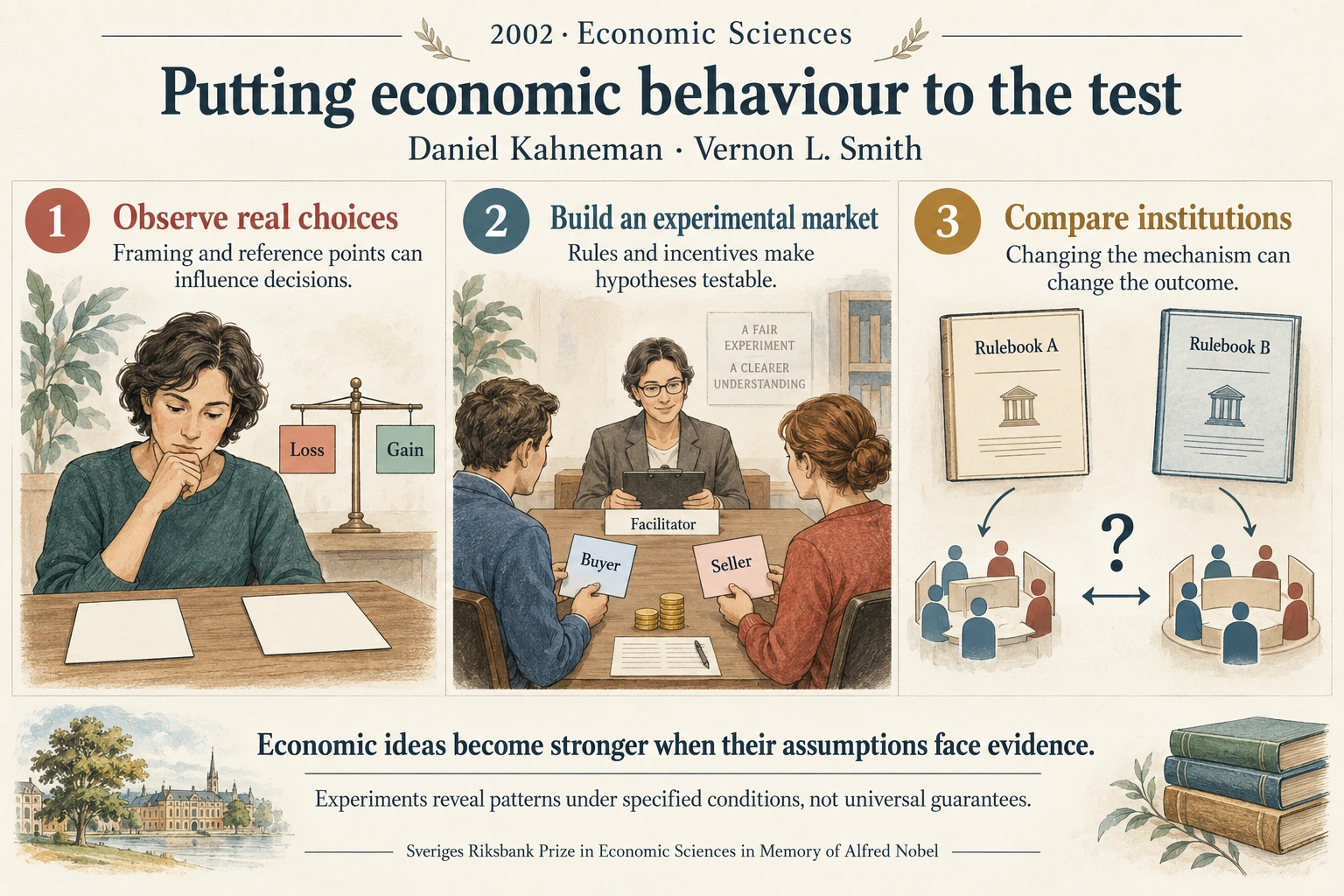
Economic models often begin with assumptions about how people evaluate choices. Kahneman, working closely with Amos Tversky, used psychological experiments to examine those assumptions. Their research showed systematic effects of mental shortcuts, reference points and framing. Prospect theory described choices under risk in ways that could account for patterns standard expected-utility models struggled to explain.
Smith approached economic behaviour through controlled markets. Participants became buyers and sellers under specified rules and incentives, allowing researchers to compare outcomes with theory and vary the institution itself. Some markets coordinated prices remarkably well even when no participant knew the whole situation. Other experiments showed that changing the trading rules could change the outcome.
Why it matters
The contributions widened the evidence used in economics. Psychology helped explain recurring departures from idealised choice, while market experiments made institutional design open to controlled comparison. Their influence reaches research on auctions, market rules and decision-making. Together they encouraged economists to ask which assumptions work, under what conditions, and what changes when people or institutions behave differently.