c.curionodeThe Nobel Archive

2005 · Economic Sciences

Why rivals sometimes cooperate

Game theory examines how commitments, expectations and future encounters change choices.

The Sveriges Riksbank Prize in Economic Sciences in Memory of Alfred Nobel.

game theoryrepeated gamescommitmentcoordination
2005Economic Sciences

Visual guide

The prize, pictured

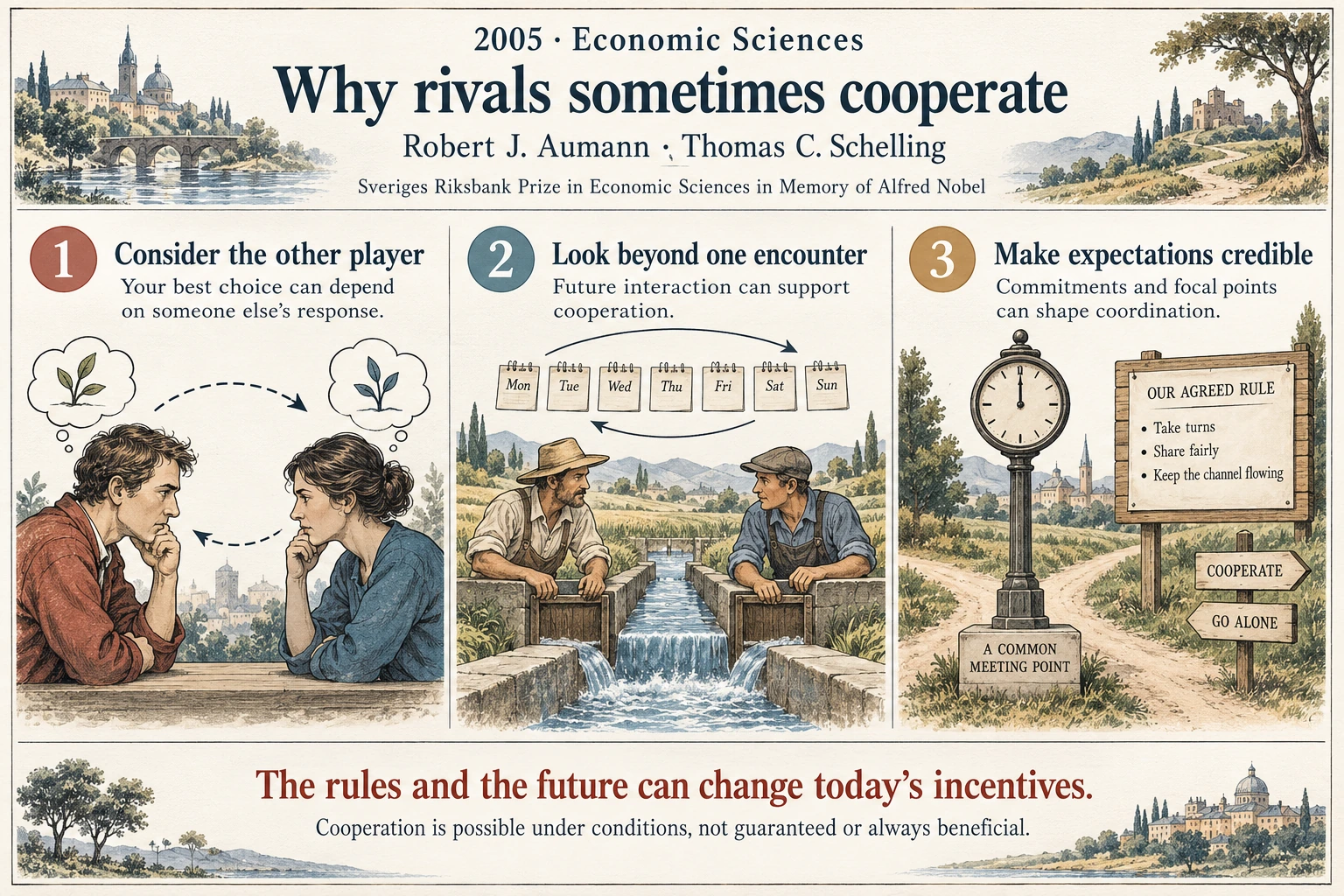
Infographic explaining Why rivals sometimes cooperate
Original AI-generated infographic. A conceptual overview; the explanations and sources below provide context.
Read the poster text

The rules and the future can change today’s incentives.

  1. Consider the other player

    Your best choice can depend on someone else’s response.

  2. Look beyond one encounter

    Future interaction can support cooperation.

  3. Make expectations credible

    Commitments and focal points can shape coordination.

Cooperation is possible under conditions, not guaranteed or always beneficial.

01 · The discovery

The idea, in everyday language

When the outcome depends on what several people do, choosing well means considering their choices too. Schelling showed how a credible commitment can change another party’s expectations, and how a shared focal point can help people coordinate even without an explicit agreement. An option that looks attractive in isolation may become less useful once others respond to it.

Aumann analysed repeated interaction mathematically. If participants expect to meet again, the future consequences of breaking an agreement may outweigh a short-term gain. Cooperation can therefore be sustained under conditions involving patience, information and credible responses. His work also examined what happens when people have different information and different knowledge about one another.

Why it matters

These ideas made strategic interaction a common framework across economics and other social sciences. They help analyse bargaining, international agreements, shared resources and institutional rules. Schelling also showed how simple individual preferences can produce surprising collective patterns, while Aumann clarified the conditions behind possible long-run outcomes.

02 · The people

Who brought the idea to life?

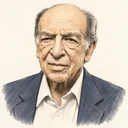
Illustrated portrait of Robert J. Aumann

Robert J. Aumann

Prize share · 1/2

Aumann developed rigorous analysis of repeated games: situations in which the same participants interact again and again. The prospect of future rewards or responses can make cooperation sustainable even when a one-off encounter creates incentives to defect. His work also addressed incomplete information, common knowledge and correlated equilibrium. Cooperation is a possible outcome under specified conditions, not an automatic result of repetition.

Read the biography ↗
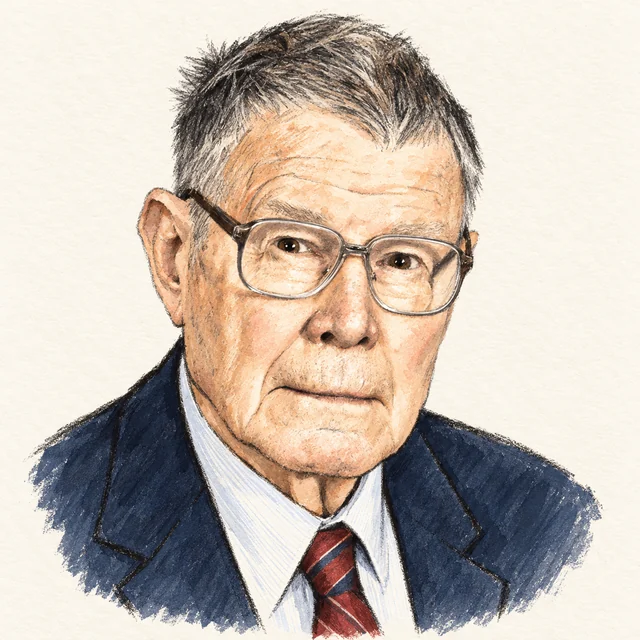
Illustrated portrait of Thomas C. Schelling

Thomas C. Schelling

Prize share · 1/2

In The Strategy of Conflict, published in 1960, Schelling showed how commitments, expectations and shared points of reference shape strategic interaction. Sometimes restricting one’s own options can make a promise credible; sometimes a focal point helps people coordinate without communication. His work also showed how individual preferences can create unexpected collective patterns. These are analytical insights, not a general claim that threats or inflexibility always improve an outcome.

Read the biography ↗

03 · Years in the making

The path here

  1. 1960

    Schelling published The Strategy of Conflict, developing ideas about commitment and coordination.

  2. 1960s

    Aumann advanced the analysis of repeated games and interaction with incomplete information.

  3. 2005

    The memorial prize recognised their contributions to understanding conflict and cooperation.

04 · Read further

From the original sources

Original explanations by Curionode, based on the official records below. Biographical details and affiliations refer to the award year.

  1. Official announcement nobelprize.org
  2. Popular science background nobelprize.org

More in Economic Sciences

Browse this subject ↗