c.curionodeThe Nobel Archive

2007 · Economic Sciences

Designing rules when information is private

Mechanism design asks which rules can achieve an objective when people respond to incentives.

The Sveriges Riksbank Prize in Economic Sciences in Memory of Alfred Nobel.

mechanism designincentive compatibilityprivate information
2007Economic Sciences

Visual guide

The prize, pictured

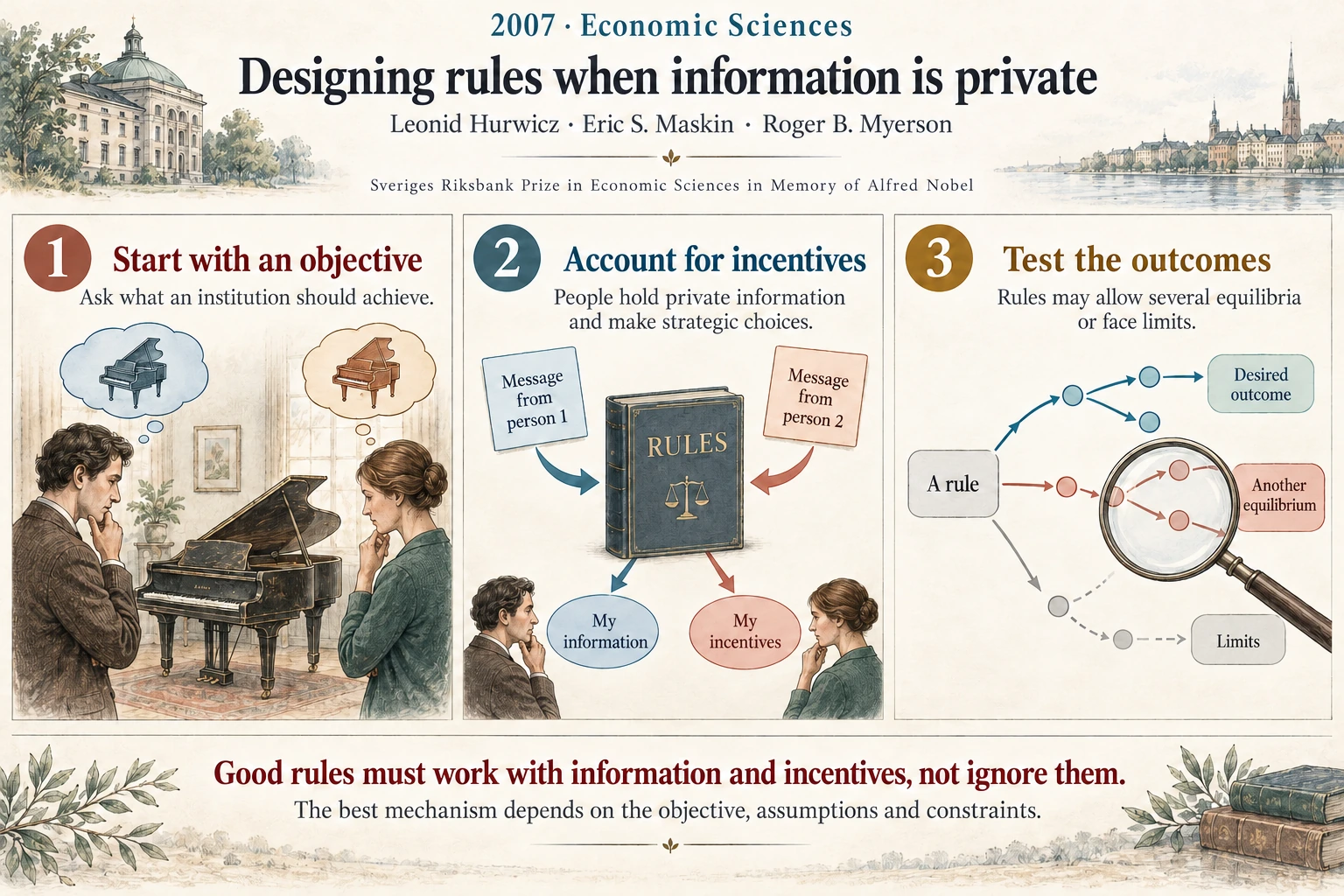
Infographic explaining Designing rules when information is private
Original AI-generated infographic. A conceptual overview; the explanations and sources below provide context.
Read the poster text

Good rules must work with information and incentives, not ignore them.

  1. Start with an objective

    Ask what an institution should achieve.

  2. Account for incentives

    People hold private information and make strategic choices.

  3. Test the outcomes

    Rules may allow several equilibria or face limits.

The best mechanism depends on the objective, assumptions and constraints.

01 · The discovery

The idea, in everyday language

An ordinary economic model may start with the rules and ask what people will do. Mechanism design begins with a goal and works backward: which rules could bring it about? The difficulty is that participants know things a designer does not, such as their willingness to pay or the cost of producing a good. They may have reasons to misrepresent that information.

Hurwicz made information and incentives part of the formal design problem. Myerson developed tools, including the revelation principle, that make it possible to analyse suitable truthful-reporting mechanisms. Maskin studied implementation: can the rules support the intended outcomes without also leaving undesirable equilibria? Together these ideas let researchers study what institutions can achieve, and which combinations of goals are impossible under specified conditions.

Why it matters

The theory supplies a common framework for auctions, regulation, public projects and voting. It distinguishes different objectives, such as efficient allocation and a seller’s revenue, instead of treating them as the same thing. It also lets economists compare a proposed institution with the best achievable outcome under its informational and strategic constraints.
02 · The people

Who brought the idea to life?

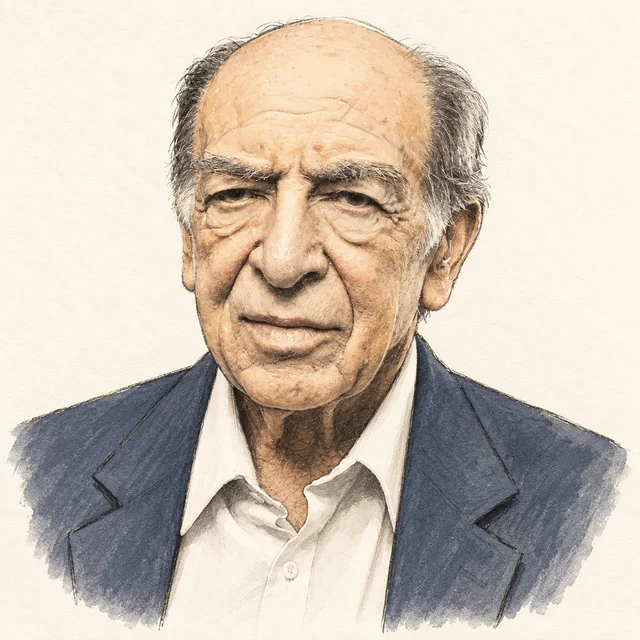
Illustrated portrait of Leonid Hurwicz

Leonid Hurwicz

Prize share · 1/3

Hurwicz formulated mechanisms as systems of messages and rules that assign outcomes. He introduced incentive compatibility: a proposed arrangement must take account of what participants find it worthwhile to reveal or do. This made it possible to compare institutions while acknowledging dispersed information and self-interest, rather than assuming a planner already knows everyone’s preferences.

Read the biography ↗
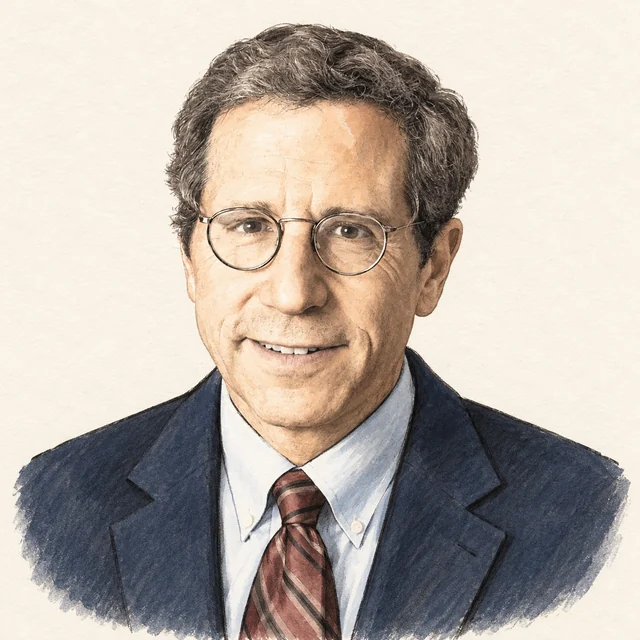
Illustrated portrait of Eric S. Maskin

Eric S. Maskin

Prize share · 1/3

Maskin developed implementation theory, asking when a set of rules can make the desired outcomes emerge as equilibria. One satisfactory outcome is not enough if the same rules also allow other, undesirable equilibria. His work identified conditions under which objectives can be implemented and helped turn mechanism design into a theory of both possibilities and limits.

Read the biography ↗
Illustrated portrait of Roger B. Myerson

Roger B. Myerson

Prize share · 1/3

Myerson developed the revelation principle in a broad form and used it to study auctions and regulation. It lets a researcher analyse suitable mechanisms in which truthful reporting is an equilibrium, rather than examine every complicated bargaining procedure separately. His work also exposed limits: under standard private-information and voluntary-trade conditions, a mechanism cannot always realise every possible gain from exchange.

Read the biography ↗

03 · Years in the making

The path here

  1. 1960

    Hurwicz formalised the study of mechanisms and their informational requirements.

  2. 1970s

    Incentive compatibility, revelation methods and implementation theory advanced the field.

  3. 2007

    The prize recognised the foundations of mechanism design theory.

04 · Read further

From the original sources

Original explanations by Curionode, based on the official records below. Biographical details and affiliations refer to the award year.

  1. Official announcement nobelprize.org
  2. Popular science background nobelprize.org

More in Economic Sciences

Browse this subject ↗