01 · The discovery
The idea, in everyday language
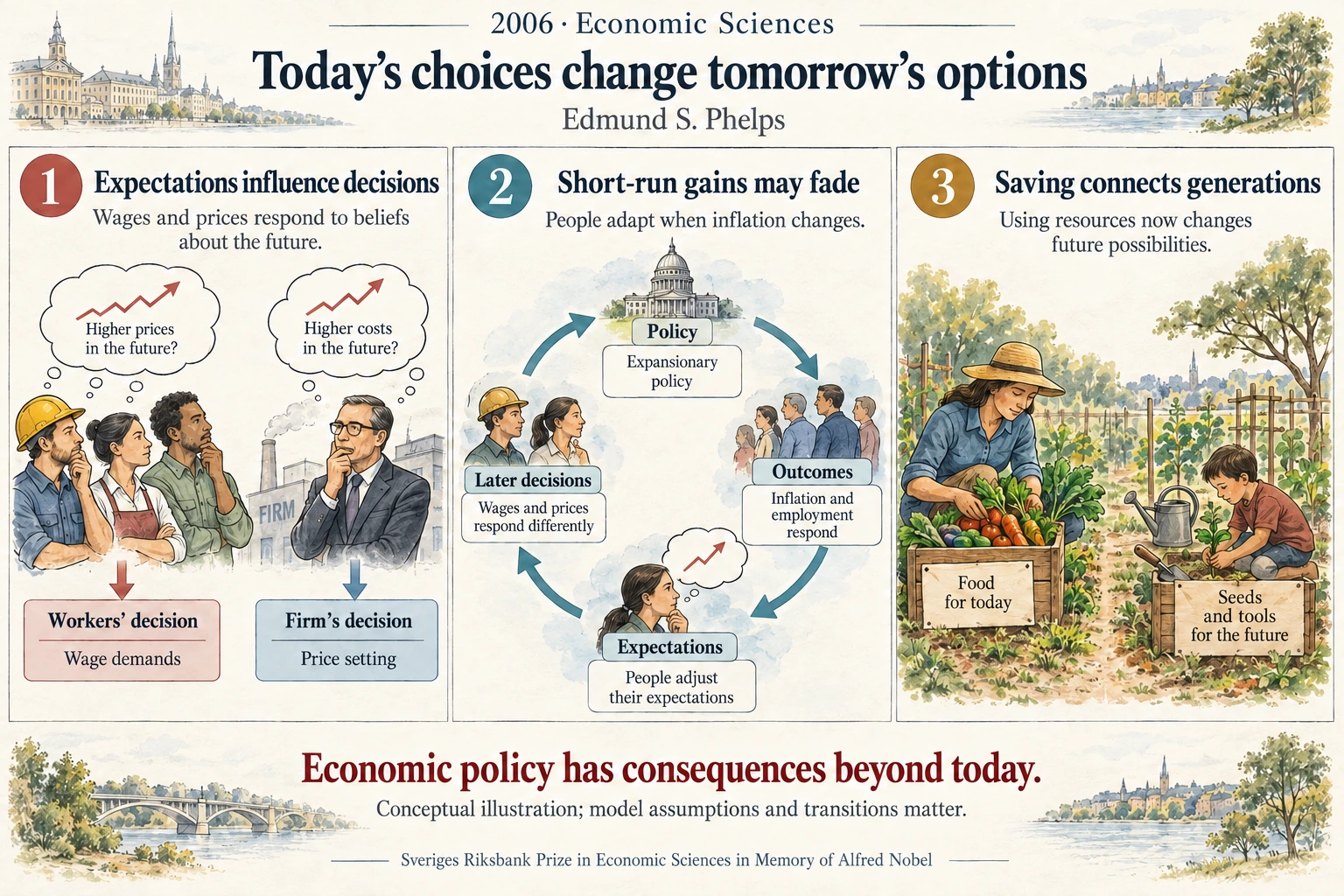
A simple reading of the Phillips curve suggested a stable choice: accept more inflation and obtain less unemployment. Phelps showed why expectations upset that bargain. Workers and firms make wage and price decisions partly on what they expect prices to do. When expectations adjust, an apparent short-run gain need not persist. A permanently higher inflation rate does not reliably buy permanently lower unemployment.
Phelps also studied a second intertemporal choice: how much output to consume now and how much to save for future production. His golden-rule analysis asked which capital stock could support the highest sustainable consumption in the long run. Reaching that position may impose costs on the present generation, so comparing distant steady states is not the same as deciding a fair transition.
Why it matters
The work helped economists connect wage-setting and job matching with macroeconomic outcomes, and made expectations central to policy analysis. It also clarified that current decisions shape future constraints. The contribution was a framework for reasoning about tradeoffs over time, not a mechanical instruction to choose one inflation target or savings rate everywhere.