01 · The discovery
The idea, in everyday language
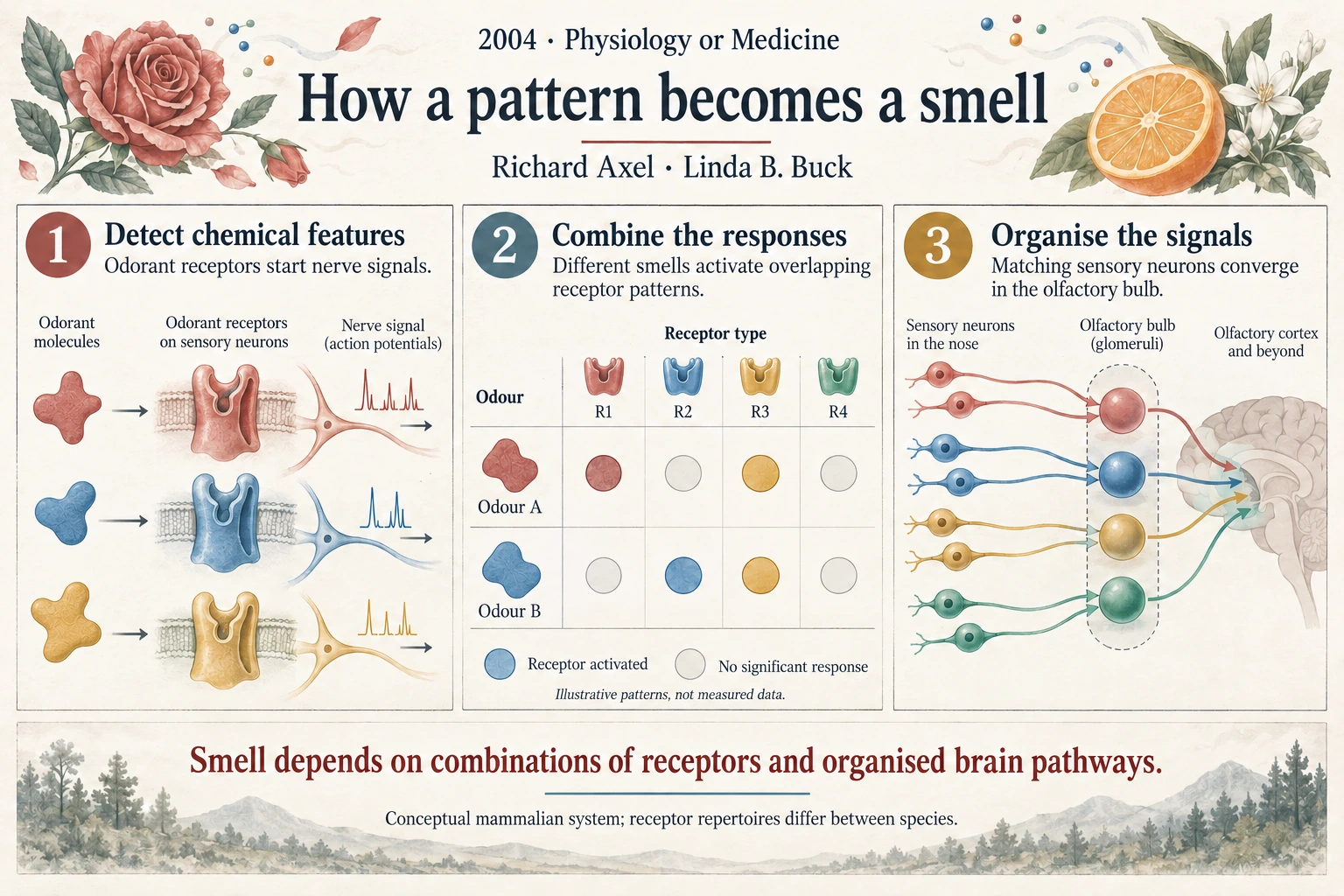
A scent begins with molecules reaching sensory neurons high in the nasal cavity. Receptor proteins on those neurons respond to particular chemical features and trigger electrical signals. In 1991 Buck and Axel identified a large family of genes encoding odorant receptors. This gave researchers molecular handles for asking how many different chemicals could be recognised and how the signals were organised.
The code is combinatorial: one odorant can activate several receptor types, while a receptor can respond to several odorants. A sensory neuron generally expresses one predominant receptor type. Neurons carrying the same receptor send their axons toward particular glomeruli in the olfactory bulb. Signals then reach further brain regions, where patterns are processed in ways that contribute to recognition, learning and memory.
Why it matters
The discovery opened a molecular route into a sensory system that had been difficult to explain. Researchers could connect genes, receptors, individual neurons and organised brain pathways. Work by the laureates and their groups helped show how a large chemical world can be represented with a more limited set of receptor types, establishing a foundation for further studies of sensory perception.