c.curionodeThe Nobel Archive

2005 · Physics

Understanding light, measuring its rhythm

Quantum optics explains detection patterns; frequency combs provide a precise ruler for light.

quantum opticscoherencefrequency combprecision spectroscopy
2005Physics

Visual guide

The prize, pictured

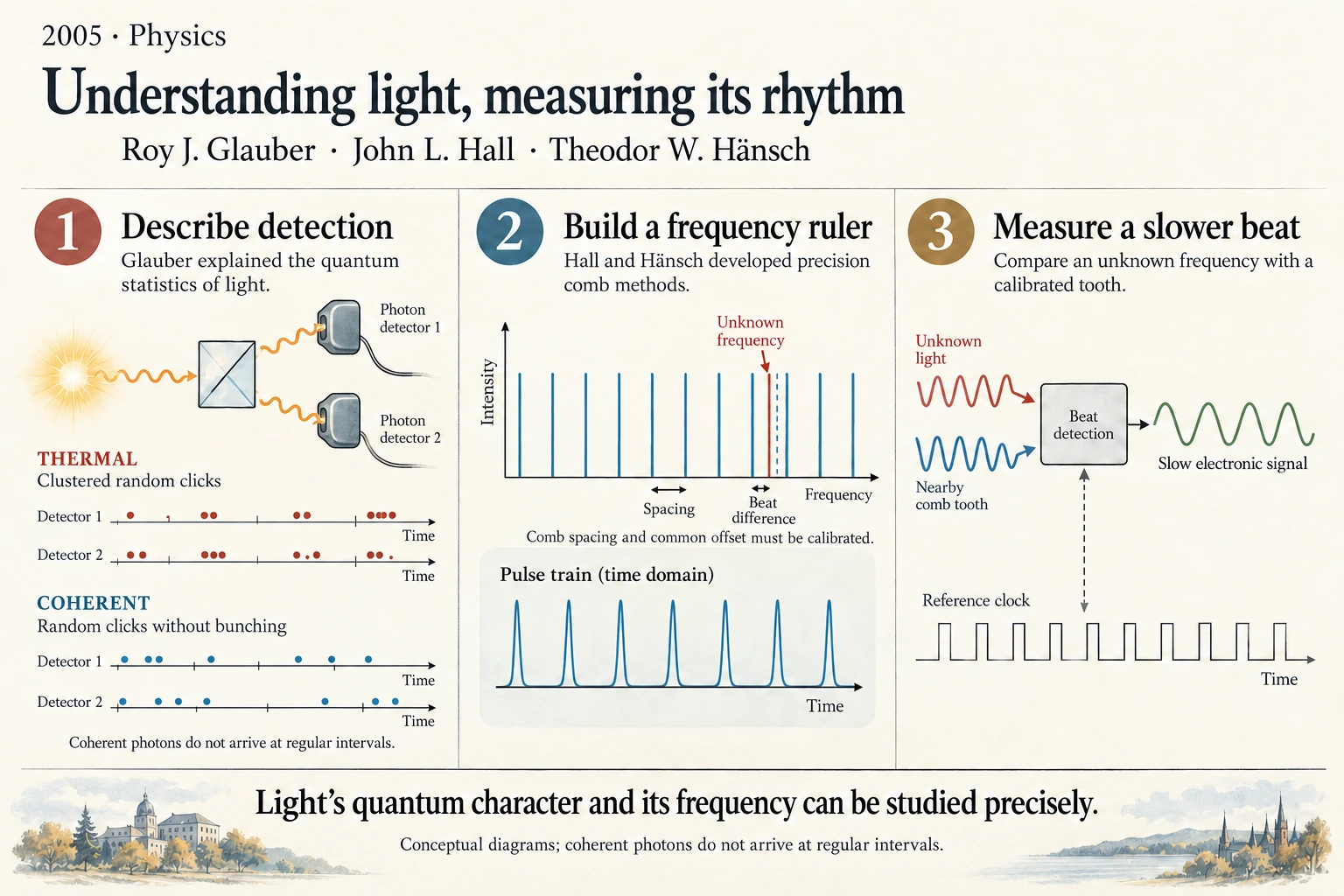
Infographic explaining Understanding light, measuring its rhythm
Original AI-generated infographic. A conceptual overview; the explanations and sources below provide context.
Read the poster text

Light’s quantum character and its frequency can be studied precisely.

  1. Describe detection

    Glauber explained the quantum statistics of light.

  2. Build a frequency ruler

    Hall and Hänsch developed precision comb methods.

  3. Measure a slower beat

    Compare an unknown frequency with a calibrated tooth.

Conceptual diagrams; coherent photons do not arrive at regular intervals.

01 · The discovery

The idea, in everyday language

Light behaves as an electromagnetic field, but a detector absorbs its energy in discrete events. Glauber developed a quantum description that connects the state of the light with the statistics of these events. Two beams with the same average brightness can have different correlations: thermal light tends to produce bunching, while an ideal coherent state has different counting statistics.

Hall and Hänsch addressed precision measurement. A laser producing a regular train of very short pulses also supplies a set of evenly spaced frequencies: an optical frequency comb. Once its spacing and common offset are calibrated, an unknown optical frequency can be compared with a nearby comb tooth. Their difference produces a slower beat signal, connecting rapid optical oscillations to frequencies that electronics can measure.

Why it matters

The theory helped establish quantum optics and the study of light states that classical descriptions cannot fully capture. Precision spectroscopy and frequency combs made accurate comparisons of atomic transitions much more practical, supporting optical clocks and tests of fundamental physics. The prize honoured complementary theoretical and experimental advances.
02 · The people

Who brought the idea to life?

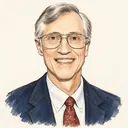
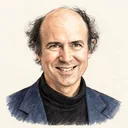
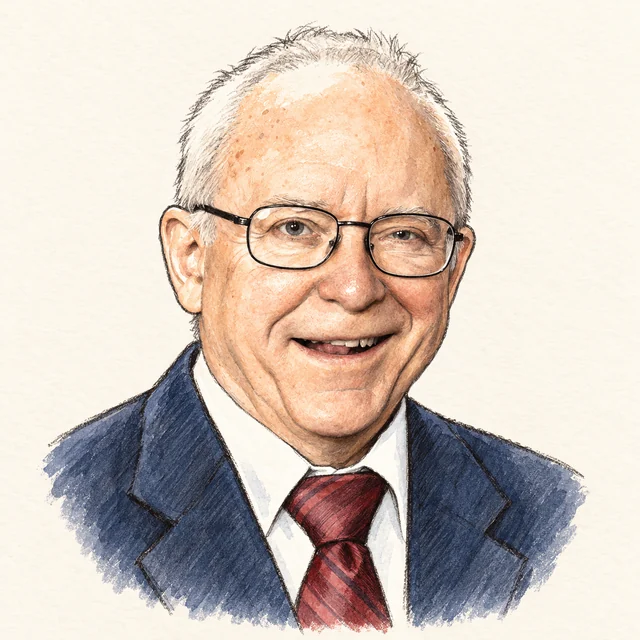
Illustrated portrait of Roy J. Glauber

Roy J. Glauber

Prize share · 1/2

In 1963 Glauber developed a quantum framework for optical coherence and photodetection. It explains correlations between detection events and distinguishes different states of light, including ideal coherent light and thermal light. His contribution provided a foundation for quantum optics; it was not the invention of the laser or of the frequency comb that shared the 2005 prize.

Read the biography ↗
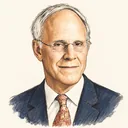
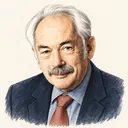
Illustrated portrait of John L. Hall

John L. Hall

Prize share · 1/4

Hall and colleagues helped turn optical frequency combs into practical tools for precise measurement. A comb supplies many evenly spaced optical frequencies, but their common offset must also be determined. Around 2000 his group demonstrated a practical approach to this calibration using a sufficiently broad spectrum. Comparing an unknown optical signal with a comb tooth yields a much slower beat signal that electronics can count.

Read the biography ↗
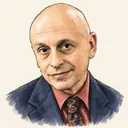
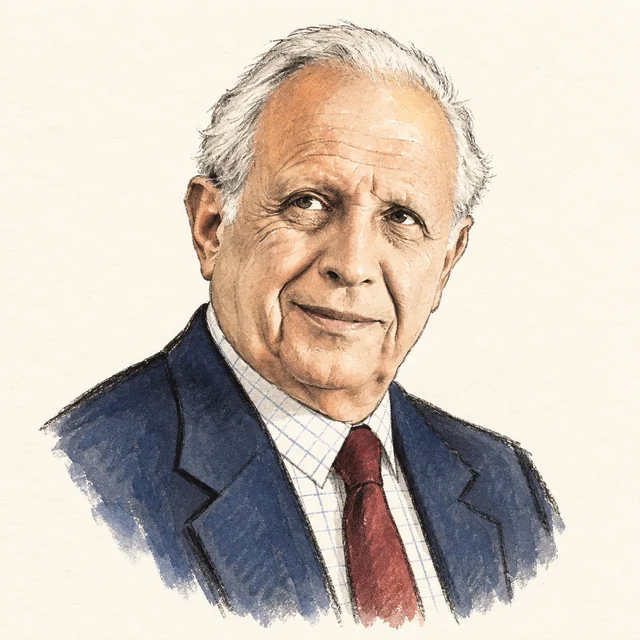
Illustrated portrait of Theodor W. Hänsch

Theodor W. Hänsch

Prize share · 1/4

Hänsch recognised how the evenly spaced frequencies of a short-pulse laser could serve as a ruler for optical frequencies. His group demonstrated the extraordinary regularity of the spacing and developed methods to determine and stabilise the comb’s offset. Work by his group, Hall’s group and collaborators made it possible to connect optical measurements with much slower frequency references.

Read the biography ↗

03 · Years in the making

The path here

  1. 1963

    Glauber developed his quantum description of optical coherence and detection.

  2. 1999–2000

    Frequency-comb methods connected precise optical measurements with frequency references.

  3. 2005

    The prize linked quantum optics with laser-based precision spectroscopy.

04 · Read further

From the original sources

Original explanations by Curionode, based on the official records below. Biographical details and affiliations refer to the award year.

  1. Official announcement nobelprize.org
  2. Popular science background nobelprize.org