c.curionodeThe Nobel Archive

2009 · Chemistry

Inside the cell’s protein-making machinery

Atomic structures revealed how ribosomes read a message and join amino acids.

ribosomeprotein synthesisX-ray crystallography
2009Chemistry

Visual guide

The prize, pictured

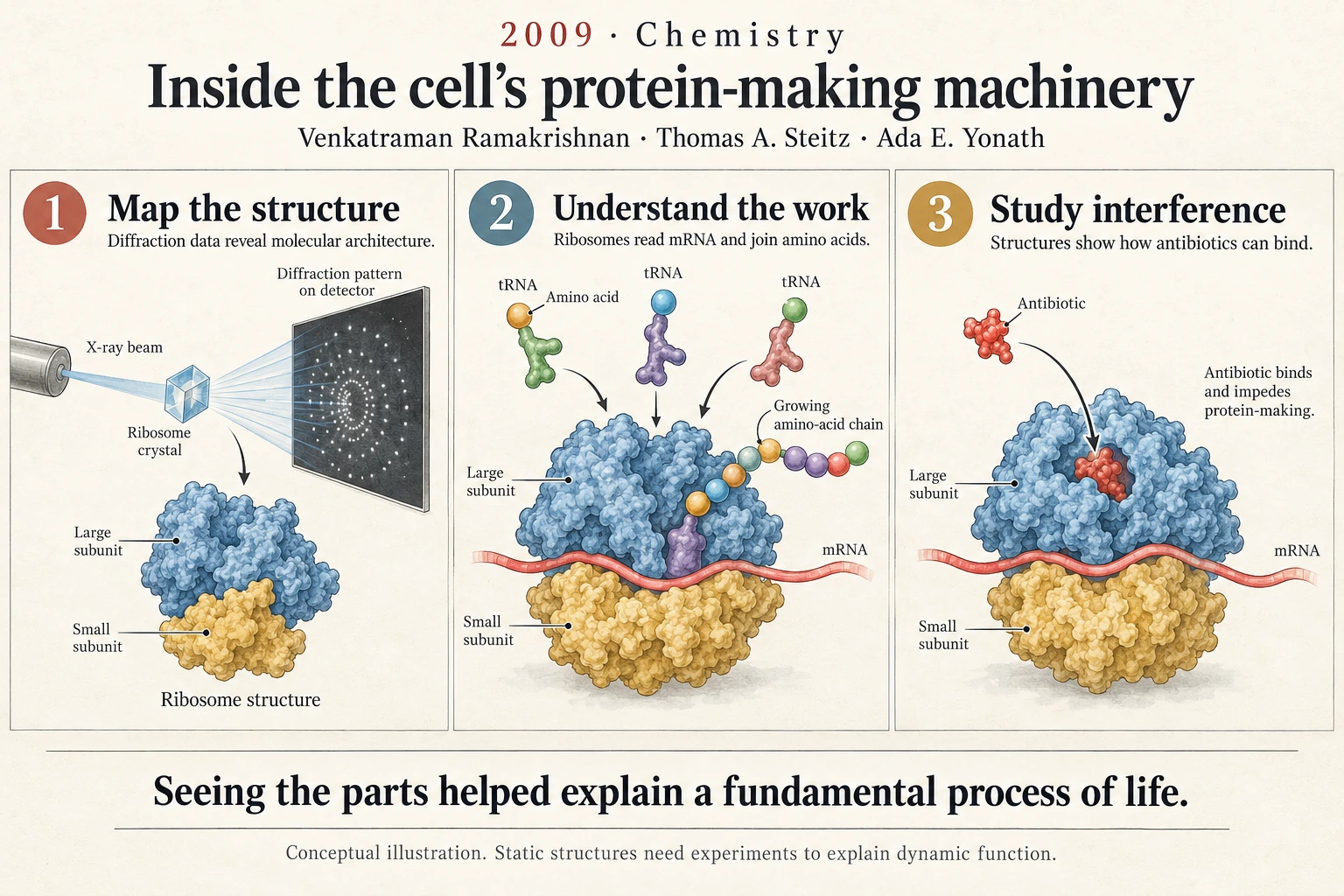
Infographic explaining Inside the cell’s protein-making machinery
Original AI-generated infographic. A conceptual overview; the explanations and sources below provide context.
Read the poster text

Seeing the parts helped explain a fundamental process of life.

  1. Map the structure

    Diffraction data reveal molecular architecture.

  2. Understand the work

    Ribosomes read mRNA and join amino acids.

  3. Study interference

    Structures show how antibiotics can bind.

Conceptual illustration. Static structures need experiments to explain dynamic function.

01 · The discovery

The idea, in everyday language

A ribosome translates information carried by messenger RNA into a chain of amino acids. Transfer RNAs bring the building blocks and pair with the message, while the ribosome helps choose the right match and form the links. It is a large assembly of RNA and proteins with two interacting subunits. Knowing the broad outline was different from seeing how its working parts fit together.

Yonath pioneered the difficult crystallisation work. Steitz and his team mapped the large subunit, including its catalytic centre; Ramakrishnan and Yonath’s groups determined high-resolution structures of the small subunit. Structures published in 2000 allowed researchers to interpret atomic positions and investigate decoding, peptide-bond formation and antibiotic binding. These models came from X-ray diffraction and analysis, not from looking through an ordinary microscope.

Why it matters

The work helped explain the accuracy of translation and the central role of ribosomal RNA in making peptide bonds. It also showed where many antibiotics bind and how they disrupt bacterial protein production. Structural information can guide drug research, alongside experiments on activity, resistance, delivery and safety.


02 · The people

Who brought the idea to life?

Illustrated portrait of Venkatraman Ramakrishnan

Venkatraman Ramakrishnan

Prize share · 1/3

His team determined high-resolution structures of the ribosome’s small subunit and investigated its decoding function. These structures helped explain how the ribosome checks the pairing between a messenger-RNA codon and a transfer-RNA anticodon. Studying antibiotics bound to the subunit also clarified how drugs can interfere with bacterial protein synthesis.

Read the biography ↗
Illustrated portrait of Thomas A. Steitz

Thomas A. Steitz

Prize share · 1/3

Steitz’s group determined the structure of the ribosome’s large subunit, reaching atomic detail in 2000. This revealed the organisation of the region that joins amino acids into a protein chain and supported the central catalytic role of ribosomal RNA. Structures with bound molecules helped connect the architecture to chemical function and to the action of antibiotics.

Read the biography ↗
Illustrated portrait of Ada E. Yonath

Ada E. Yonath

Prize share · 1/3

Yonath pioneered the experimental groundwork for ribosome crystallography and later determined high-resolution structures, including the small subunit in 2000. Her research also examined how antibiotics bind to ribosomes and obstruct their function. The achievement required years of improvements in sample preparation, diffraction data and structural analysis, rather than a single direct photograph of a working cell.

Read the biography ↗

03 · Years in the making

The path here

  1. 1980

    Yonath produced early three-dimensional crystals of a ribosomal large subunit.

  2. 2000

    The laureates’ teams published high-resolution structures of ribosomal subunits.

  3. 2009

    The Chemistry Prize recognised studies of ribosome structure and function.

04 · Read further

From the original sources

Original explanations by Curionode, based on the official records below. Biographical details and affiliations refer to the award year.

  1. Official announcement nobelprize.org
  2. Popular science background nobelprize.org

More in Chemistry

Browse this subject ↗