c.curionodeThe Nobel Archive

2012 · Peace

Making cooperation part of everyday government

The 2012 prize recognised the European Union and its predecessors for their contribution to reconciliation, democracy and peace.

reconciliationshared institutionsdemocratic cooperation
2012Peace

Visual guide

The prize, pictured

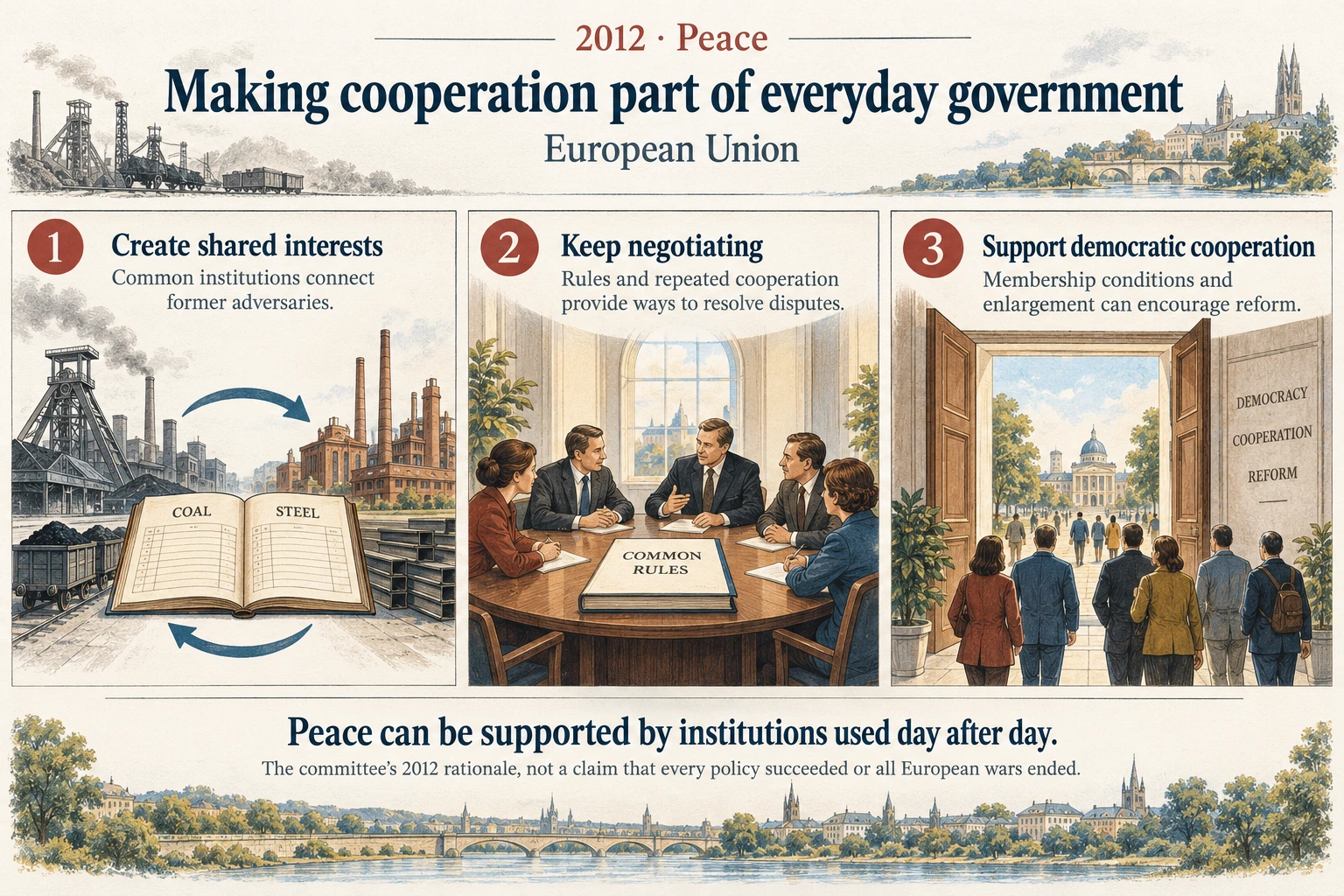
Infographic explaining Making cooperation part of everyday government
Original AI-generated infographic. A conceptual overview; the explanations and sources below provide context.
Read the poster text

Peace can be supported by institutions used day after day.

  1. Create shared interests

    Common institutions connect former adversaries.

  2. Keep negotiating

    Rules and repeated cooperation provide ways to resolve disputes.

  3. Support democratic cooperation

    Membership conditions and enlargement can encourage reform.

The committee’s 2012 rationale, not a claim that every policy succeeded or all European wars ended.

01 · The contribution

The idea, in everyday language

After devastating wars, European integration created institutions through which former adversaries could work together. The European Coal and Steel Community, operating from 1952, placed strategically important industries within a shared framework. Cooperation later expanded into other areas. The Nobel Committee especially emphasised the transformation of relations between France and Germany: sustained negotiation and common institutions helped replace habitual rivalry with partnership.

The committee also highlighted the relationship between membership and democratic development. Countries seeking to join had to meet conditions, and enlargement helped connect societies previously separated by dictatorship or the Cold War. The European Union itself was established under that name in 1993; the award deliberately covered the longer history of its predecessors as well. It recognised an institutional contribution over decades, rather than a single treaty or one leader.

Why it matters

The award draws attention to a form of peacebuilding that happens through law, negotiation, economic ties and recurring cooperation. Institutions can make commitments more durable than a temporary agreement between leaders. They can also create channels for challenging decisions, although the quality and fairness of those channels must continue to be assessed.

02 · The recipients

Who brought the idea to life?

Symbolic illustration representing European Union

European Union

Prize share · 1/1

The Nobel Committee highlighted reconciliation between former enemies, especially France and Germany, and the role of membership conditions and enlargement in supporting democracy. It recognised shared institutions as a way to resolve disputes and sustain cooperation. These were the committee’s stated reasons for the 2012 award, not a claim that every EU policy was successful or that war had ended throughout Europe.

Read the biography ↗

03 · Years in the making

The path here

  1. 1952

    The European Coal and Steel Community begins operating, an institutional predecessor of the EU.

  2. 1993

    The Maastricht Treaty enters into force and the European Union is established.

  3. 2012

    The Nobel Committee recognises the union and its predecessors for more than six decades of contribution.

04 · Read further

From the original sources

Original explanations by Curionode, based on the official records below. Biographical details and affiliations refer to the award year.

  1. Official announcement nobelprize.org
  2. European Union: founding agreements european-union.europa.eu