01 · The discovery
The idea, in everyday language
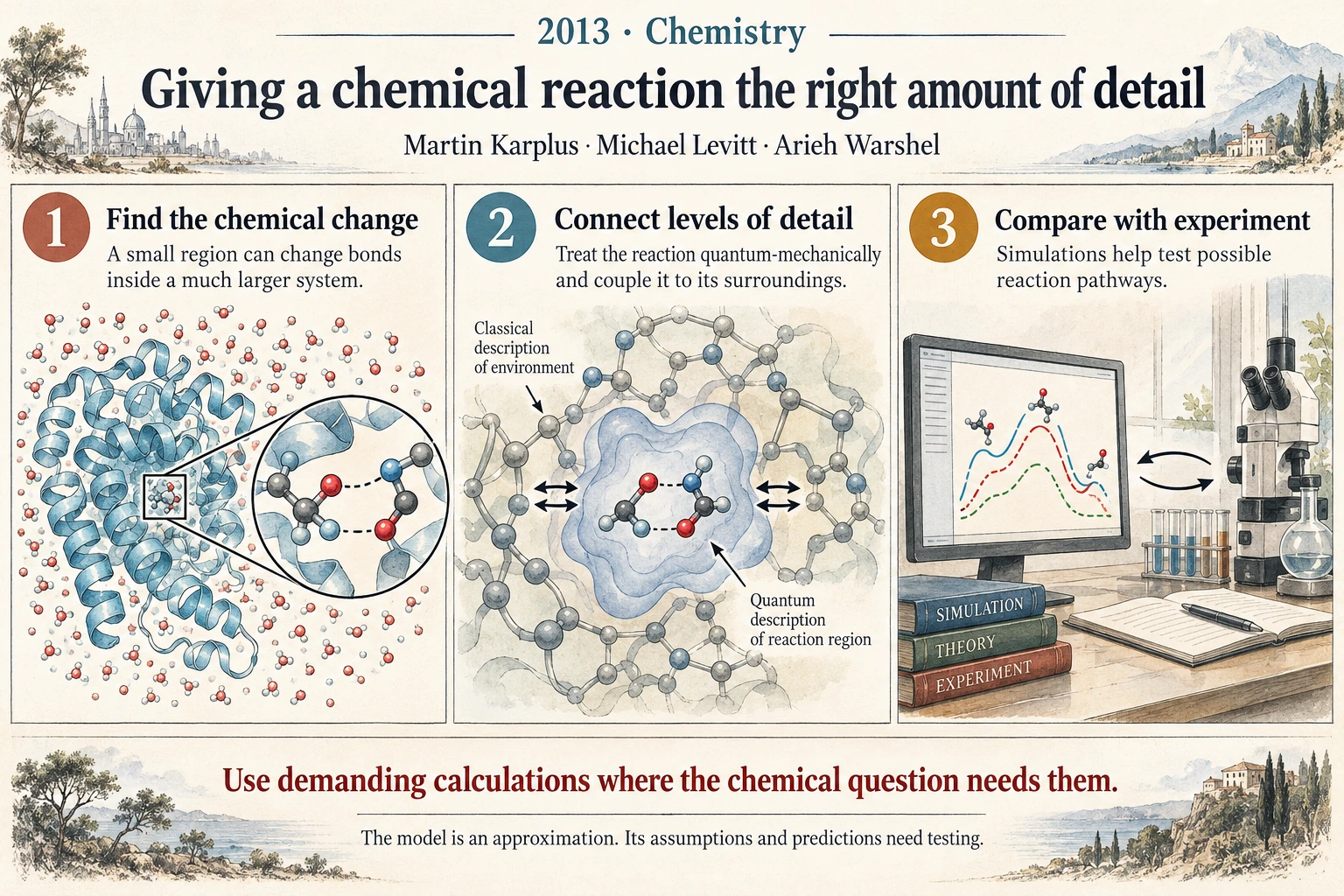
A picture of a protein shows where its atoms are, but not necessarily how a reaction happens inside it. Bonds can break and form as electrons rearrange. Quantum calculations can describe that changing electronic structure, but treating an entire large protein and its environment at the same detailed level is expensive. A simpler classical model handles many atoms efficiently, but an ordinary fixed-bond model cannot adequately describe a changing chemical bond.
Karplus, Levitt and Warshel developed ways to connect descriptions at different levels. A chemically active region can receive a quantum treatment while much of the surrounding system uses classical mechanics. The important step is coupling them so that the environment still influences the reaction. Karplus and Warshel demonstrated a hybrid molecular calculation in 1972. Levitt and Warshel’s 1976 enzyme-reaction model extended the approach to a biological setting. Related simplifications can group atoms together when the question does not require every atomic detail.
Why it matters
The methods made computation a powerful partner to laboratory experiments. Scientists could compare possible reaction pathways, investigate how a protein’s surroundings affect its chemistry and design experiments that distinguish competing explanations. The contribution was a general modelling approach useful across chemistry, rather than the discovery of one particular drug or a claim to simulate all of life exactly.