c.curionodeThe Nobel Archive

2015 · Peace

Four groups keep a dialogue open

Tunisia’s civil-society mediators helped political rivals negotiate during a dangerous transition.

civil societymediationTunisia
2015Peace

Visual guide

The prize, pictured

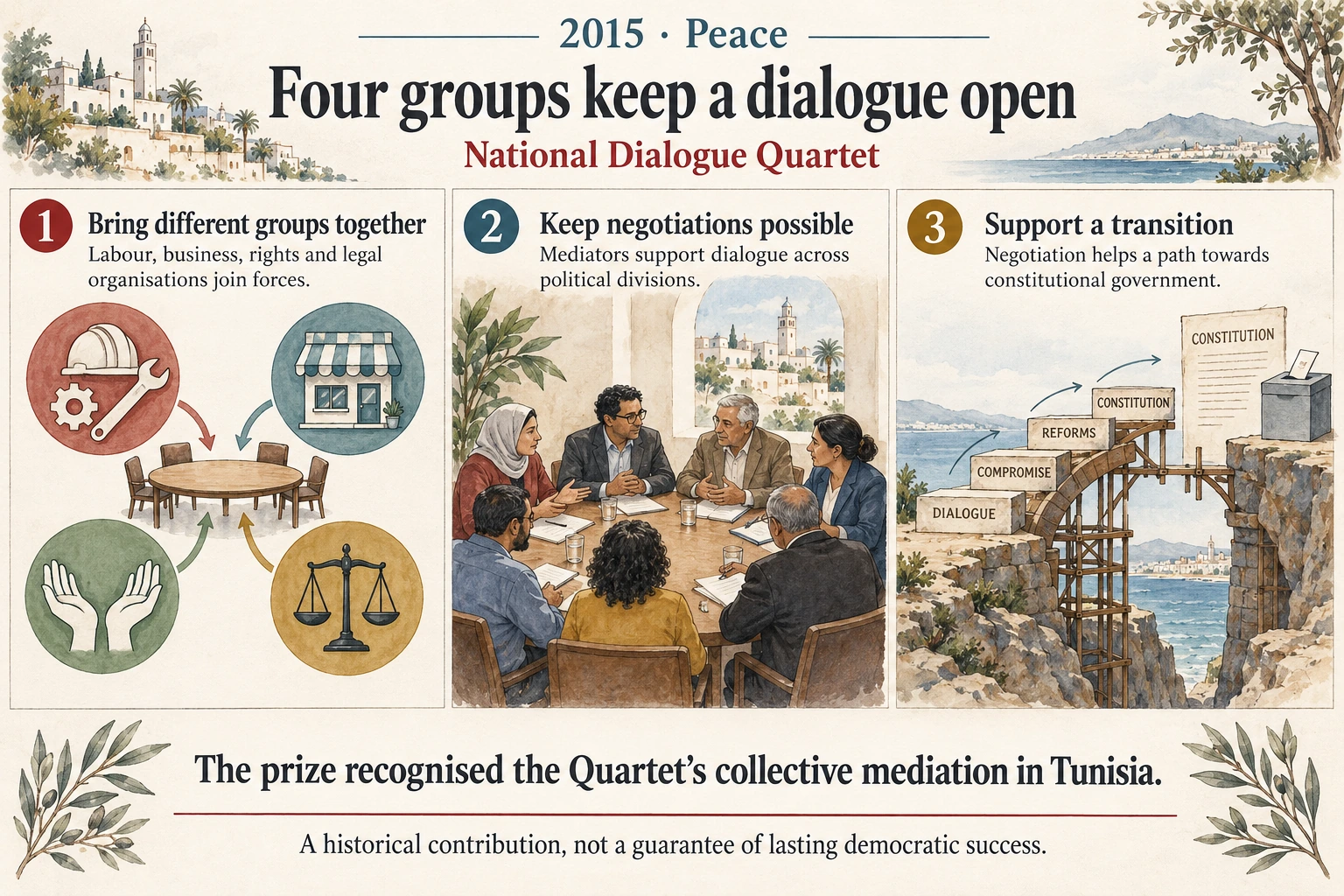
Infographic explaining Four groups keep a dialogue open
Original AI-generated infographic. A conceptual overview; the explanations and sources below provide context.
Read the poster text

The prize recognised the Quartet’s collective mediation in Tunisia.

  1. Bring different groups together

    Labour, business, rights and legal organisations join forces.

  2. Keep negotiations possible

    Mediators support dialogue across political divisions.

  3. Support a transition

    Negotiation helps a path towards constitutional government.

A historical contribution, not a guarantee of lasting democratic success.

01 · The contribution

The idea, in everyday language

After Tunisia’s 2011 revolution, building new political institutions required agreement among groups with sharply different priorities. In 2013, political assassinations and unrest threatened the transition. The National Dialogue Quartet brought together four civil-society organisations: the labour union UGTT, the employers’ confederation UTICA, the Tunisian Human Rights League and the Tunisian Order of Lawyers. Their different constituencies gave the mediation effort a broader base than any one organisation could supply.

The Quartet supported negotiations across political and religious divisions, helping a process that led towards the 2014 constitution and elections. The contribution was not a scientific discovery or a new law of politics. It was the practical work of bringing rivals into a shared process, maintaining channels of communication and supporting negotiated steps when violence threatened to replace them. The 2015 Peace Prize went to the Quartet collectively, not as four separate awards.

Why it matters

The award highlighted how organisations outside government can help sustain political dialogue. Labour, business, human-rights and legal organisations brought different forms of social connection to the effort. The example made the role of civil society visible alongside the work of political parties and elected institutions.

02 · The recipients

Who brought the idea to life?

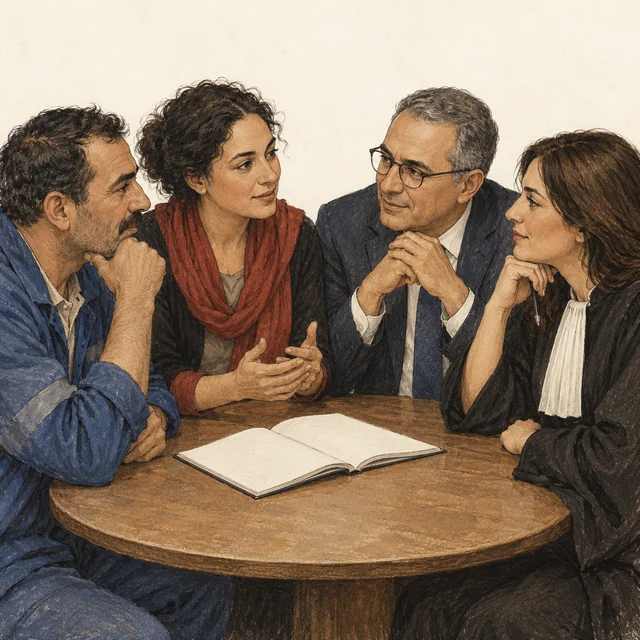
Symbolic illustration representing National Dialogue Quartet

National Dialogue Quartet

Prize share · 1/1

It helped mediate across political divisions and support a path towards a new constitution and elections. The award recognised that historical contribution, not a guarantee that democratic gains would last. The illustrated group on this page is symbolic and does not depict the organisations’ named representatives.

Read the biography ↗

03 · Years in the making

The path here

  1. 2011

    Tunisia’s revolution opens a political transition.

  2. 2013

    The Quartet forms amid a crisis and supports national dialogue.

  3. 2015

    The Peace Prize recognises its contribution to the transition.

04 · Read further

From the original sources

Original explanations by Curionode, based on the official records below. Biographical details and affiliations refer to the award year.

  1. Nobel Prize announcement nobelprize.org
  2. Amnesty International: Tunisia, July 2022 amnesty.org