01 · The discovery
The idea, in everyday language
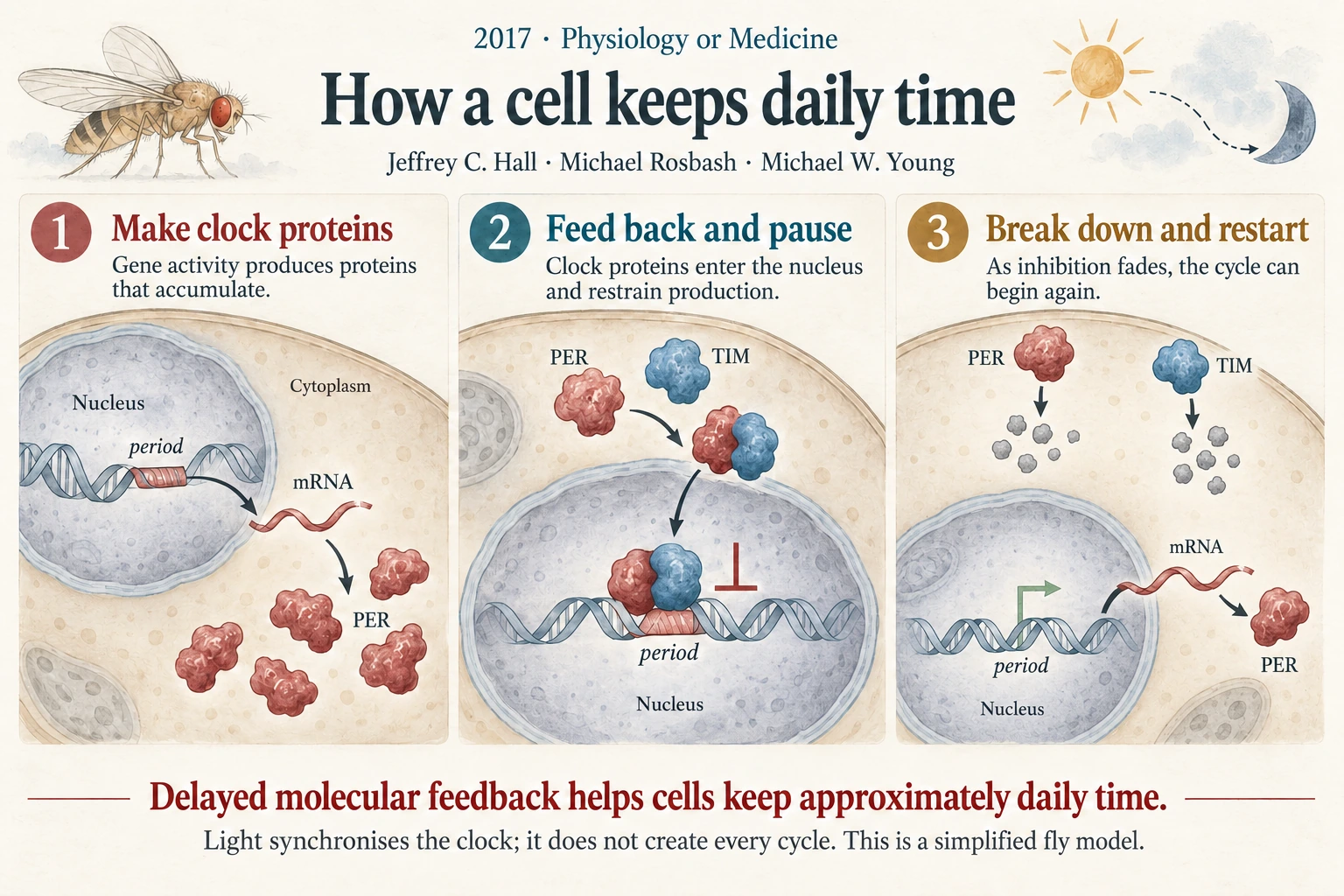
Daily rhythms continue even without a fresh sunrise to trigger every cycle. That observation suggested an internal clock, but did not explain its machinery. In 1984, Jeffrey Hall and Michael Rosbash, and independently Michael Young, isolated the fruit-fly period gene. Hall and Rosbash showed that its protein product, PER, changes in abundance over the daily cycle. A key idea followed: the protein could eventually inhibit the activity that produces more of itself.
The loop needs timing. Protein is made in the cytoplasm, while gene regulation occurs in the nucleus. Young’s work on timeless showed how TIM helps PER enter the nucleus and close the inhibitory loop. His discovery of doubletime identified another regulator, DBT, that affects the delay in PER accumulation. As clock proteins are broken down, inhibition eases and production can resume. Additional components connect this internally generated cycle to environmental cues such as light.
Why it matters
These discoveries established principles for understanding biological time. Circadian systems help coordinate behaviour, metabolism and other functions with the daily environment. They also explain why an internal rhythm can become misaligned with a changed light–dark schedule, as in jet lag. The fruit fly supplied a tractable experimental system, with related principles found in other organisms.