c.curionodeThe Nobel Archive

2018 · Chemistry

Improve proteins by testing generations

Directed evolution and phage display turned variation and selection into tools for making useful enzymes and antibodies.

Directed evolutionPhage displayProtein engineering
2018Chemistry

Visual guide

The prize, pictured

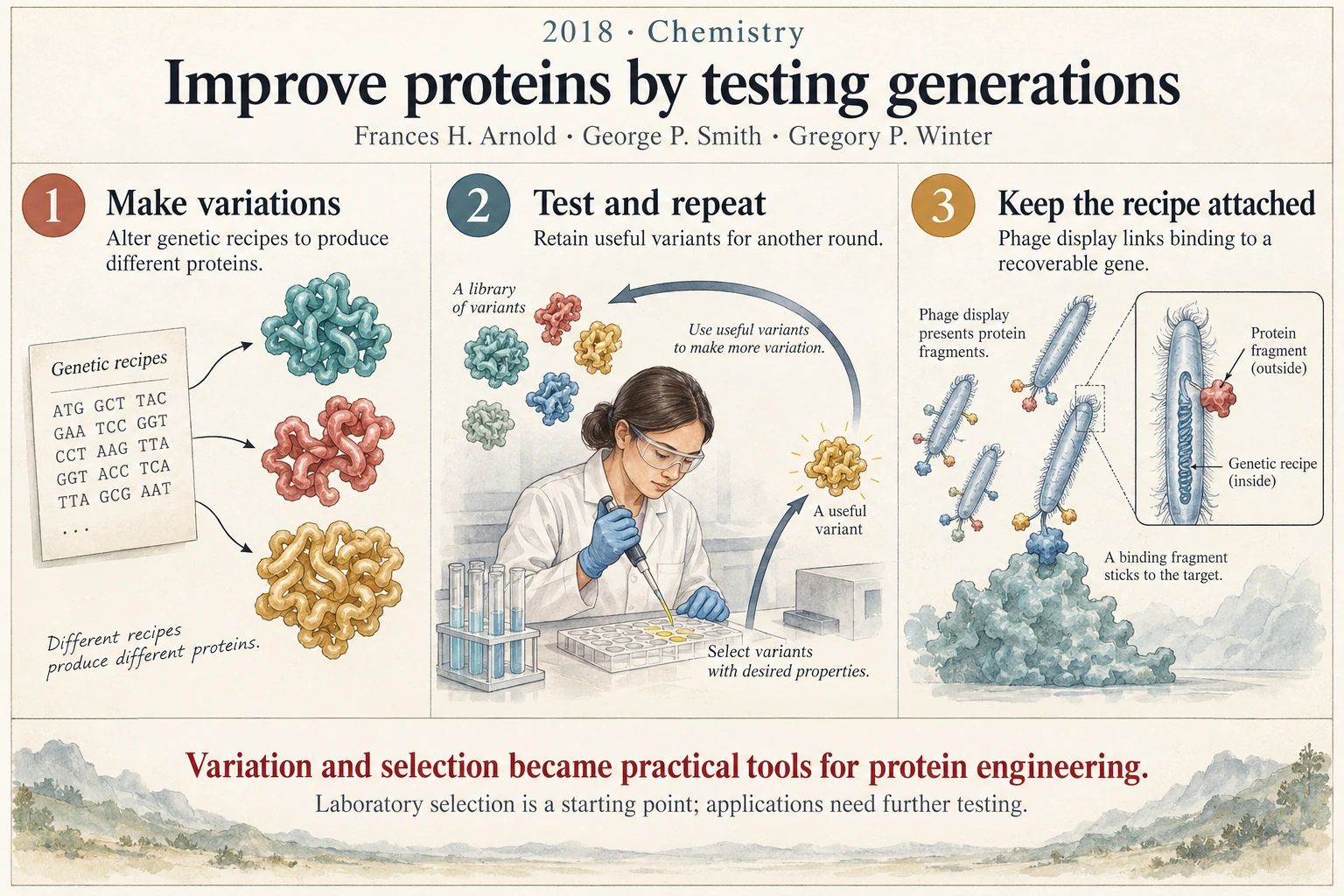
Infographic explaining Improve proteins by testing generations
Original AI-generated infographic. A conceptual overview; the explanations and sources below provide context.
Read the poster text

Variation and selection became practical tools for protein engineering.

  1. Make variations

    Alter genetic recipes to produce different proteins.

  2. Test and repeat

    Retain useful variants for another round.

  3. Keep the recipe attached

    Phage display links binding to a recoverable gene.

Laboratory selection is a starting point; applications need further testing.

01 · The discovery

The idea, in everyday language

Proteins are folded chains whose sequence affects what they do. Predicting every useful change is difficult. Frances Arnold instead varied the genes for an enzyme, produced the resulting versions, and tested them against a chosen task. Promising versions supplied the starting point for another round. Repetition can improve a property such as working in a difficult solvent. The experimenter chooses the test; the protein does not know the goal, and a change is only an improvement relative to the conditions being measured.

George Smith created another useful link between a protein and its genetic recipe. A bacteriophage, a virus that infects bacteria, could display a protein fragment on its surface while carrying the relevant gene inside. Researchers could select phages whose displayed fragments bound a target and then recover the associated genes. Gregory Winter adapted the method to antibodies and their fragments. Repeated selection from many variants could identify increasingly useful binders and guide the development of antibody medicines.

Why it matters

Directed evolution helps create catalysts suited to manufacturing tasks, sometimes allowing milder or more selective chemistry. Phage display became a powerful way to find binding molecules. An early antibody medicine developed with the method, adalimumab, was approved in 2002. These are platforms for discovering and improving candidates, followed by further development and testing.


02 · The people

Who brought the idea to life?

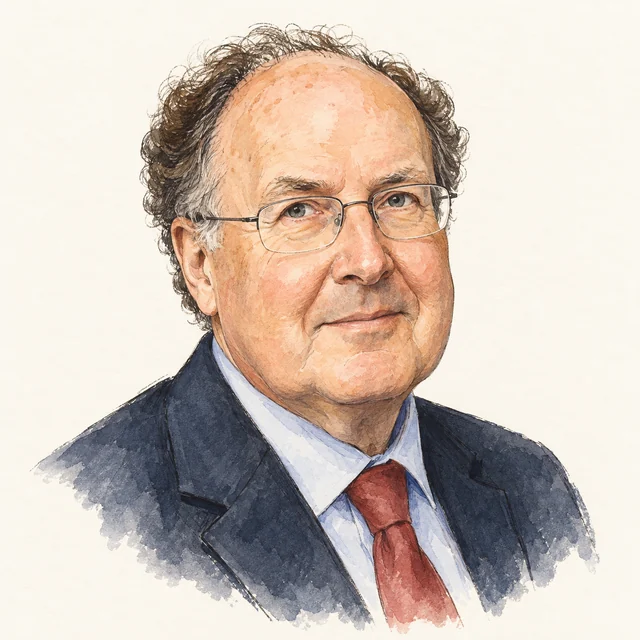
Illustrated portrait of Frances H. Arnold

Frances H. Arnold

Prize share · 1/2

In 1993 she demonstrated directed evolution of enzymes. Researchers change the genes that encode an enzyme, measure the resulting variants against a chosen task, and repeat with promising versions. This made evolutionary principles into a practical protein-engineering method.

Read the biography ↗
Illustrated portrait of George P. Smith

George P. Smith

Prize share · 1/4

In 1985 he introduced phage display: a bacteriophage carries a displayed protein fragment on its surface and the corresponding genetic instructions within it. Selecting phages with a useful binding property therefore also selects the genes needed to make that protein fragment.

Read the biography ↗
Illustrated portrait of Gregory P. Winter

Gregory P. Winter

Prize share · 1/4

He adapted phage display to select and improve antibodies that bind chosen targets. Repeated selection links useful binding behaviour to the antibody’s genetic recipe. The approach helped establish a route from large libraries of variants to therapeutic antibody candidates.

Read the biography ↗

03 · Years in the making

The path here

  1. 1985

    Smith introduces phage display, linking displayed protein fragments to genes.

  2. 1993

    Arnold demonstrates directed evolution of an enzyme.

  3. 2002

    Adalimumab, developed using phage display, receives its first approval.

04 · Read further

From the original sources

Original explanations by Curionode, based on the official records below. Biographical details and affiliations refer to the award year.

  1. Official award announcement nobelprize.org
  2. Nobel Committee’s accessible background nobelprize.org

More in Chemistry

Browse this subject ↗