c.curionodeThe Nobel Archive

2021 · Physiology or Medicine

How heat and touch become nerve signals

Molecular gates in cell membranes translate temperature and mechanical force into electrical activity.

SensationIon channelsTouch
2021Physiology or Medicine

Visual guide

The prize, pictured

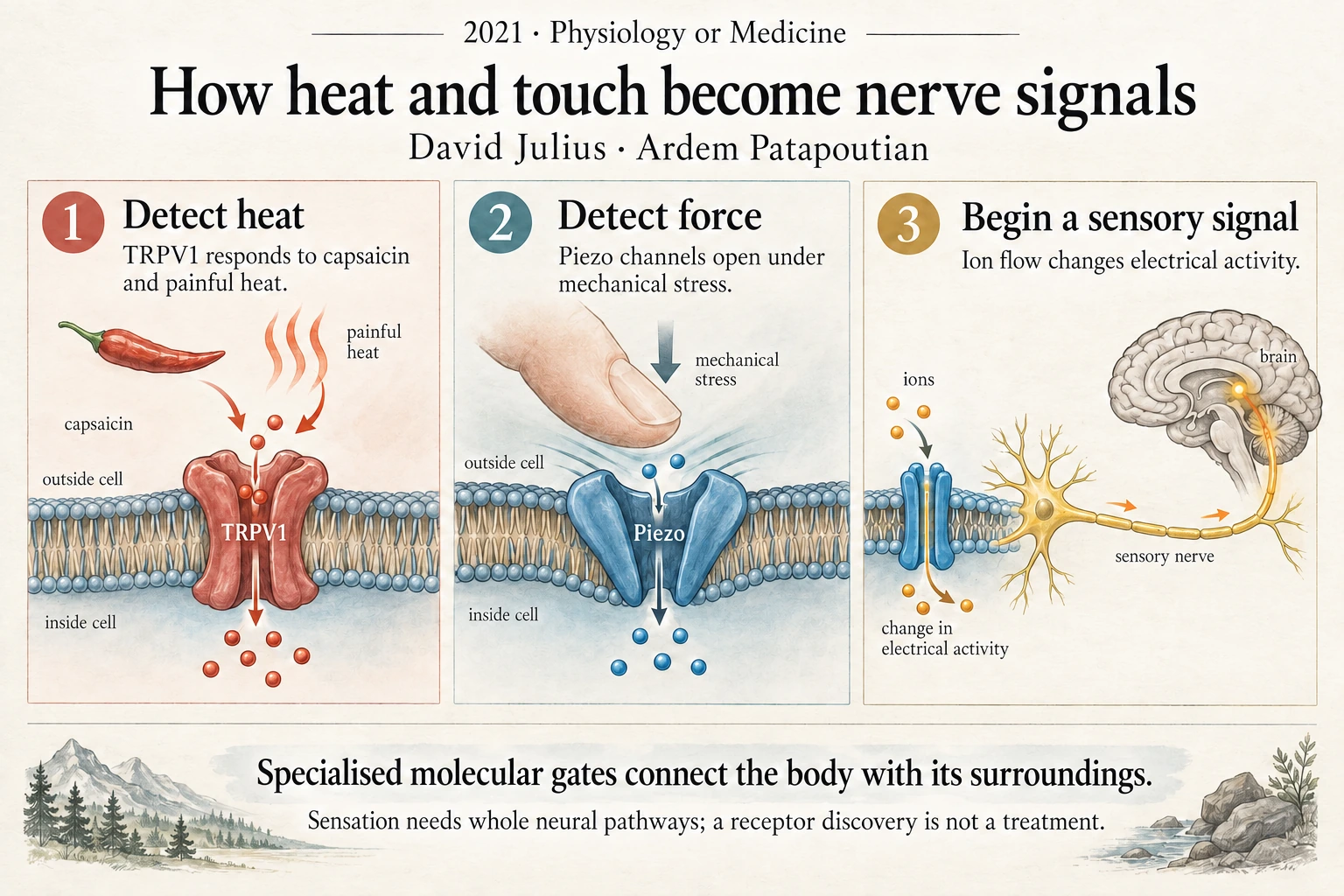
Infographic explaining How heat and touch become nerve signals
Original AI-generated infographic. A conceptual overview; the explanations and sources below provide context.
Read the poster text

Specialised molecular gates connect the body with its surroundings.

  1. Detect heat

    TRPV1 responds to capsaicin and painful heat.

  2. Detect force

    Piezo channels open under mechanical stress.

  3. Begin a sensory signal

    Ion flow changes electrical activity.

Sensation needs whole neural pathways; a receptor discovery is not a treatment.

01 · The discovery

The idea, in everyday language

A warm surface and a gentle touch feel different, but both begin with physical changes being converted into cellular signals. Julius used capsaicin, the substance responsible for chilli’s burn, to find TRPV1. This ion channel also opens in response to painful heat, allowing charged particles to cross a cell membrane.

Patapoutian’s group approached touch by gently poking cells and switching off candidate genes. They discovered the force-sensitive Piezo channels. Piezo2 helps us feel touch and know where our limbs are without looking. Together, these findings reveal early molecular steps that sensory pathways use to communicate with the nervous system.

Why it matters

The discoveries opened research into temperature sensing, touch, body-position sensing and other functions that depend on mechanical forces. They also gave researchers molecular targets for investigating pain, while showing that these channels have many normal jobs in the body.


02 · The people

Who brought the idea to life?

Illustrated portrait of David Julius

David Julius

Prize share · 1/2

His team screened genes until one made normally unresponsive cells react to capsaicin. The resulting protein, TRPV1, also responds to painful heat. This 1997 discovery connected a physical stimulus with a molecular gate in sensory cells.

Read the biography ↗
Illustrated portrait of Ardem Patapoutian

Ardem Patapoutian

Prize share · 1/2

His team silenced candidate genes in cells that responded electrically to a gentle poke. This identified Piezo1, followed by the related Piezo2: ion channels opened by mechanical force. Piezo2 is central to touch and to sensing the position of the body.

Read the biography ↗

03 · Years in the making

The path here

  1. 1997

    Julius’s team identifies TRPV1 using capsaicin.

  2. 2002

    Julius’s and Patapoutian’s groups independently identify the cold-sensitive TRPM8 channel.

  3. 2010

    Patapoutian’s team reports the mechanically activated Piezo1 and Piezo2 channels.

04 · Read further

From the original sources

Original explanations by Curionode, based on the official records below. Biographical details and affiliations refer to the award year.

  1. Official award announcement nobelprize.org
  2. Scientific background nobelprize.org

More in Physiology or Medicine

Browse this subject ↗