01 · The discovery
The idea, in everyday language
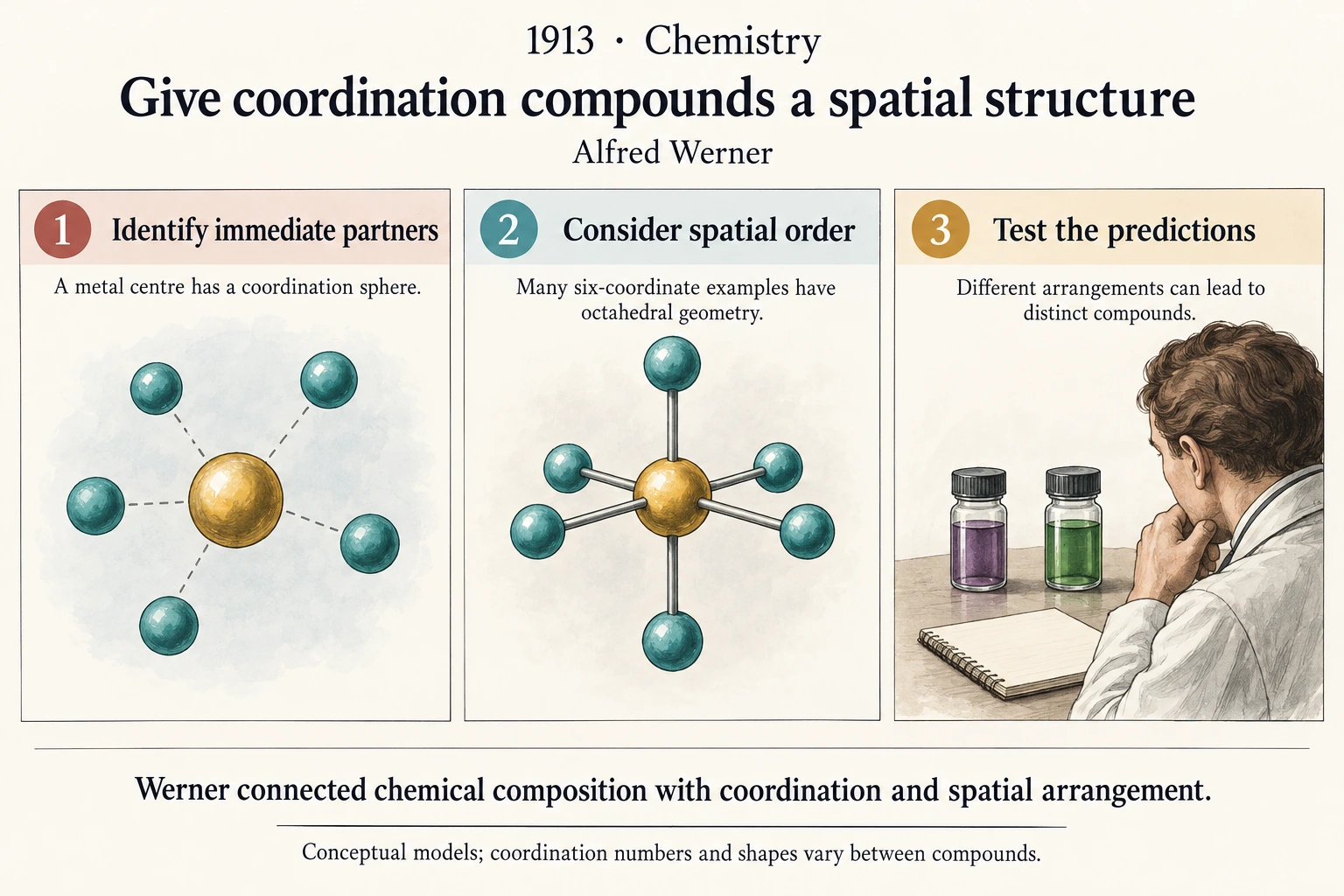
Werner’s 1893 coordination theory distinguished a central atom’s immediate coordination sphere from ions outside it. The number and arrangement of directly coordinating atoms mattered alongside the chemical composition. For many six-coordinate examples, an octahedral arrangement explained observed patterns. Other coordination numbers and shapes also occur.
A proposed arrangement could predict which distinct compounds should be possible. Werner and his collaborators prepared and compared series of compounds to test those predictions, including cases of geometrical isomerism and optical isomers. Spatial chemistry was therefore an experimental framework as well as a way of drawing models. The 1913 prize recognised the new understanding of atomic linkages and the research fields it opened.
Why it matters
Coordination chemistry gave inorganic chemistry a framework for connecting composition, bonding and shape. It helped explain why related compounds could have different properties and made structural predictions available for chemical testing.