01 · The discovery
The idea, in everyday language
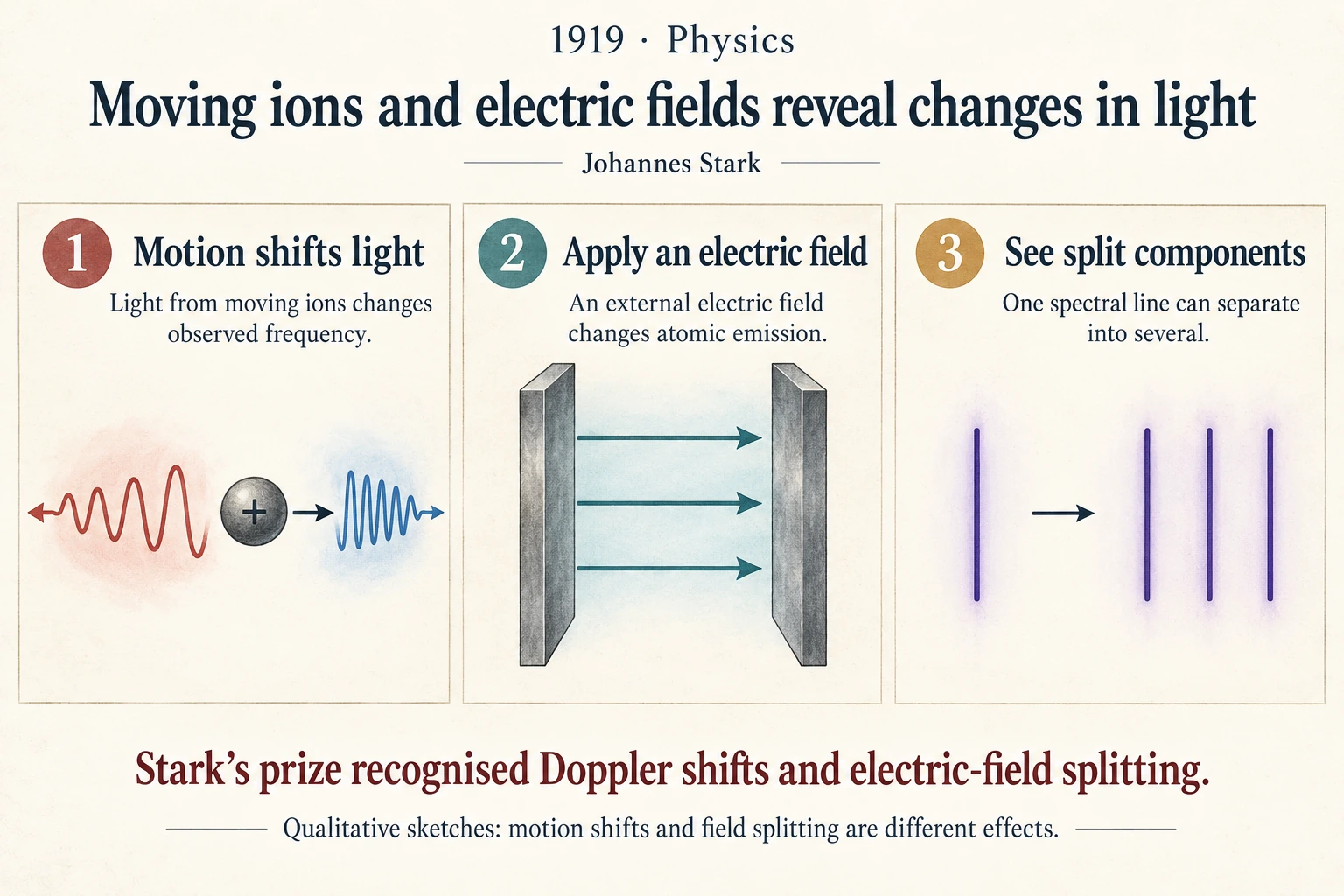
A spectrum separates light into components, letting researchers compare the narrow lines emitted by atoms. Canal rays contain fast-moving positive ions. Stark showed in 1905 that their light exhibits a Doppler effect: looking along different directions relative to the motion changes the observed frequency. The motion of the emitter and the light received by an observer are connected.
A different question is what happens to light emission when the atom is placed in an electric field. Stark found that a spectral line could separate into several components. The official presentation account dates the discovery to 1913. This electric-field splitting, now called the Stark effect, supplied new evidence about atomic behaviour and a demanding test for atomic theory. The 1919 prize was presented on 1 June 1920, by the Nobel Foundation’s president rather than the King, according to the ceremony account.
Why it matters
The work made emitted light a probe of moving ions and of how atoms respond to external electric fields. Spectral shifts and splitting constrain explanations of atomic structure. Their significance lies in distinguishing measurable effects and testing theories, rather than merely producing colourful light.