01 · The discovery
The idea, in everyday language
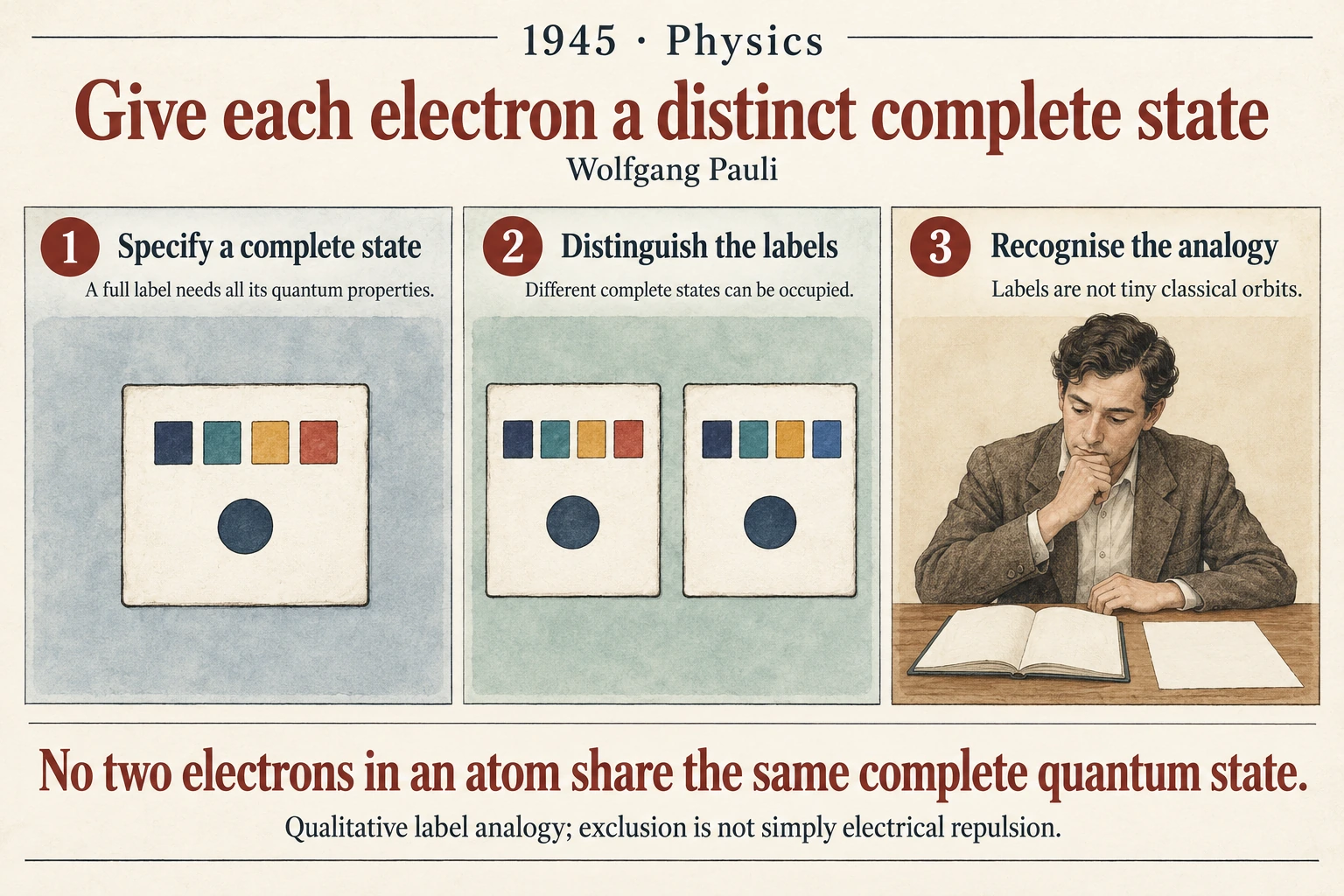
Why do electrons form a structured atom rather than all take the same lowest available state? Energies and electrical attraction alone did not supply the missing rule. In 1925 Pauli stated that two electrons in an atom cannot have identical complete sets of quantum numbers. A two-valued property, later understood through spin, is part of that complete description.
The distinction between a complete state and a spatial orbital matters. Two electrons can share a spatial orbital when their spin states differ; their complete states are then different. The principle helped make electron configurations intelligible and became essential to explaining patterns in the elements. It also has applications to other particles, including protons and neutrons.
Why it matters
The rule connects microscopic quantum structure with recurring chemical properties, the behaviour of metals and the description of nuclei. Pauli’s award recognised a general constraint on possible electronic arrangements, rather than a new photograph of the atom.