c.curionodeThe Nobel Archive

1946 · Physiology or Medicine

Show that X-rays can change heredity

Muller demonstrated induced mutations in fruit flies, turning rare inherited changes into experimentally accessible evidence.

MutationHeredityExperimental geneticsX-rays
1946Physiology or Medicine

Visual guide

The prize, pictured

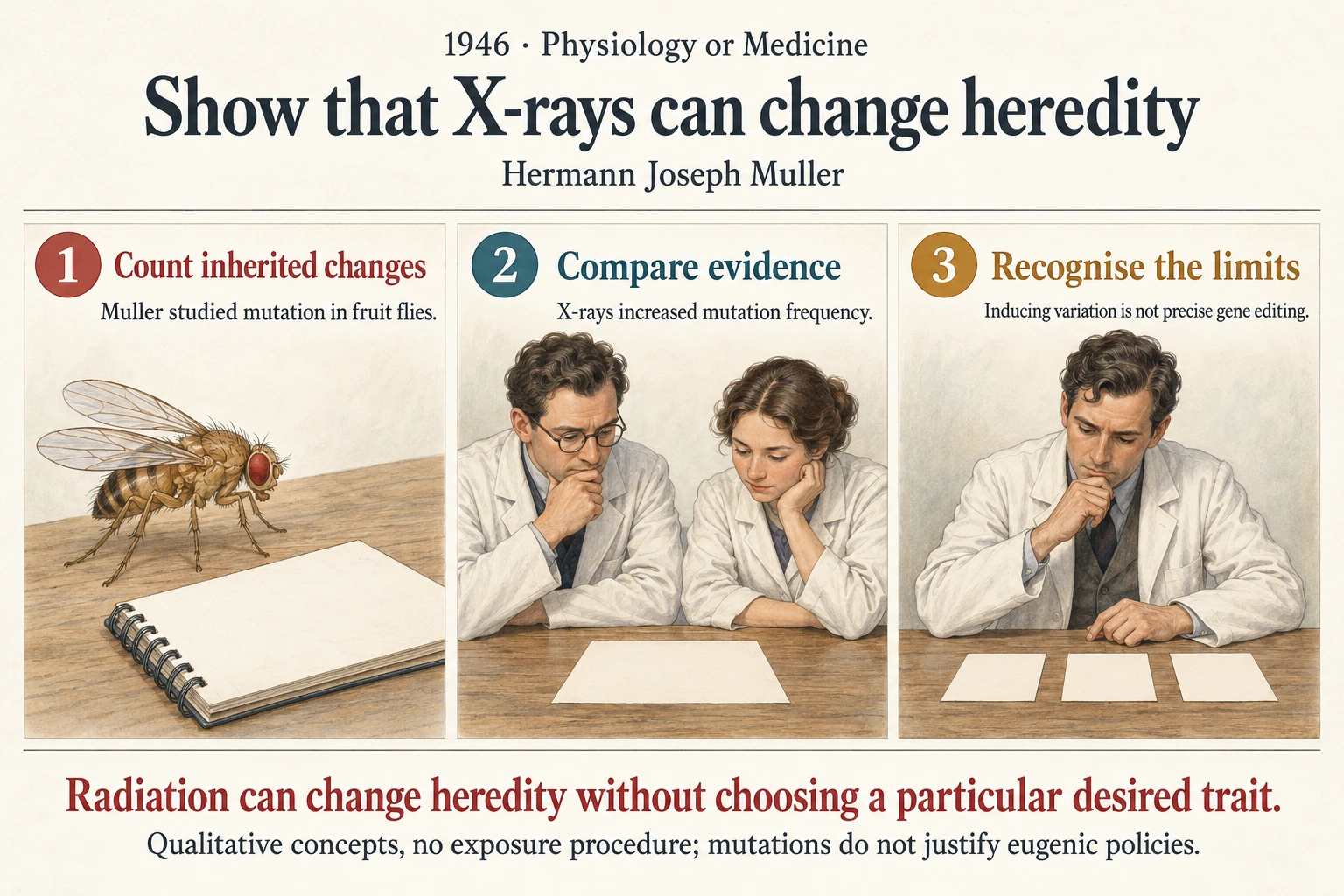
Infographic explaining Show that X-rays can change heredity
Original AI-generated infographic. A conceptual overview; the explanations and sources below provide context.
Read the poster text

Radiation can change heredity without choosing a particular desired trait.

  1. Count inherited changes

    Muller studied mutation in fruit flies.

  2. Compare evidence

    X-rays increased mutation frequency.

  3. Recognise the limits

    Inducing variation is not precise gene editing.

Qualitative concepts, no exposure procedure; mutations do not justify eugenic policies.

01 · The discovery

The idea, in everyday language

Inherited characteristics can change, but rare spontaneous mutations were difficult to study systematically. Muller developed ways to measure their frequency in fruit flies. Experiments in late 1926, reported in 1927, showed that X-ray irradiation could greatly increase the occurrence of inherited changes.

The result made mutation an experimental tool and connected heredity with physical influences. Work by Muller, his collaborators and other researchers examined gene effects and chromosome changes. The 1946 prize recognised this discovery. The evidence came from inheritance and chromosome studies, rather than direct reading or rewriting of a DNA sequence.

Why it matters

Induced mutations widened the tools available for studying genes, chromosomes and the relationship between inherited factors and observable characteristics. The findings also made the genetic effects of ionising radiation a subject for systematic investigation. Morgan, Bridges, Sturtevant and the wider research community formed part of the context in which Muller worked.


02 · The people

Who brought the idea to life?

Illustrated portrait of Hermann Joseph Muller

Hermann Joseph Muller

Prize share · 1

Muller demonstrated that X-ray irradiation could induce mutations and made them tools for investigating heredity. He received the full Medicine Prize for this discovery; induced variation does not mean precise control over a desired trait.

Read the biography ↗

03 · Years in the making

The path here

  1. 1915

    Begins teaching at Rice after Columbia research.

  2. 1920

    Moves to the University of Texas at Austin.

  3. 1927

    Publishes the induced-mutation result.

  4. 1937

    Moves to Edinburgh after research in the Soviet Union.

  5. 1945

    Joins Indiana University in Bloomington.

  6. 1946

    Receives the Medicine Prize for X-ray-induced mutations.

04 · Read further

From the original sources

Original explanations by Curionode, based on the official records below. Biographical details and affiliations refer to the award year.

  1. Official award summary nobelprize.org
  2. Award ceremony speech nobelprize.org
  3. Official biography: Hermann Joseph Muller nobelprize.org

More in Physiology or Medicine

Browse this subject ↗