c.curionodeThe Nobel Archive

1947 · Chemistry

Work out how complex plant products fit together

Robinson joined structural reasoning and synthesis to investigate biologically important plant substances, especially alkaloids.

Plant productsAlkaloidsStructureSynthesis
1947Chemistry

Visual guide

The prize, pictured

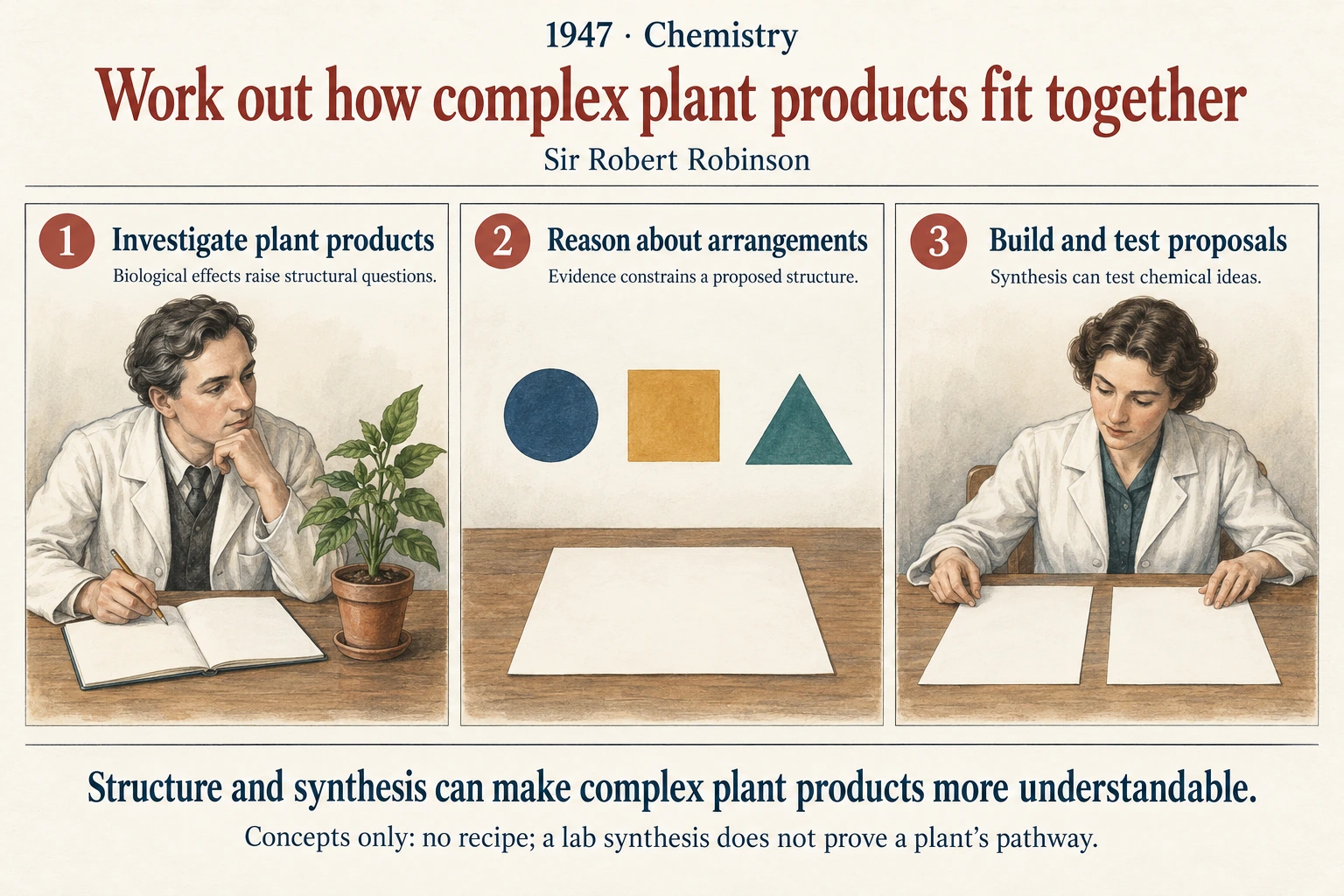
Infographic explaining Work out how complex plant products fit together
Original AI-generated infographic. A conceptual overview; the explanations and sources below provide context.
Read the poster text

Structure and synthesis can make complex plant products more understandable.

  1. Investigate plant products

    Biological effects raise structural questions.

  2. Reason about arrangements

    Evidence constrains a proposed structure.

  3. Build and test proposals

    Synthesis can test chemical ideas.

Concepts only: no recipe; a lab synthesis does not prove a plant’s pathway.

01 · The discovery

The idea, in everyday language

Plants produce substances with striking effects, but knowing a substance exists does not reveal how its atoms are arranged. Robinson investigated the structures of important plant products and considered how relatively simple precursors might be assembled into more complex molecules.

His 1917 tropinone synthesis became an influential example of constructive chemical reasoning. Work on alkaloid structures and plant pigments extended far beyond that one result. The Chemistry Prize recognised investigations of biologically important plant products, especially alkaloids. A plausible laboratory construction can support a proposal without proving that every plant uses exactly the same sequence.

Why it matters

Connecting structure with possible formation made natural-product chemistry more explanatory. It provided ways to test proposals about complex compounds and helped establish ideas later developed in biosynthesis and synthetic planning. Biological activity alone does not make a plant substance safe or medically useful.
02 · The people

Who brought the idea to life?

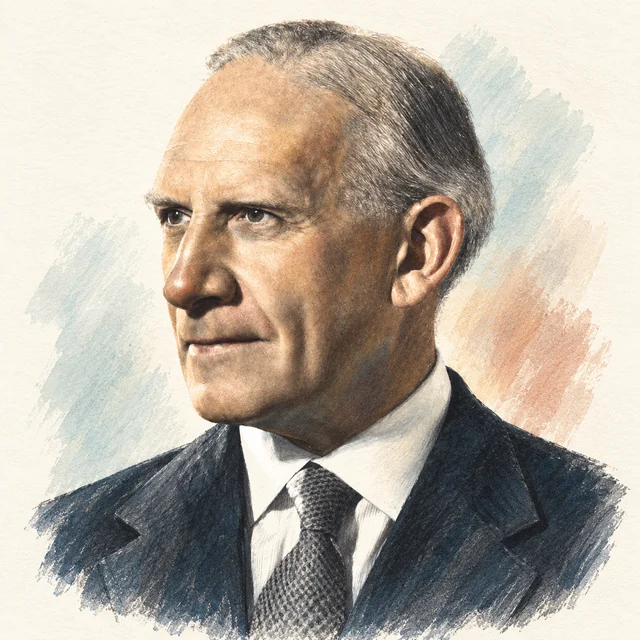
Illustrated portrait of Sir Robert Robinson

Sir Robert Robinson

Prize share · 1

Robinson helped determine the structures and possible formation of important plant products, especially alkaloids. His full Chemistry Prize covered this wider contribution, rather than a single synthesis or proof of every natural biosynthetic pathway.

Read the biography ↗

03 · Years in the making

The path here

  1. 1906

    Receives his BSc at Manchester; DSc follows in 1910.

  2. 1912

    Becomes professor of organic chemistry in Sydney.

  3. 1917

    Publishes the tropinone synthesis.

  4. 1930

    Becomes Waynflete professor at Oxford.

  5. 1947

    Receives the Chemistry Prize for important plant-product investigations.

04 · Read further

From the original sources

Original explanations by Curionode, based on the official records below. Biographical details and affiliations refer to the award year.

  1. Official award summary nobelprize.org
  2. Award ceremony speech nobelprize.org
  3. Nobel explanation: Robinson’s tropinone synthesis nobelprize.org
  4. Original publication metadata: tropinone, 1917 zenodo.org
  5. Official biography: Sir Robert Robinson nobelprize.org

More in Chemistry

Browse this subject ↗