01 · The discovery
The idea, in everyday language
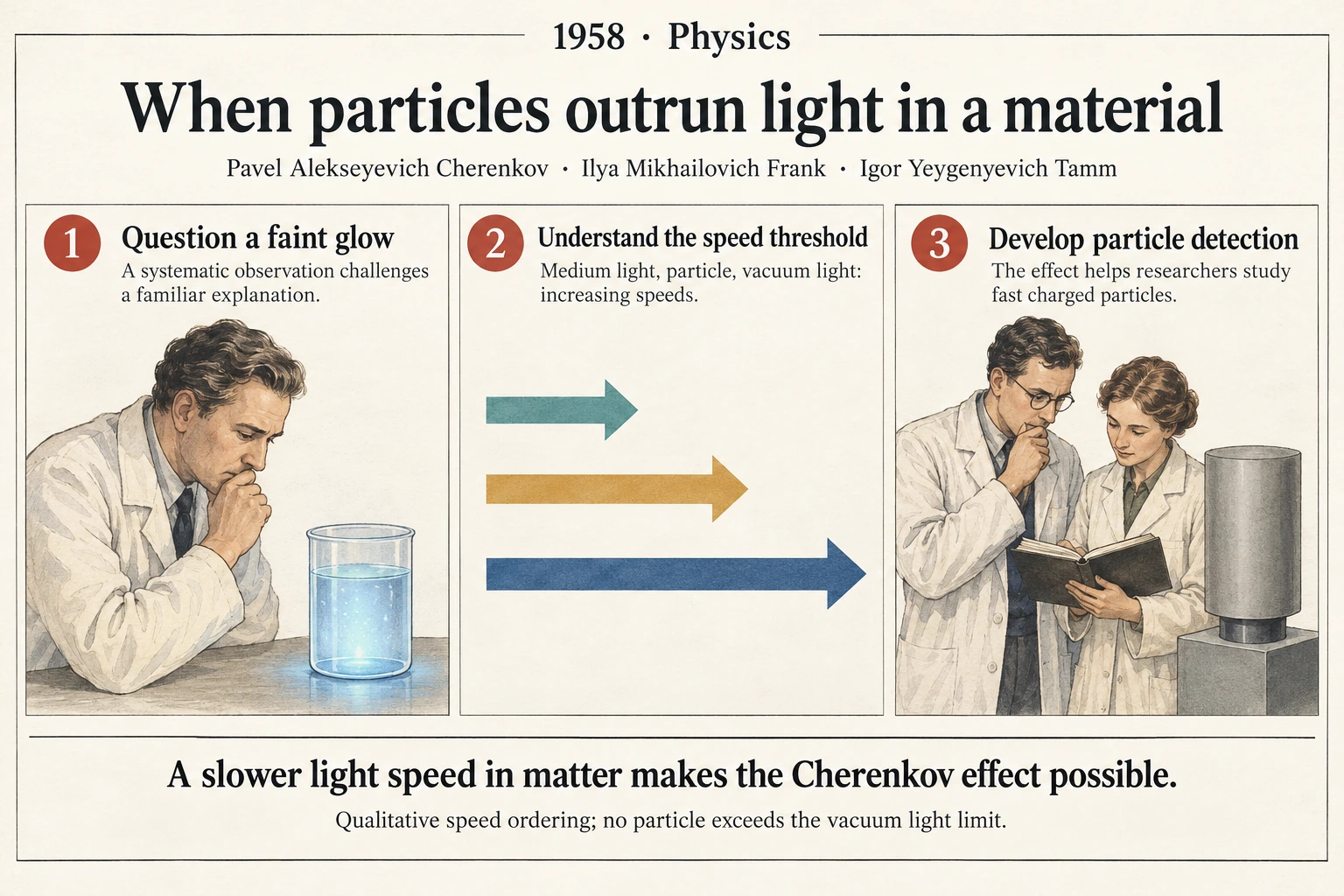
A faint blue glow appeared when radiation passed through liquids. It seemed natural to call it fluorescence, but Cherenkov’s experiments under Vavilov found properties that did not fit that explanation. A systematic account of the light was needed.
Cherenkov established the experimental properties in work published from 1934 onward. In 1937 Frank and Tamm showed how a charged particle travelling faster than light propagates in a material could produce the radiation. Light travels more slowly in such a medium than in a vacuum, so the particle can cross the material’s threshold while remaining below the vacuum light limit.
Why it matters
The discovery and interpretation gave particle researchers a new way to detect sufficiently fast charged particles and investigate their properties. Cherenkov detectors contributed to later experiments, including the 1955 antiproton discovery. Each recipient received one third of the 1958 prize, recognising the experimental and theoretical contributions within a wider research effort.