c.curionodeThe Nobel Archive

1969 · Physics

Finding order among particle families

New experiments revealed a growing collection of particles. Gell-Mann developed classifications and relationships that made the collection more intelligible and suggested missing members.

Particle familiesSymmetryQuark model
1969Physics

Visual guide

The prize, pictured

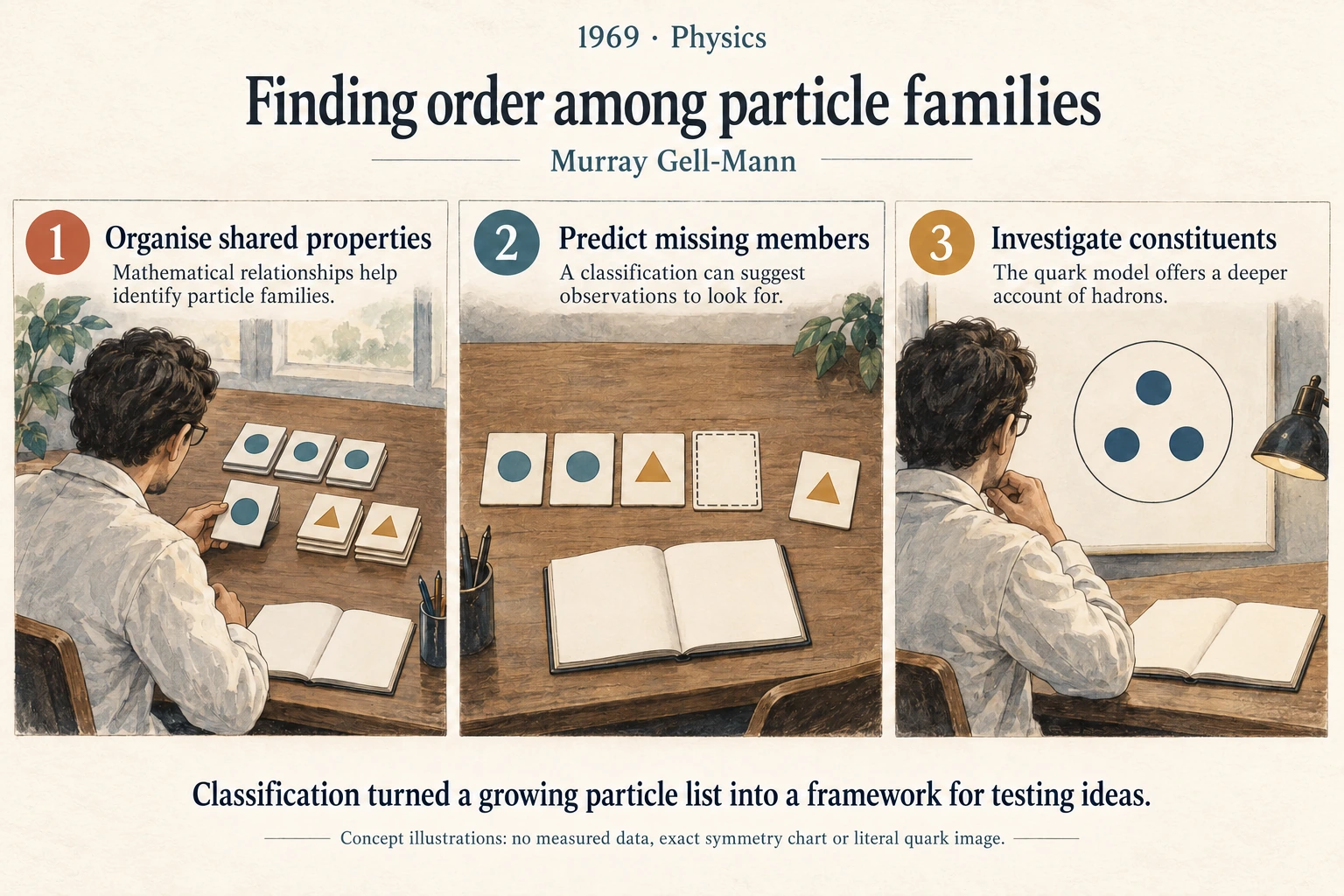
Infographic explaining Finding order among particle families
Original AI-generated infographic. A conceptual overview; the explanations and sources below provide context.
Read the poster text

Classification turned a growing particle list into a framework for testing ideas.

  1. Organise shared properties

    Mathematical relationships help identify particle families.

  2. Predict missing members

    A classification can suggest observations to look for.

  3. Investigate constituents

    The quark model offers a deeper account of hadrons.

Concept illustrations: no measured data, exact symmetry chart or literal quark image.

01 · The discovery

The idea, in everyday language

Strangeness helped describe particles whose production and decay had seemed inconsistent. The Eightfold Way used symmetry to organise related hadrons, the strongly interacting particle families that include protons, neutrons and mesons.

A useful classification could make testable predictions. Gell-Mann predicted the omega-minus baryon in 1962. His 1964 quark proposal offered constituents for hadrons; Zweig independently pursued a related model. The prize recognised a broader body of work on classification and interactions.

Why it matters

The work gave researchers powerful methods for relating particle properties, interactions and new observations. It helped replace a growing list with a framework that could be examined and tested.
02 · The people

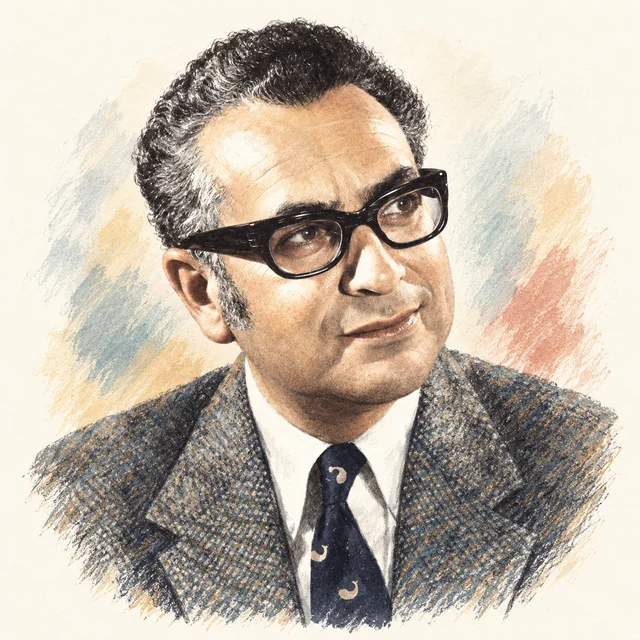
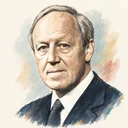
Who brought the idea to life?

03 · Years in the making

The path here

  1. 1953

    Strangeness helps organise puzzling particle behaviour.

  2. 1961

    Gell-Mann introduces the Eightfold Way.

  3. 1962

    He predicts the omega-minus baryon.

  4. 1964

    He proposes quark constituents; Zweig independently proposes a related model.

  5. 1969

    He receives the Physics Prize.

04 · Read further

From the original sources

Original explanations by Curionode, based on the official records below. Biographical details and affiliations refer to the award year.

  1. Official award summary nobelprize.org
  2. Award ceremony speech nobelprize.org
  3. CERN scientific biography home.cern
  4. Official biography: Murray Gell-Mann nobelprize.org