c.curionodeThe Nobel Archive

1981 · Peace

Protection beyond an emergency

UNHCR’s second Peace Prize recognised the fundamental rights of refugees. Immediate help mattered, but protection and a future beyond displacement mattered too.

Refugee rightsInternational protectionLasting solutions
1981Peace

Visual guide

The prize, pictured

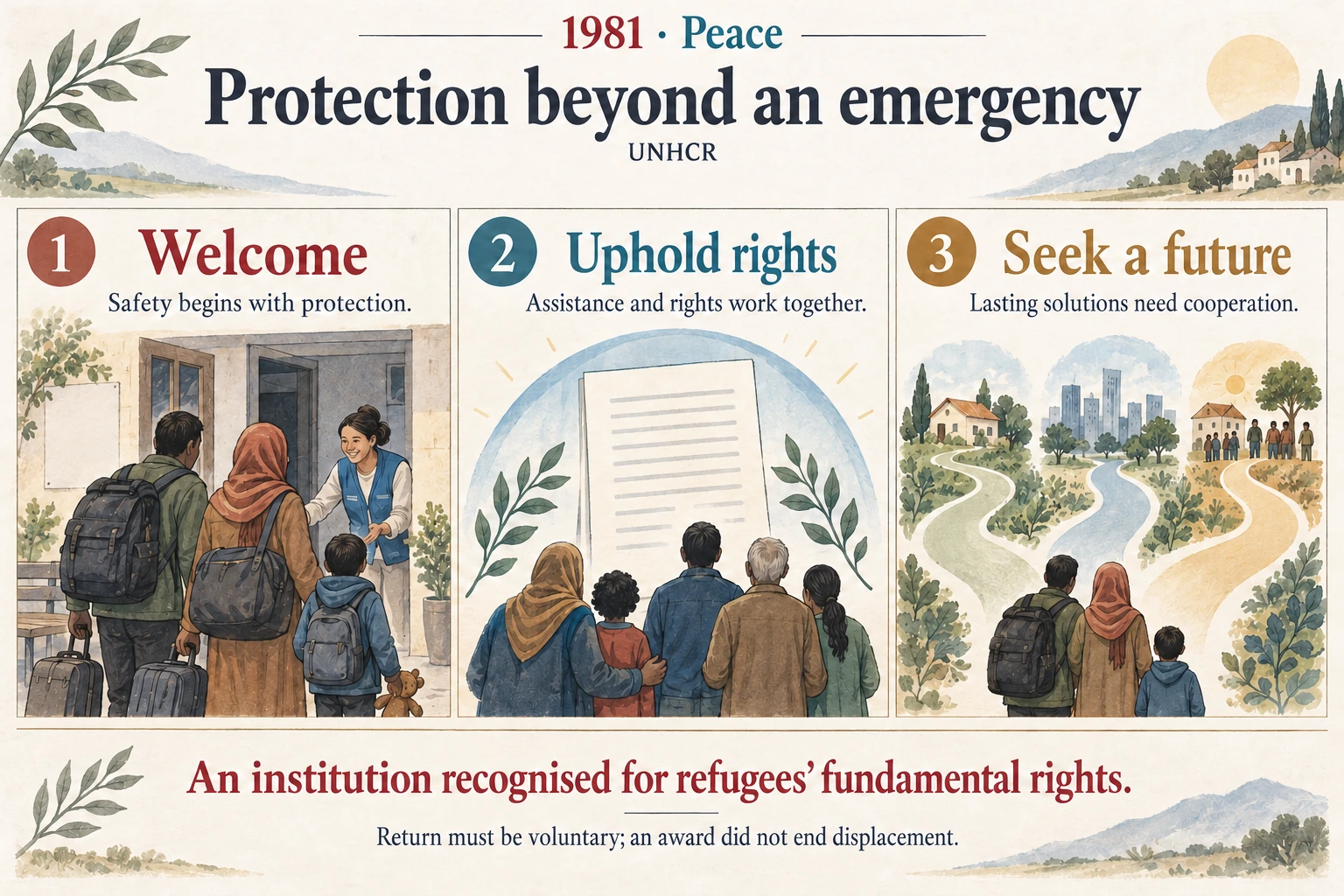
Infographic explaining Protection beyond an emergency
Original AI-generated infographic. A conceptual overview; the explanations and sources below provide context.
Read the poster text

An institution recognised for refugees’ fundamental rights.

  1. Welcome

    Safety begins with protection.

  2. Uphold rights

    Assistance and rights work together.

  3. Seek a future

    Lasting solutions need cooperation.

Return must be voluntary; an award did not end displacement.

01 · The contribution

The idea, in everyday language

People forced to leave their country can lose the practical protection ordinarily provided by their state. UNHCR was created to help secure international protection and seek lasting solutions. Its work connected the legal recognition of refugees’ rights with practical cooperation: access to safety, assistance, and support for rebuilding lives. The 1981 award recognised the institution, not a particular high commissioner.

The office began with postwar European refugees, but displacement in Africa, Asia and Latin America expanded its responsibilities. The 1951 Convention and 1967 Protocol were important foundations; host countries, other UN bodies and voluntary organizations were indispensable partners. Lasting solutions could involve voluntary return, integration in a host country or resettlement elsewhere, depending on safety, available opportunities and cooperation.

Why it matters

The Nobel Committee linked refugee protection with peace, continuing a tradition associated with Fridtjof Nansen and UNHCR’s first award in 1954. The 1981 recognition supported work across a wider international setting, including responses to displacement in Southeast Asia. It highlighted the difference between charity alone and efforts grounded in rights and shared responsibilities. Governments’ decisions remained essential to putting those principles into practice.
02 · The recipients

Who brought the idea to life?

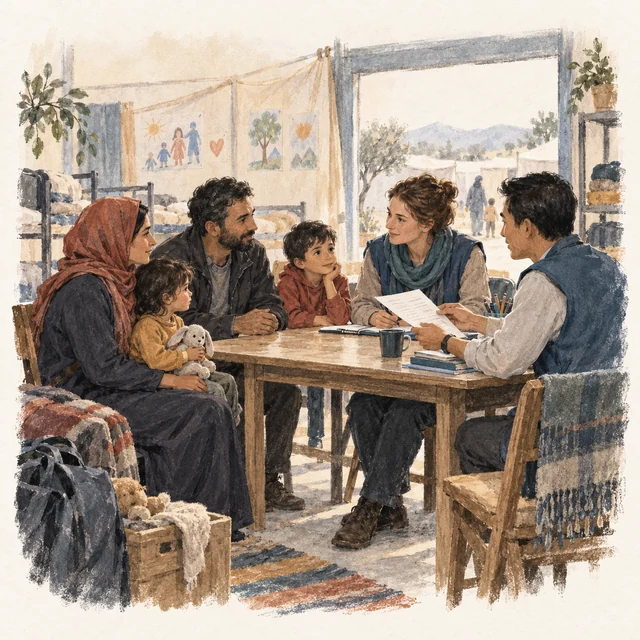
Symbolic illustration representing Office of the United Nations High Commissioner for Refugees

Office of the United Nations High Commissioner for Refugees

Prize share · 1/1

UNHCR was recognised for promoting refugees’ fundamental rights. The institution received the full Peace Prize, not a named high commissioner. Its work joined international protection with assistance and efforts toward voluntary return, integration or resettlement; safe and lasting solutions depended on conditions and the decisions of refugees and states.

Read the biography ↗

03 · Years in the making

The path here

  1. 1950

    The UN General Assembly adopts UNHCR’s statute on 14 December.

  2. 1951

    The office begins work on 1 January; the Refugee Convention is adopted in July.

  3. 1954

    UNHCR receives its first Peace Prize.

  4. 1967

    The Protocol removes the Convention’s original time limitation.

  5. 1979

    A Geneva conference seeks shared responses to Southeast Asian displacement.

  6. 1981

    The institution receives its second Peace Prize for refugees’ fundamental rights.

04 · Read further

From the original sources

Original explanations by Curionode, based on the official records below. Biographical details and affiliations refer to the award year.

  1. Official announcement nobelprize.org
  2. UNHCR: the evolution of international refugee protection (2000) refworld.org