01 · The discovery
The idea, in everyday language
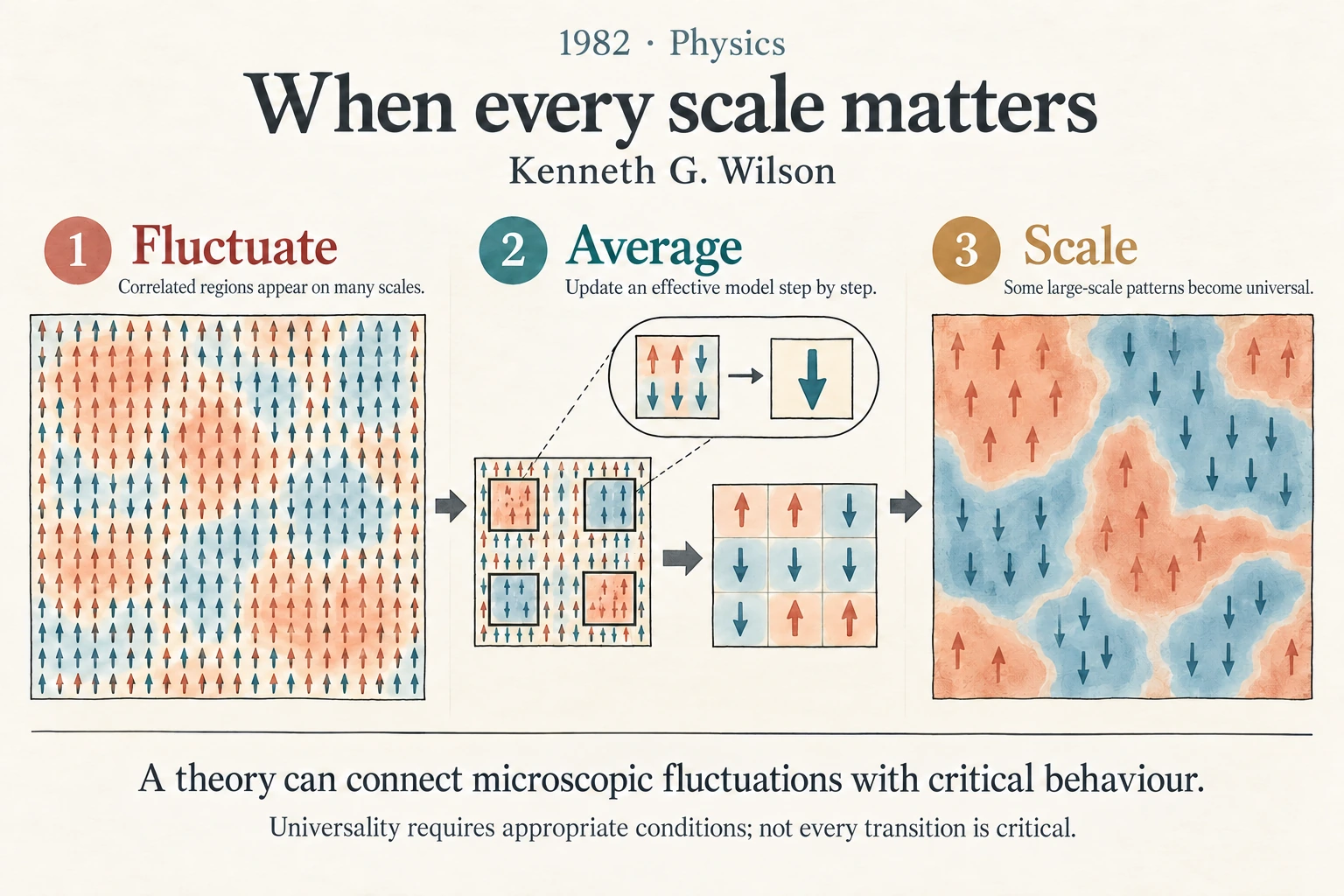
A magnet near its Curie point can have correlated regions of many sizes. A liquid near its liquid–gas critical point also develops large density fluctuations. Simply replacing each particle’s surroundings with an average field misses important correlations: the small and large scales influence one another.
The renormalization group handles those scales in successive steps. Short-distance fluctuations are averaged out, distances rescaled, and the effective interactions updated. Repeating the operation reveals which features grow, which fade and which scaling laws remain. Different microscopic systems can approach the same kind of large-scale behaviour, forming a universality class under appropriate conditions.
Why it matters
Wilson’s framework explained why some critical exponents agree across quite different materials and enabled quantitative calculations beyond simple mean-field theory. It connected statistical mechanics with methods from quantum field theory and encouraged numerical work. The result built on Landau’s theory, Onsager’s exact example and scaling ideas developed by Fisher, Widom, Kadanoff and others.