01 · The discovery
The idea, in everyday language
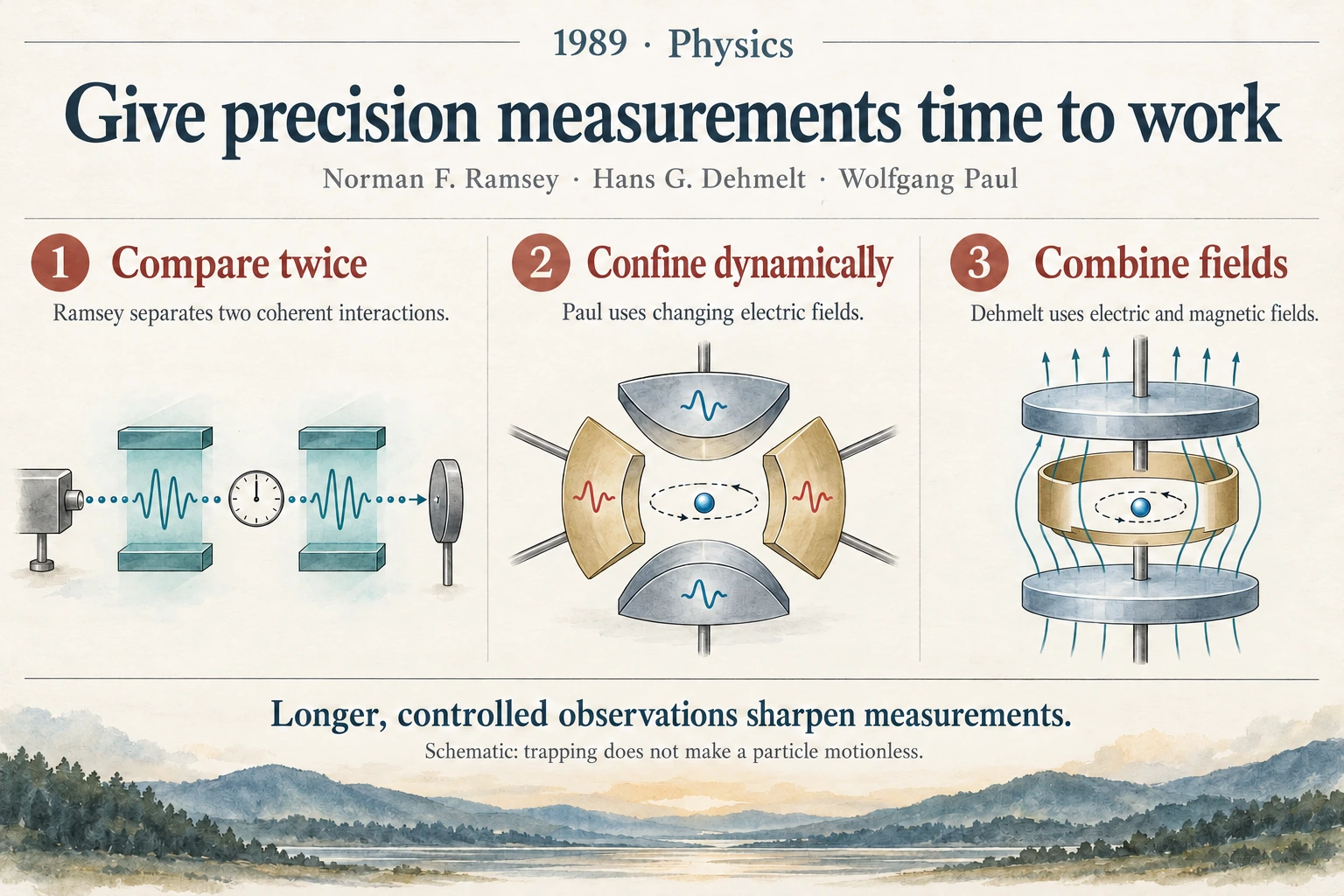
An atomic transition provides a reproducible frequency to compare with an applied signal, but motion, collisions and imperfect fields complicate measurement. Ramsey’s method uses two coherent interactions separated by free evolution. The phase accumulated between them affects the outcome of the second interaction, producing a sensitive frequency comparison. This became a foundation of atomic clocks and precision spectroscopy.
Paul and Dehmelt developed ways to hold charged particles for long observations. Paul’s radio-frequency quadrupole trap uses changing electric fields for dynamic confinement. Dehmelt developed trapped-particle methods including Penning traps, which combine static electric and magnetic fields. Isolation and cooling reduced disturbances, enabling measurements even on a single electron. Ramsey received half of the prize; Dehmelt and Paul each received a quarter.
Why it matters
The work joined reliable timekeeping with exacting tests of atomic and particle physics. Ramsey’s method supported atomic clocks; his hydrogen-maser work with Kleppner advanced frequency stability. Trapped electrons allowed stringent tests of quantum electrodynamics, and trapped ions opened new spectroscopy possibilities. The two strands complement one another without being the same apparatus or a single invention.